Hardliners are likely to strengthen control in Iran’s short-term power struggle following Khamenei’s death.
Iran’s strikes on US bases in Gulf states have been called a major strategic miscalculation, risking broader war.
Limited support from China and Russia leaves Iran militarily outmatched against US-Israel forces.
War In West Asia: Targeting GCC Countries Is A Strategic Miscalculation By Iran, Says Expert
Are hardliners poised to tighten the grip as Iran strikes US bases, fuelling fears of a broader regional war?

Summary
The assassination of Supreme Leader Ali Khamenei has thrown Iran into disarray, with a fragile interim leadership now in place and missile strikes on American bases in Gulf states threatening to widen the conflict.
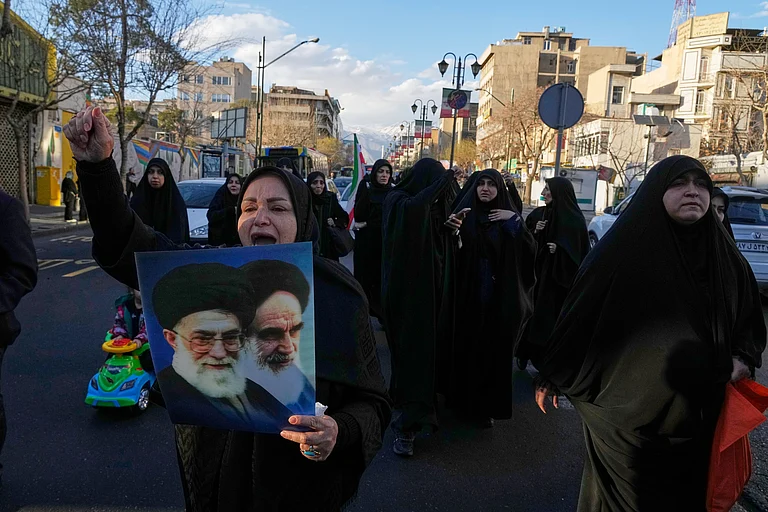
Muddassir Quamar, Associate Professor with the Centre for West Asian Studies, School of International Studies, Jawaharlal Nehru University, described the internal scenario as extremely volatile. “The situation inside the country is very fluid,” he said. “It’s a war-like situation.” With Khamenei and much of the senior command eliminated, the Iranian constitution has activated a temporary arrangement. “A three-member team has taken over the responsibility of leading the Islamic Republic at this point,” explains Quamar.
The eventual successor is expected to be chosen by the Guardianship Council and related bodies.
Quamar anticipates sharp factional fighting ahead. Hardliners tied to the Islamic Revolutionary Guard Corps (IRGC) and clerical figures are likely to clash with reformists. “There would be an internal struggle between people who are basically IRGC’s commanders … and then those who are reformists who have been within Iran talking about the need to go for a deal and reconcile with the United States,” he said.
In such crises, Quamar believes the hardliners usually prevail at least initially. “Most likely it would be those who would further strengthen themselves at least in the short to medium term and then what happens from there? We will have to wait and watch.”

Reza Pahlavi, the exiled son of the last shah and a vocal advocate for ending the Islamic Republic in favour of secular democracy, isn't a serious contender, as per Quamar. “I don’t think he is a credible figure in Iran or among Iranians even outside Iran,” Quamar said. The Pahlavi dynasty’s long rule until 1979 has left it discredited, making any return highly improbable.
Quamar stressed that imposed change from abroad seldom produces stable democracy. “External military interventions don’t really lead to the setting up of a democracy. We have seen it in Afghanistan. We have seen it in Iraq. It is only the internal process that can eventually establish some kind of stability and democracy.”
Advertisement
He suggested future leadership could emerge from several sources. “There has to be a process within Iran with which some leadership emerges. I’m not sure whether it would be from within the regime or it would be from outside the regime … or maybe it would be a youth movement that will lead to some kind of change.”
Ayatollah Arafi is currently acting as interim supreme leader.
Iranian Retaliation Risks Escalation Across the Gulf
Iran’s missile barrages targeting US bases in several Gulf Cooperation Council countries (GCCs) have been labelled a major error by Quamar. “That is a serious strategic miscalculation,” he said.
Several GCC states had quietly pressed the Trump administration to avoid full-scale war. Yet Iran struck anyway, and reports indicate civilian areas and infrastructure were also hit — possibly because of missile inaccuracy, though intent remains unclear.
The backlash was immediate. “Instead of condemning the US-Israel attack on Iran they were forced to condemn the attack against themselves so they had to take a more hardline position on Iran,” Quamar noted.
Advertisement
This shift could pull Arab states into active participation, endangering the Strait of Hormuz and Red Sea shipping lanes. “These are very critical maritime trade routes for the region, for the Gulf region, for the Middle East and for Asia,” he warned.
If the fighting spreads to Iraq’s Iran-backed militias, Lebanon or Yemen, the situation could become far more complicated. “We are looking at a very, very complex situation,” Quamar said. The regional outlook is “extremely uncertain.”

Limited Allies, Overwhelming Odds, and Divided Reactions
Only China and Russia have openly condemned the strikes on Iran as violations of sovereignty. Russia, however, is tied down in Ukraine and unlikely to provide meaningful military help. China is expected to stay out of a conflict not of its making.
Iran’s conventional forces are no match for combined US and Israeli power. Iranian leaders understood this but refused to appear weak. Before the latest escalation, Tehran had come close to accepting most US demands on the nuclear file during Oman-mediated talks in Geneva.
Advertisement
“Militarily it can perhaps go on … but not really for very long,” he predicted. Khamenei’s death prompted celebrations in Syria, where many blame Iran and the IRGC for prolonging the civil war under Bashar al-Assad. Similar sentiments appear among some Iranians abroad, including reports of gatherings in Australia. Shia communities elsewhere, however, mourn the loss of a figure they regarded as a spiritual guide.
The nuclear issue remains central to the hostility. Iran, an NPT signatory unlike Israel, India or Pakistan, enriched uranium well beyond civilian requirements while insisting its programme was peaceful. Regional states — Turkey, Saudi Arabia, Egypt — feared an Iranian bomb would threaten their own security and spark a proliferation cascade.
Mossad’s involvement in the supreme leader’s killing is considered almost certain given its history of operations inside Iran. “They would certainly be involved, there is no way they would not be involved,” Quamar said.
Advertisement
Iran now stands at a dangerous crossroads. Hardliners are almost certain to tighten their hold in the immediate aftermath, drawing strength from the IRGC as the country braces for more pressure from the outside. The strikes on Gulf bases have backfired, turning the quiet diplomatic back-channels into open hostility and putting the Strait of Hormuz and Red Sea trade at real risk. With no serious military support on the horizon—Russia bogged down, China staying clear—and US-Israeli firepower far superior, Tehran’s room to manoeuvre is shrinking fast.
The almost-reached nuclear compromise in Geneva shows the fight was never just about uranium; it was always about the regime’s survival.
Whatever comes next will be decided inside Iran, not imposed from abroad. The region, and global oil markets, wait anxiously.
Published At: