The Left and the Congress got wiped out of the state assembly in the 2021 assembly election, but the Congress managed to retain one of its two Lok Sabha seats in the state in the 2024 Lok Sabha election.
In Muslim-majority districts, in their bid to prevent bloc voting of Muslim in favour of TMC, the Left and the Congress argued that this election is not about changing the government—but about changing the opposition.
In Hindu majority areas, the Left argued that the BJP can never topple the TMC government
Bengal Elections 2026: How Can Left, Congress Impact The Verdict?
In a largely bipolar election between the TMC and the BJP, the Congress and the Left remain factors in about 60 of the state’s 294 assembly seats

Summary
Down they are, but not yet out. Not at least in visibility.
In Murshidabad district’s Domkal, a Muslim-majority constituency, several hundred ruling party supporters joined the CPI(M) just ahead of the election. Similar scenes were seen in Uttar Dinajpur’s Karandighi, where Hindus and Muslims make almost equal share of the population. Congress rallies in Murshidabad and Malda drew thousands.
In the Hindu-majority Dumdum area in the northern outskirts of the state capital of Kolkata, Left and saffron supporters clashed, as they did in Kolkata’s western outskirts of Bally in Howrah district.
In an election where large scale deletion of voters and a significant inflow of irregular voters has made the 2026 Bengal assembly contest difficult to call, the Left and the Congress have added another layer of uncertainty.
The Left and the Congress contested the last two elections in alliance, but are fighting separately this time. The CPI(M) has an alliance with the Indian Secular Front (ISF), that holds influence mostly among some Muslims in southern Bengal.
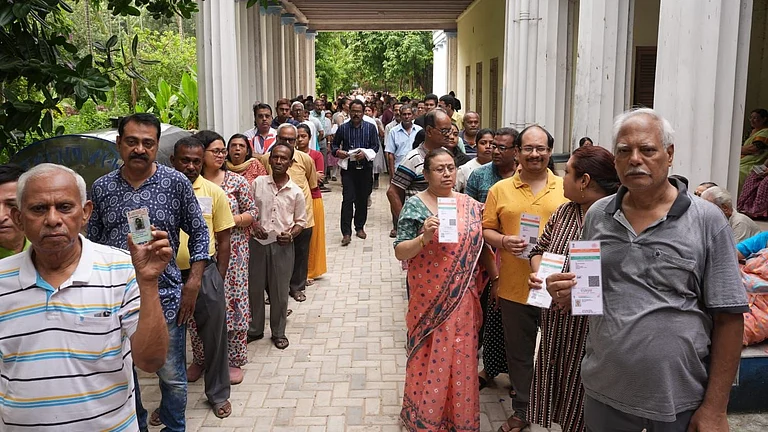
The election is happening with Bengal’s voter roll getting trimmer by nearly 11%. Due to the special intensive revision (SIR) of the electoral roll, the size of the electorate has come down from 7.66 crore voters as of 2025 to 6.82 crore. However, the state also witnessed an extraordinarily high polling in the first phase of the election of April 23, when the state recorded a polling rate of 93.18%.
It was revealed that despite a shrunken voter list, there was an increase in voting in absolute numbers by about 20 lakh. This means, voters who usually do not turn up at the polling station are also voting this time—a trend being widely attributed to the SIR-related panic created due to heavy deletions.
The CPI(M), the key Left party, and the Congress, were literally relegated to the margins after the 2019 Lok Sabha election, in which Prime Minister Narendra Modi’s Bharatiya Janata Party (BJP) emerged as the principal challenger of chief minister Mamata Banerjee’s Trinamool Congress (TMC)—and a formidable one.
Advertisement
The Left and the Congress got wiped out of the state assembly in the 2021 assembly election, but the Congress managed to retain one of its two Lok Sabha seats in the state in the 2024 Lok Sabha election.
Their cumulative vote share stood at only 13% in 2019, came down to 9.8% in 2021, and slightly rose to nearly 11%. However, these votes became electorally important because they are concentrated in a few pockets only.
For the Congress, it’s the Muslim-majority district of Murshidabad, Malda and Uttar Dinajpur. For the Left, apart from pockets of Murshidabad, it's mostly the suburban belt in Kolkata’s neighbouring districts of North 24-Parganas, South 24 Parganas, Howrah and Hooghly.

The TMC swept both belts in the 2021 assembly elections.
Of the state’s 294 assembly seats, the contest is largely bipolar between the TMC and the BJP is roughly 220 seats. However, in about 60 seats, the Left and Congress vote share is significant enough to influence results. In some of them, they see good changes of returning to the state assembly.
Advertisement
In Uttar Dinajpur district, seats like Goalpokhar, Chakulia, Karandighi and Hemtabad are likely to see three to four corner contests. In Malda, the seats of Chanchal, Harishchandrapur, Malatipur, Ratua, Manikchak, Mothabari and Baishnabnagar look set to see a similar multi-corner contest. In Murshidabad district, Suti, Jangipur, Sagardighi, Nabagram, Khargram, Baharampur, Burwan and Kandi are likely to record a similar trend.
Of them, the BJP sounds confident about gaining Karandighi, Chakulia, Hemtabad, Manikchak, Baishnabnagar, Burwan and Jangipur. The demographic composition is such in these constituencies that a sharp split in Muslim votes and a consolidation of Hindu votes can make them favourable to the BJP.
In south Bengal’s suburban belt and in Kolkata’s immediate outskirts, the Left can possibly harm the BJP more than the TMC.
In constituencies like Noapara, Khardaha, Panihati, Baranagar, Dumdum, Kamarhati, Rajarhat-New Town, Rajarhat-Gopalpur, Baruipur Purba, Baruipur Paschim, Behala Purba, Maheshtala, Bally, Shibpur, Howrah Dakshin, Sreerampur, Champdani, Chandannagar and Chunchura, the Left had roughly 20,000-30,000 votes in the last two elections.
Advertisement
In seats like Dumdum Uttar, Behala Paschim, Sonarpur Dakshin, Uttarpara and Tollygunje, the Left vote share ranged between 35,000 and 50,000. In Jadavpur, they retained a 60,000 vote support in both 2021 and 2024.
Of them, the Left evidently has focussed on Uttarpara, Dumdum Uttar, Panihati and Jadavpur, where they hope the triangular contest could be intense.
There are a few more seats in south Bengal—Tehatta, Kaliganj, Krishnanagar Dakshin, and Nabadwip in Nadia; Ranibandh and Bandwan in Purlia and Taldangra and Barjora in Bankura where the Left vote share can impact the outcome.
In suburban close-contest seats like Jagatdal and Barrackpore in North 24 Parganas, even the 16,000-17,000 vote support that the Left has retained over the past two elections can play deciders.
Besides, in the entire Purba Bardhaman district, the Left’s remaining vote base has not allowed the BJP to reach near the TMC’s support level.
Advertisement
The Left hopes their vote share will increase in all regions mentioned, as they believe more people have become disillusioned with the TMC and the BJP and are looking for a change of the political binary.
In the Muslim-majority districts, one of the key planks of the Left and the Congress has been that this election is not about changing the government—but about changing the opposition. This was done to ensure Muslims do not resort to bloc voting in favour of the TMC out of panic of the BJP coming to power.
In the Hindu-majority constituencies, the Left parties are banking on their young faces and the theory that the BJP can never dethrone the TMC, as they will not get the votes of Muslims and liberal Hindus who make up nearly half of the state's population. They argue the BJP and the TMC are faking a conflict, while they actually have an understanding.
The Congress sounds confident that it will win multiple seats from Malda and Murshidabad districts, especially those constituencies where Muslims make up over 70% of the population. Rahul Gandhi campaigned for some of their candidates.
If the TMC was working overtime in the Muslim majority district to prevent a major split in Muslim votes, it’s the BJP which is working overtime in Kolkata’s neighbouring Hindu-dominated constituencies to ensure they can eat more into the Left’s remaining voter base.
Political observers feel the TMC might not be able to gain as much support of the Muslims as it enjoyed in 2021, as people's disenchantment with the TMC appears to have increased over the past five years. This is especially visible in the districts of Murshidabad, Malda and Uttar Dinajpur. Can the anxiety around SIR deletions neutralise TMC's loss of popular support? Even several TMC leaders whom Outlook spoke to were unsure.
Will the Left be able to retain its urban Hindu vote share? The 2024 Lok Sabha election trends show that they managed to retain their vote—or even to increase—when the CPI(M) fielded a candidate who was seen as ‘strong’ in public perception. However, where their candidates were considered relatively weak, or the seat was allotted to some of their allies, a section of Left votes tended to further go towards the BJP.
Whether 2026 shows any new pattern remains to be seen.
Published At: