Argentina's win over Egypt reignited the VAR debate, with controversial decisions dominating the World Cup conversation
The article examines key incidents, VAR rules and why Argentina's matches face intense scrutiny
Can FIFA restore trust, or is VAR becoming football's biggest source of controversy
The Argentina VAR Debate: Why Every Big Refereeing Decision Is Becoming A FIFA Crisis
Argentina's controversial win over Egypt has reignited the VAR debate at the FIFA World Cup 2026. Here's a closer look at the decisions, FIFA's protocols, and why trust is under scrutiny

Summary
Argentina are through to the FIFA World Cup 2026 quarterfinals, but instead of celebrating one of the tournament's greatest comebacks, the football world is once again arguing about the referee. The defending champions overturned a two-goal deficit to beat Egypt 3-2, yet the headlines are being made by a series of contentious VAR (Video Assistant Referee) interventions instead of Lionel Messi's brilliance.
The match has become much bigger than one controversial result. It has reopened a debate that has followed VAR ever since it was introduced: Is the system actually making football fairer, or is it simply replacing human error with technological confusion? Every major decision involving Argentina now seems to trigger accusations of favouritism, while every explanation from referees appears to convince one side and frustrate the other.
It's important to be clear, there is no evidence that FIFA manipulated the match or favoured Argentina. But football has always been a game built on trust, and once that trust starts to crack, even technically correct decisions can become impossible to accept. That's why the fallout from Argentina vs Egypt could be the defining VAR debate of the 2026 World Cup.
Why This Match Exploded
The controversy surrounding Argentina's Round of 16 victory over Egypt was never about a single decision. Instead, it stemmed from a sequence of incidents that, when viewed together, created the perception of inconsistency. Egypt appeared to seize complete control of the contest when Mostafa Ziko found the net for what would have been a 2-0 lead.
However, after a lengthy VAR review, French referee Francois Letexier overturned the goal for a foul earlier in the attacking phase. While the Laws of the Game allow VAR to review fouls in the immediate attacking possession leading to a goal, critics argued the challenge was relatively minor and had not directly influenced the scoring opportunity.
The frustration intensified in the closing stages. Egypt appealed for a penalty after Mohamed Salah went down inside the area, allegedly fouled by Julian Alvarez, but neither the on-field referee nor the VAR recommended a review. Moments later, Argentina completed an astonishing comeback through Enzo Fernandez.
Advertisement
To Egyptian players and supporters, the contrast between the forensic review that ruled out their goal and the apparent lack of intervention for Argentina's winner created an impression of "double standards." Whether those decisions were technically correct became secondary to the perception that similar incidents were being judged differently.
Every Controversial Decision
Three moments have become the centrepiece of the controversy.
The first was the disallowed Egyptian goal. VAR traced play back to an earlier challenge and advised Letexier to review the incident before cancelling the goal. Supporters of the decision argue that the protocol was correctly followed because VAR can intervene if an attacking move begins with a foul. Critics counter that similar physical contact routinely goes unpunished throughout matches, raising questions over consistency.
The second incident came when Salah appealed for a penalty after contact inside Argentina's box. Despite protests from Egyptian players, play continued without a pitch-side review. Former players including Alan Shearer, Jamie Carragher and Rob Green publicly questioned why the threshold for intervention appeared different from the earlier review.
Advertisement
The third controversy emerged after the final whistle. Egypt's Football Association formally lodged a complaint with FIFA, requesting disciplinary action against the referee and VAR team while alleging "double standards" in officiating. The governing body has yet to publicly address the complaint, but the episode has already become one of the defining refereeing debates of the tournament.
The Rules Behind VAR
Much of the public debate has revealed a misunderstanding of what VAR is actually designed to do. Contrary to popular belief, the video assistant is not intended to re-referee every close challenge. Under IFAB's protocol, VAR may intervene only in four situations: goals, penalty incidents, direct red cards and cases of mistaken identity. Even then, intervention is permitted only when a "clear and obvious error" has occurred or when a serious incident has been missed altogether.
The difficulty lies in football's subjective nature. Offside decisions are largely factual, making them relatively straightforward for technology. Fouls, however, remain matters of interpretation. One referee may consider a challenge sufficient to overturn a goal, while another may see it as routine physical contact.
Advertisement
Also Check: FIFA World Cup 2026 Quarter-Final Guide
Slow-motion replays can further complicate matters by making challenges appear more deliberate than they seemed in real time. That is why VAR often succeeds in factual decisions but continues to divide opinion on subjective ones, a criticism that has followed the technology since its World Cup debut in Russia in 2018.
Why Messi's Argentina Attracts Scrutiny
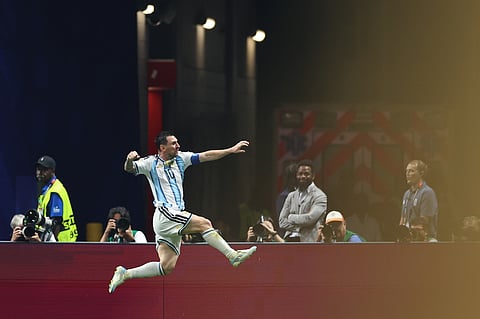
Argentina's Lionel Messi celebrates after scoring his side's second goal during the World Cup round of 16 soccer match between Argentina and Egypt in Atlanta, Tuesday, July 7, 2026 (AP Photo/Colin Hubbard)
Few teams attract more attention than Argentina, and few players generate more debate than Lionel Messi. As reigning world champions and one of football's biggest commercial attractions, every close decision involving Argentina is examined frame by frame. That scrutiny is amplified whenever the decision appears to benefit Messi's side, particularly in the latter stages of a World Cup.
The latest controversy has reignited long-standing conspiracy theories suggesting FIFA has an interest in keeping Argentina alive because of Messi's global appeal. Those claims have gained momentum online following Egypt's elimination and were further intensified after FIFA appointed an all-Argentine on-field officiating team for France's quarterfinal against Morocco.
Advertisement
However, despite widespread speculation and criticism, no credible evidence has emerged proving that refereeing decisions have been influenced in Argentina's favour. What exists instead is a growing trust deficit, one where perception increasingly outweighs proof.
Can FIFA Restore Trust?
FIFA now faces a challenge that extends far beyond defending individual referees. The governing body must convince players, coaches and supporters that controversial decisions are being reached through a transparent and consistent process.
Several domestic leagues, including England's Premier League, have experimented with releasing VAR audio after major incidents. Rugby and cricket have long embraced live communication between officials and broadcasters, helping spectators understand why decisions are reached.
Many analysts believe football must move in the same direction. Publishing VAR conversations, explaining review thresholds in real time and improving communication inside stadiums would not eliminate controversy, but they could reduce speculation.
Technology alone cannot restore confidence if supporters continue to feel excluded from the decision-making process. Transparency, rather than more cameras or better software, may prove to be VAR's most important upgrade.
What This Means For The World Cup
The Argentina-Egypt controversy has become far bigger than one Round of 16 tie. Every subsequent refereeing decision involving Argentina will now be viewed through the lens of what happened in Atlanta. Quarterfinals, semifinals and even the final could face heightened scrutiny if similar incidents arise.
For FIFA, the actual issue is whether millions of supporters believe those calls are being applied consistently. Football has always accepted disagreement over refereeing, but VAR was introduced to reduce controversy, not become its biggest source.
Published At:
Tags