After a record-breaking knock, Vaibhav Sooryavanshi returns to make his way to his first IPL final
A fire-breathing Kagiso Rabada stands in Sooryavanshi's way
The Royals plan to battle Rabada's heat with the cold precision of Jofra Archer
IPL Dispatch: All Eyes On Mullanpur Weather And Sooryavanshi Storm; Jersey No. 03 Is Real, Gear Up For Prodigy
As Gujarat Titans and Rajasthan Royals prepare for Qualifier 2, all eyes are on Vaibhav Sooryavanshi’s red-hot form, Shubman Gill’s response, the weather forecast in Mullanpur, and a blockbuster pace duel between Kagiso Rabada and Jofra Archer that could decide who reaches the IPL 2026 final

Summary
The energy surrounding Qualifier 2 of the 2026 IPL is palpable, with the stakes higher than ever for the blockbuster clash between Gujarat Titans and Rajasthan Royals.
But the true headline for the blockbuster clash isn't just the final spot at stake—it is the return of the prodigy. Rejoice everyone, boy wonder will be in action, as Vaibhav Sooryavanshi prepares to take center stage in what promises to be the most intense test of his young career.
The teenager has been nothing short of a revelation this season, consistently displaying a maturity that belies his years. His strokeplay is nothing short of extraordinary; he hits the ball with a clean, effortless power that seems impossible for his age.
His arrival on the big stage was immortalized during the clash against Sunrisers Hyderabad, where he played a scintillating knock that nearly shattered Chris Gayle’s record for the fastest IPL century, falling just short of that 30-ball milestone.
In that same masterclass against SRH, the teenager left the record books in tatters. With his 65th six of the 2026 IPL season, Sooryavanshi officially surpassed Chris Gayle’s legendary record of 59 sixes set in 2012, establishing a new benchmark for the most sixes hit by any batter in a single T20 tournament.
While Gayle’s 2012 record came over the course of an entire season, Sooryavanshi has shattered it with remarkable speed, blasting 65 sixes in just 266 deliveries.
While high-stakes qualifiers are usually defined by the composure of seasoned veterans, Sooryavanshi has shattered that mold entirely. He doesn't just play under pressure; he thrives on it, turning daunting targets into playgrounds for his unbelievable hitting. For the fans, his appearance at the crease is more than just a highlight—it is the sight of the future arriving right on schedule.
At just 15 years old, Vaibhav Sooryavanshi has transcended the role of a mere cricketer to become a global sporting phenomenon. His rise during IPL 2026 has been nothing short of epochal; he is no longer just a rising star but the new Universe Baby Boss, a nickname bestowed upon him inspired from none other than universe boss Chris Gayle.
Advertisement
Beyond the boundaries, his economic impact is staggering. Valued as a franchise multiplier, he is set to become the most sought-after asset in cricket. Like Virat Kohli, who successfully transitioned from a star player to an entrepreneur with his ONE8 brand, Sooryavanshi is already positioned to build an ecosystem beyond the sport.
His potential opportunities mirror the trajectory of modern legends. He is not just a candidate for blue-chip endorsements in footwear, fitness, and lifestyle, but a future equity partner for startups looking to tap into a digitally-native Gen-Z audience.
While Kohli built his empire on relentless discipline and premium positioning, Sooryavanshi represents the fearless evolution—a brand that offers brands a chance to connect with a global, younger demographic that values rapid impact and digital authenticity.
Brands looking to harness Sooryavanshi’s meteoric rise must shift away from traditional, static endorsements toward high-energy, digital-first engagement strategies. Unlike established stars who rely on long-standing legacy associations, Sooryavanshi represents instant impact. For brands, the key is to capitalize on his unfiltered authenticity.
Advertisement
Beyond the records, the Sooryavanshi effect has ignited a commercial firestorm. Rajasthan Royals officials report an unprecedented spike in demand for his No. 03 jersey, which has become the highest-selling merchandise in the franchise's history.
His jersey has been consistently sold out across all official retail outlets and e-commerce platforms, with reports indicating that pre-orders for the next production run are already triple the typical volume for an emerging player.
His jersey isn't just sports apparel; it has become a must-have piece of youth culture, with fans across the country rushing to secure their piece of the 'boy wonder' phenomenon.
Industry analysts note that the velocity of these sales has created a significant strain on supply chains, as the demand spans across age groups, from young cricket enthusiasts mimicking his audacious strokeplay to collectors aiming to secure the gear of a potential all-time great.
This commercial explosion has forced retail partners to fast-track restock schedules, solidifying his status as the most commercially viable young athlete in the country. For a player only years into his professional career, the sheer volume of his shirt sales represents a new gold standard in personal branding within Indian sports.
Advertisement
Shubman Gill Has A Sooryavanshi-Archer Sized Problem
The stage is set for a high-octane showdown in IPL 2026 Qualifier 2 at the Maharaja Yadavindra Singh International Cricket Stadium in Mullanpur, as the Gujarat Titans prepare to face the red-hot Rajasthan Royals.
While the Titans look to leverage their deep, disciplined bowling attack to dictate the tempo, the encounter is defined by the contrasting momentum of the two sides. Rajasthan arrive with immense confidence following their dominant Eliminator win, while Gujarat are coming off a Qualifier 1 loss and will rely on their ability to adapt to the Mullanpur surface to stifle the visitors.
Fresh off two consecutive wins, Rajasthan arrive with momentum, backed by a batting lineup led by the likes of Sooryavanshi, Dhruv Jurel, Yashasvi Jaiswal that has consistently dismantled opposition attacks throughout the season.
The tactical battle will likely hinge on whether Gujarat’s disciplined pace battery consisting of Mohammed Siraj, Kagiso Rabada, Jason Holder can neutralize the relentless aggression of Rajasthan’s top order, particularly the phenom Vaibhav Sooryavanshi.
Advertisement
Having showcased an astonishing strike rate and record-breaking power-hitting, Sooryavanshi is the primary threat, and his ability to clear the ropes early could force the Titans to abandon their traditional middle-overs control in favor of aggressive defensive plans.
Conversely, Gujarat’s success hinges on the clinical form of openers Shubman Gill and Sai Sudharsan, who have displayed remarkable composure all season, consistently anchoring the innings and building platforms that allow their middle order to flourish.
They will look to exploit any lapses in the Royals' bowling rhythm, but they must first navigate the pace and hostility of Jofra Archer. Having enjoyed a terrific season, Archer has consistently provided vital breakthroughs with the new ball and proven lethal at the death, posing a significant threat to Gujarat’s top order.
Head-To-Head
The head-to-head record between the Gujarat Titans and the Rajasthan Royals since the Titans' inception in 2022 reflects a highly competitive rivalry. Overall, the two teams have faced each other 10 times, with the Gujarat Titans holding a narrow 6-4 advantage over the Rajasthan Royals.
In their first-ever playoff meeting, Gujarat Titans defeated Rajasthan Royals by 7 wickets in Kolkata. This win secured Gujarat a direct entry into the final in their debut season.
The two sides met again for the championship in Ahmedabad. The Gujarat Titans emerged victorious by 7 wickets, clinching their maiden IPL title in front of their home crowd.
Kagiso Rabada Vs Jofra Archer
The Qualifier 2 clash at Mullanpur features an enthralling sub-plot: a high-octane duel between two of the world’s most fearsome speedsters, Kagiso Rabada and Jofra Archer. While the spotlight often shines on the willow-wielders, this match will be dictated by which of these two titans imposes their will on the opposition's lineup first.
Kagiso Rabada has been a revelation for the Gujarat Titans this season, seemingly finding a new gear of velocity. The South African quick has been consistently clocking speeds that have rattled even the most settled batters. His ability to hit the deck hard and generate awkward bounce has made him the Titans’ primary enforcer.
Rabada has focused on pure intimidation this year, attacking the batters' bodies and forcing them into uncomfortable positions, effectively acting as the anchor that holds the Gujarat bowling attack together under pressure.
At the other end, Jofra Archer has been the architect of Rajasthan’s early-innings dominance. His campaign has been defined by a terrifying inevitability; he strikes with the new ball as if by design. Archer’s ability to find movement with the seam combined with his lethal yorker makes him a nightmare in the powerplay.
He doesn't just bowl; he hunts, consistently picking up early wickets that shift the momentum of the game before the middle overs even begin.
In this Qualifier, it’s a clash of philosophies: Rabada’s raw, rising pace looking to bruise the opposition’s confidence, against Archer’s surgical, swing-laden precision looking to dismantle the top order.
Whoever wins this personal battle of attrition will likely hand their side the advantage in the race to the final.
Weather A Concern
With the threat of rain looming as a primary concern for the Qualifier 2 clash, teams and fans alike will be keeping a close eye on the skies above Mullanpur.
While the forecast points to only a 15% to 20% chance of precipitation—representing a slight risk of isolated thunderstorms or light passing showers common for this time of year—any weather-related interruption in such a high-stakes knockout match would significantly alter the tactical landscape and add a layer of unpredictability to the evening.
Assuming conditions remain clear enough to facilitate a full 40-over contest, the players will face a warm and humid environment, with evening temperatures hovering between 30°C and 32°C. As the night progresses, rising humidity levels are expected to become a factor, likely leading to the onset of dew.
This will test the bowlers' ability to maintain their grip, making the toss and the subsequent decision on whether to chase under the lights a potentially match-defining moment.
Photo Of The Day
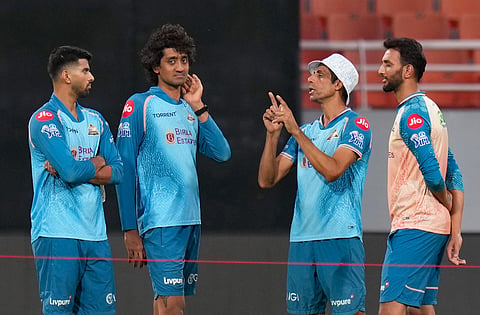
Gujarat Titans's coach Ashish Nehra, Sai Kishore, Prasidh Krishna, during practice session ahead of the Indian Premier League (IPL) 2026 T20 second qualifier cricket match between Gujarat Titans and Rajasthan Royals, in Mullanpur AP Photo
The intensity at the Maharaja Yadavindra Singh Stadium is palpable as the Gujarat Titans sharpen their tools for the high-stakes showdown against the Rajasthan Royals. In a moment of focused preparation, coach Ashish Nehra stands at the heart of the huddle, his legendary tactical mind clearly at work.
Flanked by the strategic spin of Sai Kishore and the raw, surging pace of Prasidh Krishna, the trio captures the dual-fronted approach the Titans are banking on to reach the final.
There is a deliberate stillness in the frame that belies the magnitude of the upcoming Qualifier 2. While Prasidh Krishna looks on with the steely gaze of a strike bowler preparing to hit hard lengths, and Sai Kishore reflects the calm precision required to stifle the middle overs, Nehra serves as the steady anchor.
This isn't just a training session; it’s a high-level briefing where every detail is being scrutinized. As they gather on the Mullanpur turf, the body language suggests a unit fully aware of the challenge ahead, quietly confident in their plan to dismantle the opposition's momentum and secure their path to the summit clash.
Quote Of The Day
Behind every successful team performance, there is often a sense of camaraderie that keeps the pressure in check. For the Rajasthan Royals, that comfort is clearly visible in the relationship between Riyan Parag and Jofra Archer.
After their victory in the Eliminator against Sunrisers Hyderabad, Parag shared a lighthearted story that perfectly captures their dynamic on the pitch. Providing a look at the communication that happens between deliveries, Parag explained:
“With Archer, we keep on having like fun little banters. The first ball he bowled to Abhishek that I almost got a catch, it was bit wide. So I went up to Jofra and said, ‘I need you to be a little straighter.’
“Then he gets the wicket and he asks me smiling, is that straight enough for you? So I feel he’s one of the best, if not the best in world cricket. And I feel when he’s bowling 150 clicks, you don’t ask him to bowl slow. You don’t ask him to do anything. You just remind him if at all he needs any reminding of, otherwise he just does his job," he said.
Elsewhere…
In the one-off Test match at Stormont, New Zealand currently holds a commanding grip after a dominant second day. The Black Caps declared their first innings at a mammoth 490/8, underpinned by Tom Blundell’s magnificent 186 and a near-century from debutant Dean Foxcroft.
Ireland struggled significantly in response, managing only 179 all out despite a gritty 116-run partnership between Andy McBrine and Mark Adair. Forced to follow on, the hosts finished the day at 65/2 in their second innings, still trailing by 246 runs as New Zealand’s bowlers continue to apply relentless pressure.
During the IND-W vs ENG-W 1st T20I toss at Chelmsford, Smriti Mandhana revealed that Harmanpreet Kaur was rested to manage her physical workload ahead of the upcoming ICC Women's T20 World Cup.
The team management opted for this break to keep their captain fresh for the global tournament while providing valuable playing time to other members of the squad.
With Harmanpreet Kaur rested for the upcoming series, all eyes turned to Heather Knight, who celebrated a massive personal milestone as England Women's most-capped player across all formats.
However, it was a difficult outing for the veteran, who marked her 400th international appearance with a disappointing performance in England's 38-run defeat to India at Chelmsford. Despite her extensive experience, Knight struggled to influence the game, managing only 21 runs off 24 balls as the hosts' top order faltered in pursuit of India's challenging target of 188.
The West Indies Women have finalized a largely settled 15-member squad for the upcoming T20 World Cup, with offspinner Ashmini Munisar replacing top-order batter Ebony Brathwaite as the only change from the group that faced Australia.
Led by Hayley Matthews for the third consecutive global tournament—with Chinelle Henry serving as vice-captain—the squad balances seasoned experience from stalwarts like Stafanie Taylor and Deandra Dottin with a tactical focus on versatility.
Head coach Shane Deitz emphasized that the selection prioritizes power-hitting intent and flexible top-order batting to master the English conditions, while maintaining bowling depth capable of shifting between attacking and defensive roles under pressure.
Cricket West Indies has announced a busy 2026 home season, starting with a white-ball series against Sri Lanka in June, followed by a two-match Test series in Antigua. The schedule also features a significant five-match ODI series against New Zealand held across Guyana and Barbados.
The season places a strong emphasis on the ICC World Test Championship, highlighted by two-match Test series against both Sri Lanka and Pakistan. These fixtures represent the core of the home campaign, offering crucial points as the teams compete for a spot in the upcoming WTC final.
The highly anticipated ODI series between Pakistan and Australia is set to commence, promising a clash of contrasting tactical styles as both teams fine-tune their squads ahead of the 2027 ICC Men’s Cricket World Cup. The opening match, which also marks a historic milestone for Pakistan as their 1,000th ODI, will take place on May 30, 2026, at the Rawalpindi Cricket Stadium.
Australia enters this series with a depleted squad, missing several key leaders due to injuries and IPL playoff commitments. With Mitchell Marsh ruled out due to an ankle injury and other senior figures like Pat Cummins and Travis Head unavailable, wicketkeeper-batter Josh Inglis has been appointed to lead the side.
Published At: