Textile businesses in Noida are facing a slowdown due to supply disruptions and rising raw material costs linked to the West Asia war.
India’s textile and apparel exports have declined, as manufacturers struggle to cope with increasing production costs.
Small businesses and workers are under pressure, with fewer orders, losses, and growing fears of layoffs and shutdowns.
West Asia War Hits Textiles: Orders Crash, Costs Surge, Small Businesses Struggle In Noida
Wholesale and manufacturing units in Noida report sharp decline in business, with orders dropping to as low as 10 per cent and some firms facing losses of up to 30 per cent.

Summary
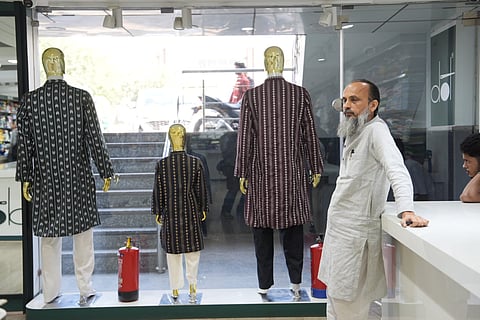
Firoz, a worker at a wholesale garment factory outlet in Kalindi Kunj, was scrolling through his phone on a Tuesday afternoon, a time that he said would typically see peak wholesale activity.
In a store that should have been packed or busy tallying orders in the back, he said the business had slowed dramatically, with orders dropping to just 10 per cent since the war in West Asia began.
“We did not even receive orders on Eid.”
A few kilometres away, Sanjay Enterprises* in the Noida Industrial Area has also fallen unusually quiet, marking an uncomfortable shift after 15 years of running.
The owner, Alok*, whose business supplies unfinished products to manufacturing companies and to custom exports, said the company is facing losses of up to 30 per cent.
“I have to pay for food and accommodation for over 100 workers, but none of them have any work to do right now,” he said. He added that if the workers left for their hometowns, they might never come back. “I am purchasing LPG for them, I don’t have any other options.”
The company manufactures cotton webbing, double-sided fashion/body tape, narrow fabric/woven tapes, and outer elastic tape.
India's primary import sources for Monoethylene Glycol (MEG), an important raw material for polyester fibre, are from West Asia, especially Saudi Arabia, UAE, Kuwait and Oman. The delivery chain has been impacted since the closure of the Strait of Hormuz.
Industry players say the disruption has triggered a broader surge in input costs across the value chain. Amit Sethi, Managing Director of Oriental Fashions, described the situation as an “absolute disaster”, noting that “sewing thread prices have gone up by 15–20% over and above raw materials which have a similar hike.” He added that petroleum-linked inputs have seen even sharper increases: “products connected with petroleum… have gone up by almost 70 to 72%.”
In March 2026, India’s textile exports declined by 9.91 per cent year-on-year, while apparel exports saw a sharper contraction of 18.99 per cent during the same period. Cumulatively, textile and apparel exports in FY26 recorded a 2.21 per cent decline compared to FY25.
Advertisement
Sethi said such cost escalations are severely squeezing exporters, particularly because existing orders cannot be re-priced. “Margins do not allow us to absorb such drastic hikes,” he said. “Presently for all orders already booked and committed which are in the pipeline we cannot pass [the costs on].” He warned that if these costs are reflected in future pricing, global buyers may shift to other countries offering similar products at lower rates.
Kalindi Kunj garmet workers Vikram Sharma
The war in West Asia has disrupted manufacturing and supply chains, affecting both retail, wholesale and export sectors. Gujarat Textiles, a small unit established in 2019 in Noida, had been operating steadily until rising inflation and the recent escalation brought its operations to a halt while it was still in a nascent stage.
“We worked through Covid, the business was functional. We got machines, but now we don’t have any orders,” Vilas said. He added that if the situation persists, he may have to return to his native Maharashtra with his family. “I don’t know what I will do there.”
Advertisement
Chandrima Chatterjee, Secretary General of the Confederation of Indian Textile Industry (CITI), says raw material prices have risen, with polyester being the first to feel the immediate impact due to its dependence on inputs like MEG sourced from the region in West Asia. “As a result, prices have fluctuated by as much as 30 per cent,” she says, adding that it is not even the peak time for India's exports.
The textile industry was only recovering from a steep 50 per cent US tariff for over five months in the previous fiscal year.
India largely produces summer garments, so for the finished product, the order cycle typically peaks between September and March, alongside some demand driven by Christmas orders, Chatterjee said. “We are hoping that by the time the next cycle starts, things stabilise.”
The primary export markets are Western regions, including the US and Europe, where India mainly supplies summer garments. However, when it comes to yarn and fabric, the cycle differs, as it tends to be more continuous rather than seasonal, she said.
Advertisement
The textile sector is not the only one facing the fallout. Disruptions in the import of raw materials have also impacted the leather industry. "About 95 per cent of our market is in the US, and existing orders have not been fulfilled due to a shortage of raw materials,” Danish Rahman, who runs Young Stallions, a Kanpur-based company manufacturing leather goods, said.
“Prices increase by 10 per cent fortnightly or biweekly, due to which we are not in a position to quote any number. Everything is connected. For instance, the polythene has increased by ₹100 per kg, which has affected sales,” Rahman said.
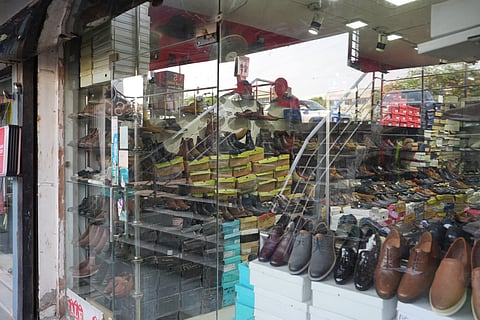
Mohd. Javed, the owner of a wholesale garment shop, said he is bracing for tougher times ahead as he sat in an already empty store. “There are limited opportunities to earn, and with the LPG price hike, people are already paying double for everything,” he said. Textiles, in particular, are hit because people need to cut costs somewhere, and “that’s understandable.”
Advertisement
Javed had to let go of two of his employees as a cost cutting measure, now barely able to afford his shop space for which he pays 1 lakh rupees per month.
Kalindi Kunj garmet workers Vikram Sharma
Mohd. Shakeel Ahmad, an employee at a wholesale chikankaari garment shop, started working as a seller only a year ago. The large shop space employs over 10 workers. With rising fuel prices increasing input costs and a drastic decline in sales, he remains wary of the current situation.
While he acknowledges the broader impact on the economy, he fears that if the West Asia crisis persists, he may lose his job if the owner decides to cut down jobs.
“At least during COVID, people were assured that the pandemic would end soon. But the end of the war is nowhere in sight; it only risks further escalation.”
Chatterjee explained that the West Asia region itself was a big market for India, so the market is impacted furthermore. She said that industry experts are cautiously gauging the ceasefire talks and geopolitical situation. “If the uncertainty continues, which of course is going to impact the demand position, the order position, then we have grave times ahead.”
Echoing these concerns, Sethi warned that disruptions could deepen if energy supplies remain unstable. “Already gas suppliers within Delhi are only supplying 70% of the last six-month average… if this continues and there is a gas disruption then the whole supply chain will come to a standstill.”
With factories now heavily dependent on consistent fuel supply, any prolonged shortage could halt production across units.
Published At: