75 years after the drafting of the Indian constitution, the Hindutva project is no longer to burn the book, but to become its high priest.
Unlike the Emergency of 1975, the current regime’s assault is incremental, systemic, and camouflaged in the language of the Constitution itself.
Defending the Constitution requires building an alternative common sense, a counter-hegemony rooted in the values of solidarity and justice, as was promised by the Constitution makers.
The Indian Constitution At 75 And The RSS At 100: Who Won?
At 100, RSS has changed its strategy—the goal is no longer to defeat the Constitution, but to inhabit it like a Trojan Horse, and to hollow it out from within. Is our Constitution ready for it at its 75th year?

Summary
For decades, liberal thought has comforted itself with the idea that the Constitution is a sacred bulwark against the RSS's profane project. But to view the present moment through this lens is to mistake the nature of the war.
In the life of the Indian Republic, two anniversaries arrived this year. At seventy five is the Constitution—an ambitious document which promised its people a future of liberty, equality, and secular fraternity. Now a century old, is the Rashtriya Swayamsevak Sangh (RSS)—an organisation founded with the express purpose of dismantling that very promise and forging a nation in the exclusionary crucible of Hindutva.
The Sangh, in its Olympian patience, no longer lays siege to the fortress of the Constitution from the outside. It has understood a more profound truth of power and meaning-making. The goal is no longer to defeat the Constitution, but to inhabit it like a Trojan Horse, and to hollow it out from within. This is perhaps what Italian thinker Antonio Gramsci would call a “long march through the institutions”, which has now proved to be terrifyingly successful. Is our Constitution ready for it at its 75th year?
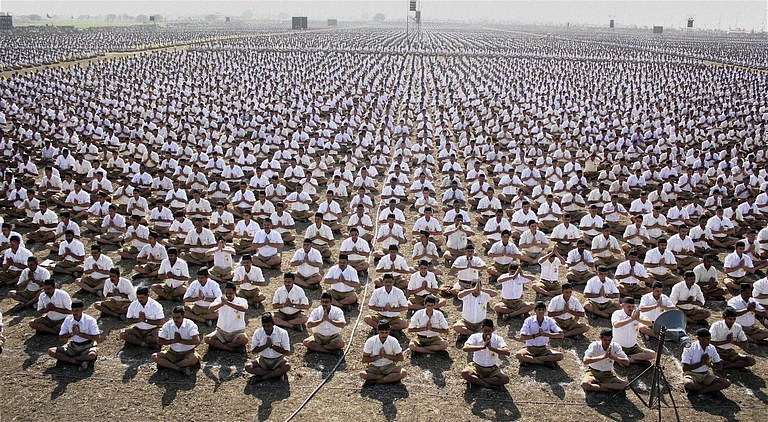
A Gramscian Victory
The original ideologues of the RSS spoke of the Constitution with contempt. MS Golwalkar, the Sangh’s second supreme leader, found “absolutely nothing that can be called our own” within its pages, praising the laws of Manu instead. Dattopant Thengadi, the founder of the RSS’s legal front, the Akhil Bharatiya Adhivakta Parishad (ABAP), called for it to be overthrown and replaced.
At one point, even Ambedkar suggested burning the Constitution, as he believed that the Constitution is only as good as those administering it. 75 years later, the Hindutva project is no longer to burn the book, but to become its high priest. It has learned what Antonio Gramsci knew—that enduring power arises not from a coup, but from the patient manufacturing of a new ‘common sense’. The organisation’s deep grassroots praxis is long documented, but let us see specifically its legal front, the Akhil Bharatiya Adhivakta Parishad (ABAP). The Caravan has meticulously detailed how, from its establishment in 1992, the Adhivakta Parishad has grown into arguably the largest organisation of lawyers in India. Its strategy is classically Gramscian: it builds cadres through study circles and mentorship, places its members in bar associations and on the bench, and spearheads “ideological litigation” that serves the Sangh’s agenda.
Advertisement
The RSS is non-existent, yet omnipresent. At one end, the Hindutva state can cancel FCRA licences, outrightly ban human rights NGOs, or push any independent think tanks critical of the state in the shadow of compliance; whereas the RSS operates without any papers—no registration either as a society or an organisation. Today, the Sangh does not need to suspend the Constitution, when it can simply capture the institutions designed to protect it by the weaponisation of accountability mechanisms such as the ED and CBI and the weakening of the Election Commission.
Unlike the Emergency of 1975—a full-frontal assault on Constitutionalism that was visible and resisted—the current regime’s assault is incremental, systemic, and camouflaged in the language of the Constitution itself. Most notable is the challenge to the constitutionality of the Places of Worship Act, which was designed to put an end to communal claims over temples, mosques or gurdwaras and freeze their status on Independence Day. Ashwini Kumar Upadhyay, a known ‘serial petitioner’ for the Sangh brigade, filed a petition arguing that the Places of Worship Act is violative of secularism and the religious freedoms of Hindus. Similarly, while defending the constitutional validity of the Waqf Amendment Act, the Union justified the inclusion of non-Muslim members on the Waqf Boards on the premise that waqf properties are frequently in conflict with properties of people from other communities. The same kind of legal skullduggery was used in legislation such as anti-conversion laws, abolishment of Madrasa Boards and even banning of halal certification in U.P. The language of Hindu victimhood, once the text of WhatsApp forwards, now occupies statute books or Writ petitions before Constitutional Courts.
Advertisement
Save the Constitution, Decolonisation and Other Shibboleths
The second, and perhaps more insidious, victory of the RSS lies in the realm of language. We are now in a bizarre political moment where the Constitution is invoked by everyone, yet its values seem to mean less than ever. In the last two years of the election season, the red Constitution book held in hand at rallies by Rahul Gandhi and Opposition leaders rose to an iconic status. In fact, it was perhaps the first time that saving the Constitution itself became a major electoral appeal by the Opposition.
The BJP and the RSS, whose founders disdained the document, were then pushed to claim to be its greatest defenders—so much so that when some Sangh leaders suggested removing the word secular from the Preamble, the BJP distanced itself from the statements and assured that it has no plans to do so. Prime Minister Modi, upon the consecration of the Ram temple, a structure built upon the graveyard of a mosque and the rule of law, thanked the judiciary for ensuring the temple “was built in a just manner,” asserting that “Lord Ram is India’s... law”. Very frequently, he is seen bowing down to the Constitution.
Advertisement

This act of semantic appropriation, whereby the Constitution is celebrated at the precise moment its spirit is being violated, also found its echo in the highest echelons of the judiciary itself. Former Chief Justice D.Y. Chandrachud—a figure widely perceived as a liberal progressive—in a recent interview, went beyond the text of his own Ayodhya judgement to offer a stunning ideological justification for it. Chandrachud claimed that the “fundamental act of desecration” was not the demolition of the mosque in 1992, but its construction in the 16th century itself. When the Chief Justice of the Republic claims divine guidance in authoring a judgement that rewards criminality, the law has been fully subsumed by faith, specifically of the majority. The nature of this war then, is not of the anti-constitutionalist Goliath and the constitutionalist David. Rather, it is a moment of political tragedy, where everyone is allowed to be a “constitutionalist”, including the demolisher and the defender. The Prime Minister consecrates the temple, while a former Chief Justice legitimises its foundations. So when civil society groups in Karnataka asked the RSS to carry the Constitution in its march, it is very likely that the RSS might not mind that at all now.
Advertisement
The Cultural War for Constitutional Morality
The liberal defence of the Constitution has too often placed its faith in the inherent power of the document itself, in the neutrality of the judiciary, and in the idea that Constitutionalism—when all else fails—would perhaps be upheld by the ‘People’. This is a fatal misreading of the nature of a proto-fascist society. The Sangh Parivar, from its inception, understood that the war for the soul of India would be fought not in the courtroom alone, but in the minds of people.
The judiciary is not an ideologically neutral space. Remarks like that of former CJI Chandrachud, or outright hate speech by Justice Shekhar Yadav of the Allahabad High Court, are not aberrations; they are symptoms of a deeper ideological convergence. The malaise is not a few “pro-RSS” lawyers or judges, or even an institutional capture by Sangh personnel, but rather a systemic capitulation of even the liberal centre of the state. Constitutional morality is not a self-evident truth; it is the product of a hegemonic culture. The RSS has spent a century building that culture through its thousands of shakhas and front organisations, creating a “new common sense” where its majoritarian worldview seems natural.
The Indian Constitution has been described in various ways by scholars—ranging from “colonial” that needs to be “decolonised”, to a “feminist” constitution, a People’s constitution, or even Ambedkar’s Constitution. The Sangh has clearly shown us that we were asking the wrong questions. To truly defend the Constitution, then, is to recognise that the fight is not merely invoking the Constitution or excavating its radical history. It requires building an alternative common sense, a counter-hegemony rooted in the values of solidarity and justice, as was promised by the Constitution makers. It requires recognising that the slogan “Save the Constitution” is meaningless, unless it is accompanied by a political and cultural project to win back the ground that has been lost.
As the machine of the RSS celebrates its centenary, the ghost of the Constitution turns seventy-five. The machine no longer fears the ghost. It has learned to wear its form, to speak its language. The final victory of the RSS will not be the day the Constitution is formally abrogated. It will be the day it is celebrated with the greatest pomp and ceremony, its words recited by all, while its soul has long since been exorcised, leaving behind only a hollowed-out carcass of a nation that once dared to imagine itself otherwise.
(Views expressed are personal)
Faizan Ahmad is an Advocate practising at the Supreme Court of India and a former Weidenfeld-Hoffmann Scholar at the University of Oxford. He writes on Indian constitutionalism and minority rights
Published At: