UGC 2026 regulations seek to end caste discrimination in universities but are opposed by the same anti-reservation forces seen in Mandal and 2006 protests.
Supreme Court stayed the rules while earlier allowing EWS reservation, exposing deep contradictions in India’s social justice journey.
Persistent caste oppression clashes with constitutional equality goals, making real change in higher education a continuing hard fight.
Seeking Equity: Caste Discrimination Remains Firmly Entrenched With Little Progress
The UGC regulations reflect the contradictory reality of Indian society that has defined the post-Independence historical context and remain unresolved to this day

Summary
The University Grants Commission (Promotion of Equity in Higher Education Institutions) Regulations, 2026, have stated in their objective the eradication of discrimination not merely on the basis of caste, but also on other grounds. It is caste-based discrimination though that is at the centre of the sharply diverging reactions and responses to the regulations and the Supreme Court’s controversial stay of them. What lies behind these reactions and counter-reactions, however, is not substantively a contention between alternative reasoned positions, something that any public policy measure could invite. Instead, it reflects the contradictory reality of Indian society that has defined the post-Independence historical context and remains unresolved to this day.
On the one hand is the continued significance of caste in its social life, and therefore, of the social oppression and discrimination that is inextricably tied to it. On the other is the presence of a strong aspiration for equality and a more egalitarian social order, whose awakening has found its reflection in several provisions in the Constitution.
While one cannot say that nothing has changed in the last three quarters of a century, it would be impossible to dispute that the distance still to be travelled in achieving the goal of social justice far exceeds any progress that may have been made on the basis of available evidence. Moreover, any movement that has happened has not always proceeded in a linear fashion or smoothly. Every small step forward has been taken only when the aspiration for progressive change has attained sufficient strength to force the political processes to respond to it, and it has always had to take place in the face of resistance from the forces of conservatism. The latter have sometimes expressed themselves overtly through ‘protests’ and taking to the streets, but they have almost always worked on an everyday basis through their structurally privileged and endogenously reproduced dominance in society, in the economic domain, and in the form of the presence of the carriers of its consciousness in the institutions of the state and those that make and reflect ‘public opinion’.
Advertisement
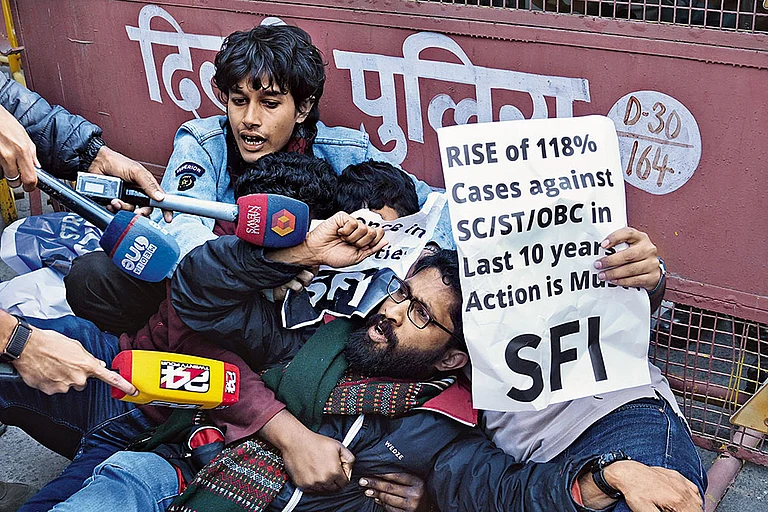
What is playing itself out in relation to the University Grants Commission (UGC) equity regulations is simply a new version of a familiar story. The protests that erupted after the notification of the regulations, and much of the media debate that followed, were reminiscent of the anti-reservation movements that have taken place from time to time. This included what followed the enactment of the Central Educational Institutions (Reservation in Admission) Act, 2006, which implemented reservations for the Other Backward Classes (OBCs) in admissions to higher education institutions (HEIs), and gave the existing reservation for the Scheduled Castes (SCs) and the Scheduled Tribes (STs) a statutory basis. It may be remembered that it was only in order to pacify that opposition to reservations that the then government felt compelled to do something that should have happened of its own accord, and for much more valid reasons—namely the expansion of the public higher education system by increasing intake by 54 per cent. An even larger-scale protest had taken place in the early 1990s in opposition to the decision of the V. P. Singh government to implement the Mandal Commission recommendations.
Advertisement
These movements, like the protests against the UGC equity regulations, have always invoked an anti-caste rhetoric, alleged that anti-discrimination measures are promoting caste division in society, and portrayed those belonging to privileged caste groups as being the victims of the ‘discrimination’ inherent in those measures. The current protests have only repeated the hackneyed arguments, which basically invert the causal relation between measures like reservations and the true role of caste in Indian society. They make caste division and discrimination a result of these measures, instead of seeing them as a limited act of reform in response to a social reality where such division and discrimination are rife. These arguments have been decisively repudiated many times over and cannot be derived from any serious study of Indian society. Such a study can, however, explain why these exist nevertheless—they are components of an outlook that suits the objective of preserving the structure of division and discrimination.
Advertisement
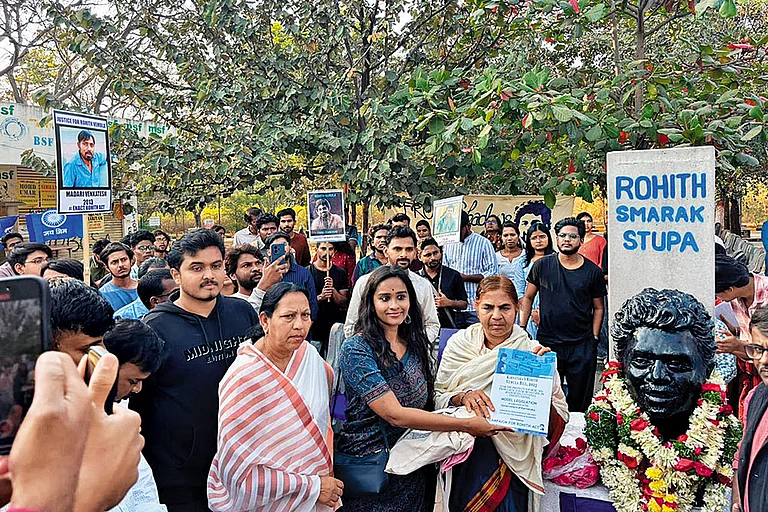
The protests that erupted after the announcement of the Regulations were reminiscent of the anti-reservation movements that have taken place from time to time.
Just as in the case of the UGC regulations of 2026, the implementation of the Mandal Commission had also been initially stayed by the Supreme Court untill the case was finally disposed of and the constitutional validity of reservations for OBCs was upheld. The more recent implementation of the reservation for Economically Weaker Sections (EWS), which specifically excluded SCs, STs and OBCs from the benefit of that reservation, in contrast, had been allowed to be implemented without any stay even when its constitutional validity was under challenge. Moreover, while upholding the EWS reservation, the final Supreme Court ruling did not find such exclusion to be ‘discriminatory’ and, strangely, also argued that the 50 per cent limit it itself had previously set on reservations was applicable only to reservation for backward classes. Those for whom reservation was capped incidentally constituted not only the overwhelming majority of the Indian population but were also certainly more than five times the number of those who were economically weak but not members of the backward classes. That judicial interpretations are not free from the pulls and pressures created by the underlying social reality is also reflected in the fact that the UGC regulations it stayed had also emerged as a result of its own directives.
Advertisement
In addition to the protracted struggle and judicial petitioning that has followed Rohith Vemula’s tragic death, one other important episode in this long and continuing battle took place in 2019. This was the widespread movement that forced the Union government in 2019 to enact an ordinance, later to become an act, to protect reservations in the appointments to faculty positions in Central Universities. These reservations were in danger of taking an adverse hit on account of court orders on what could be considered the appropriate unit for applying reservation in faculty appointments, particularly when applied on the basis of a Supreme Court judgement on post-based reservation delivered more than two decades earlier.
These struggles, in fact, reflected the changes in the context of the universities that had been produced by the history of those reservations—with some of its major centres being those very same institutions that in the past had been the hotbeds of anti-reservation agitations. This transformation was one part of a larger shift that has been taking place in the social composition of students as well as faculty. One other important consequence of that same shift though was also that universities and other HEIs, from being islands of exclusivity created by the larger structure of social discrimination and exclusion, increasingly became also potential sites or locations within which these processes could reflect themselves and also be resisted. Inclusion marked by an increasing presence of those who had limited access earlier could and did always go with the experience of a hostile environment. It is from this that emerged the necessity of regulations specifically designed to address discrimination in the context of HEIs.

The real flaw in the UGC equity regulations is not that it seeks to solve an invented problem or in its understanding of what is caste-based discrimination. It instead lies in its limited recognition of the nature and extent of that problem and how discrimination truly works. That is why the regulations propose to create an institutional mechanism that vests all powers in the heads of institutions and in the administration working under their control, rather than one which can work independently. It is the working of these very administrative structures though which have continued to try and thwart the reservation policies and created as well as permitted the hostile conditions for those who still get through to change which makes imposing such regulations on them necessary. That the UGC has only gone thus far as to enact such regulations, and not been able to guarantee that they are not designed to fail, and even the implementation of these have been stayed—these are all indications of the fact that the realisation of the goal of equality and social justice still involves a long and hard fight.
(Views expressed are personal)
Surajit Mazumdar is professor, Centre For Economic Studies And Planning, Jawaharlal Nehru University, and president, Jawaharlal Nehru University Teachers’ Association
This article appeared in Outlook's February 21 issue titled Seeking Equity which brought together ground reports, analysis and commentary to examine UGC’s recent equity rules and the claims of misuse raised by privileged groups.
Published At:
Tags