Despite JD(U) winning 85 seats in 2025 Bihar polls, Nitish Kumar gave up the Home Ministry to BJP , a major concession never made before, seen as a sign of his declining dominance.
Post-election slogans like “Nitish Again 2025–2030” and “Tiger Abhi Zinda Hai” projected him as indispensable, but by March 2026 he filed for Rajya Sabha, shocking supporters.
Workers mourned his Bihar exit, some alleging he was “hijacked”; son Nishant’s entry into JD(U) begins dynastic transition, but his inexperience raises questions about sustaining the party’s legacy and caste coalition.
From ‘Tiger’ To Successor: Political Transition In Bihar And JD(U)’s Future
After a decade of dominance in Bihar politics, Nitish Kumar moves to Delhi and his son Nishant joins JD(U) raises questions about the party’s survival and succession.

Summary
Despite winning 85 seats, Nitish ceded key ministries like Home to the BJP, signaling a possible decline in his political dominance and fueling speculation about his move to national politics.
Nishant’s entry into JD(U) marks a new era, but unlike other political heirs, he lacks prior grooming and experience, raising doubts about his ability to maintain JD(U)’s caste-based coalition and political legacy.
While some leaders fear that the party cannot function without Nitish, others argue that with proper guidance and adherence to Nitish’s policies, the party can continue under Nishant’s leadership.
Nearly a year before the Bihar Assembly elections, when political questions were being raised about Nitish Kumar’s health and his political future, Patna city was flooded with posters and hoardings carrying with slogans: “25 se 30, Phir Se Nitish” (2025–2030, Nitish Again).
Through this slogan, the Janata Dal (United) was sending a message not just to the Opposition but to its ally, the BJP, that the alliance would not be acceptable without Nitish as the chief ministerial face.
After months of speculation, the picture became clear that Nitish would indeed remain the NDA’s chief ministerial face. On November 14, when early election trends were showing the NDA gaining a significant lead, a newly put-up poster at the JD(U) office caught everyone’s attention.
This time, it read: “Tiger Abhi Zinda Hai” (The Tiger Is Still Alive). The poster was yet another assertion that reaching the seat of power without Nitish would be nearly impossible.
Yet, within just three months, the political script that led to the end of this “25–30 Nitish again”, “tiger” surprised everyone.
The beginning of this script had actually started soon after the government formation, during the distribution of ministries. However, the political curtain would fall so quickly, which was something few expected, and it triggered a political tremor in Bihar.
Nitish, who took oath as Chief Minister for the tenth time, had always retained certain key ministries with himself. Among them, the Home Department was one portfolio he never gave up under any circumstances.
Advertisement
Even the last time, when his party had managed to secure only 43 seats, he still kept the Home Ministry with himself. But this time, despite winning 85 seats, he had to compromise with the BJP over this department.
Many observers interpreted this major shift as an early sign of the beginning of the end of Nitish’s political dominance.
When reports surfaced in the media on Holi that Nitish might move to national politics, the news spread like wildfire among his supporters.
On March 5, when Nitish filed his nomination for the Rajya Sabha, apparently preparing for a shift to Delhi, a sense of grief spread among party workers, ministers, and supporters.
JD(U) MLA Vijay Chaudhary, breaking down emotionally, reportedly said, “Now he has ended the entire game. We tried hard to persuade him, but he just wouldn’t agree.”
Some workers even alleged that Nitish had been “hijacked,” while others claimed they were ready to sacrifice their lives to stop him from leaving Bihar politics.
Advertisement

Nishant Kumar’s Entry
For nearly a year, speculation had been circulating that Nitish’s son Nishant Kumar might enter politics.
On March 8, Nishant formally took membership of the JD(U) at the party office in Patna. With this, it became clear that after Nitish, Nishant would be the new face of the party. But this political transition has raised an important question in many minds:
What will be the future of JD(U) now? Can Nishant carry forward the ideology and political legacy of his father?
Former MLC Prem Kumar Mani, once considered close to Nitish, says that Nitish’s shifting to Delhi politics is unfortunate for Bihar’s political future. Mani says, “I don’t think Nitish has the same level of political consciousness anymore. It is being said that he is unable to take decisions on his own. If that is true, it is even worse. I cannot imagine a Chief Minister leaving the post for a Rajya Sabha seat.”
Advertisement
Speaking about Nishant, Mani argues that he lacks political maturity and managing Bihar would be extremely difficult for him. Nitish’s model of social justice politics, Mani says, involved bringing multiple caste groups together. Maintaining such a broad coalition will not be easy for Nishant.
Nitish belongs to a generation of leaders whose political exit may also mark the end of the socialist and social justice chapter in Bihar politics, he says.
He further adds that if Nitish becomes weaker after moving to Delhi, the BJP will emerge as the dominant political force in Bihar, eventually absorbing JD(U), turning Bihar into a “BJP state.”
Nitish Kumar’s Social Engineering
Many political observers compare Nitish’s strategy to the legacy of Karpoori Thakur. Nitish built a complex caste coalition through social engineering: He divided OBCs into OBC and EBC (Extremely Backward Classes). Among Dalits, he created the Mahadalit category, excluding the Paswan community, weakening the political base of Ram Vilas Paswan. With the help of leaders like Ali Anwar, he emphasised the identity of Pasmanda Muslims.
Advertisement
Former JD(U) MP Ali Anwar, long-regarded as the most-prominent Pasmanda Muslim face in the party, does not see Nishant as a natural political successor like Tejashwi or Chirag.
Anwar says he sees two phases of Nitish politics, before 2017 and after 2017.
According to him, Nitish’s political decline began after he, once again, aligned with the BJP in 2017. He says that despite repeated attempts, Nitish did not allow the BJP’s communal agenda to fully take root in Bihar.
Anwar says Nitish managed to prevent large-scale communal or caste tensions in the state, something that had often surfaced during earlier political phases. However, he doubts whether Nishant possesses the same political abilities.
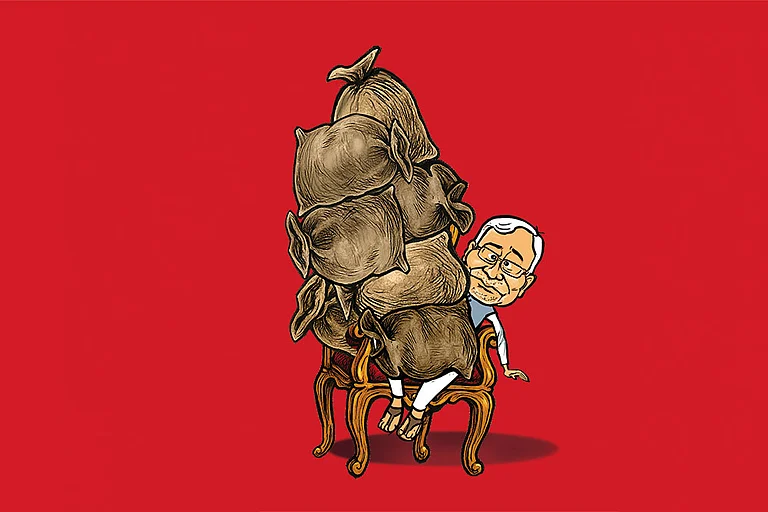
Nishant’s Image and Challenges
Looking at Nishant’s life so far, his public image has been that of a simple and soft-spoken person, largely removed from political and public life.
For someone who has remained distant from politics for decades, the biggest question now is whether he can navigate Bihar’s deeply complex caste-driven political landscape.
His entry into politics will also serve as a litmus test for dynasty politics, particularly because Nitish had always positioned himself as a critic of political dynasties.
With Nishant’s formal entry into JD(U), Nitish has now joined the list of leaders like Lalu Prasad Yadav and Ram Vilas Paswan, whose political legacy is being carried forward by their children.
Both Lalu and Paswan ensured that their children, Tejashwi Yadav and Chirag Paswan, were politically groomed within the party and among the masses before handing them leadership roles.
In Nishant’s case, no such political training or gradual grooming is visible.
Anwar says that JD(U) may find it difficult to survive for long without Nitish. Just as Tejashwi retained the RJD’s core Yadav–Muslim vote base and Chirag Paswan consolidated the Paswan vote, Nishant will face the challenge of keeping JD(U)’s Kurmi–Koeri base intact.
Bashistha Narayan Singh’s View
Veteran JD(U) leader Bashistha Narayan Singh, who has been with Nitish since the Samata Party days, offers a different perspective. After joining the party, Nishant visited Singh’s residence to seek blessings. Now away from active politics, due to age and health issues. According to Singh, Nitish wants someone to take charge of the party while he is still present to guide and mentor them, and Nishant will run the party under his supervision.
Singh dismisses fears that the party will collapse after Nitish. However, he also acknowledges that the party can survive only if it continues to follow Nitish’s policies and ideological direction.
He says, “When a leader who has established his identity leaves, discussions naturally arise for some time. But the political stream he created does not disappear. The programs and policies of Nitish will remain the foundation for the party’s future.”
Some party workers and leaders have alleged that decisions within JD(U) are now being taken by others rather than Nitish himself due to his declining health. When news emerged that he might move to the Rajya Sabha, some workers even claimed that he had been “hijacked.” This raises another question that If Nishant eventually leads the party organisation or becomes Deputy Chief Minister under JD(U)’s quota, how independent will his decision-making actually be? However, Bashistha Narayan Singh rejects these claims. He points out that during the same period when such rumours were spreading, Nitish continued travelling across Bihar to review government programs. According to him, repeatedly raising questions about Nitish’s mental health is incorrect and unfair
Published At: