A US missile strike on a school in Minab, Iran killed dozens of children on 28 February.
The Pentagon’s investigation into the attack has not been released, leaving responsibility unclear.
Rights groups estimate up to 157 deaths, including 123 children, but no official list has been published.
US Strike On Iran School In Minab: What Happened And Why Answers Are Still Missing?
A school strike in southeastern Iran killed dozens of children, but the Pentagon investigation has not been released and key facts remain disputed.

Summary
More than 120 days after at least one US missile struck a primary school in the southeastern Iranian city of Minab, killing dozens of children, there is still no final accounting of what happened. The Pentagon has not released its investigation, the US government has not formally accepted responsibility, and key details of the strike remain unclear, according to reporting reconstructed by The Associated Press (AP).
The strike on 28 February is described as the deadliest reported incident in the US-Israeli war against Iran, with most victims being children. Yet basic questions remain unresolved, including how many munitions hit the site, the exact number of dead, and the full findings of the Pentagon inquiry. The absence of disclosure, alongside restricted access inside Iran and competing political narratives, has left families without closure and created an accountability gap around the bombing.


What is known about the strike
The strike hit Shajareh Tayyebeh school in Minab, a southeastern Iranian city near the Strait of Hormuz, on 28 February, a normal school day during Ramadan. Students were inside the building when teachers received news that strikes had begun elsewhere in Iran.
The school stood inside a walled compound that also contained a Revolutionary Guard base. Satellite imagery and open-source mapping reviewed by AP suggest the school may have once been part of that base before being separated more than a decade earlier.
After reports of strikes in Tehran, teachers and administrators called parents to collect their children early. AP reports that parents were contacted by landline phones, and a separate Airwars investigation also found that families were called in for early pickup.
Minutes later, multiple munitions struck the compound, hitting at least five buildings. The analysis of satellite imagery shows extensive destruction and the collapse of the school structure.
Advertisement
By the end of the day, hospital staff in Minab estimated at least 108 bodies had been recovered, warning it was likely an undercount. State media later raised the toll to around 150, and then to 168.
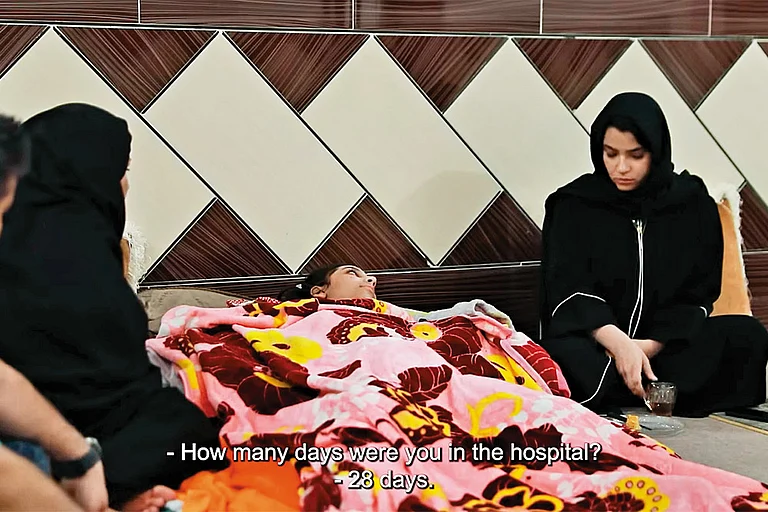
Airwars, a conflict monitoring group cited by AP, later identified 157 of the dead, including 123 children aged 13 or younger, alongside adults including school staff and parents.

What remains disputed or unknown
Despite months of investigation, several core questions remain unanswered.
The exact number of munitions that struck the school has not been established. A complete and verified list of the dead has not been published. The findings of the Pentagon’s internal investigation have also not been released publicly, even though AP reports that Central Command has completed its review and is now examining the results.
Advertisement
Responsibility remains contested. Iran has blamed the United States. The Trump administration has not formally accepted responsibility.
President Donald Trump said he had not seen evidence confirming US involvement, stating: “I don’t know that they’re ever going to solve that problem in terms of whose fault was it, because there were missiles flying all over the place,” and added, “I don’t think it was us.”
A US official with knowledge of the investigation told AP that American forces had conducted strikes in the area and that the military initially knew of activity near the site, but it took time to confirm that a school had been struck.
The official also said internal US military records had identified the building as a school years earlier, but that this information was not properly integrated into targeting systems.
Why answers have been delayed
AP reports that multiple constraints have shaped the lack of clarity around the strike.
Advertisement
Inside Iran, foreign journalists were largely barred from accessing affected areas. Early internet shutdowns during the conflict made communication from inside the country difficult, limiting independent verification. Iranian authorities also tightly controlled public messaging, framing victims within official narratives that described them as “martyrs,” according to reporting cited by AP and findings referenced from Amnesty International.
On the US side, the Pentagon has not released its findings. A former defence official told AP that organisational changes under the Trump administration, including reduced staffing in civilian protection functions, may have weakened systems designed to prevent strikes on protected sites such as schools.
The absence of public findings has added to uncertainty over whether procedural safeguards were followed or failed in the targeting process.
Advertisement
What investigators have been able to reconstruct
Even without official disclosure, researchers have built a partial account of the impact and victims.
Airwars, cited by AP, identified 157 of the dead, including 123 children aged 13 or younger, 34 adults, school staff members including at least one pregnant woman, and parents who each lost a child. The group estimates between 95 and 111 people were injured and places the death toll between 157 and 168.
AP reports that video evidence, satellite imagery, and witness accounts show multiple impact points across the compound and heavy structural damage consistent with aerial bombardment. Children’s belongings, including backpacks, drawings and school materials, were recovered from the debris.
However, gaps remain in victim identification and in reconstructing the full sequence of strikes on the compound.
Why the case has drawn scrutiny
The Minab strike has become a focal point in wider questions about civilian harm and accountability in modern warfare, particularly in air campaigns where independent verification is limited.
AP notes that in previous incidents, such as a 2021 US strike in Kabul that killed 10 civilians, the Pentagon acknowledged responsibility within weeks. In contrast, the Minab investigation remains unpublished months after the event.
Members of the US Congress have raised concerns about the lack of information. Senator Mike Rounds, a Republican on the Armed Services and Intelligence Committees, told AP that Congress had not received sufficient details and expected a full report, adding: “The issue has not gone away.”
(With inputs from AP)
Published At: