Netanyahu has dominated Israeli politics for three decades, making occupation, settlements, and disregard for Palestinian life central to governance
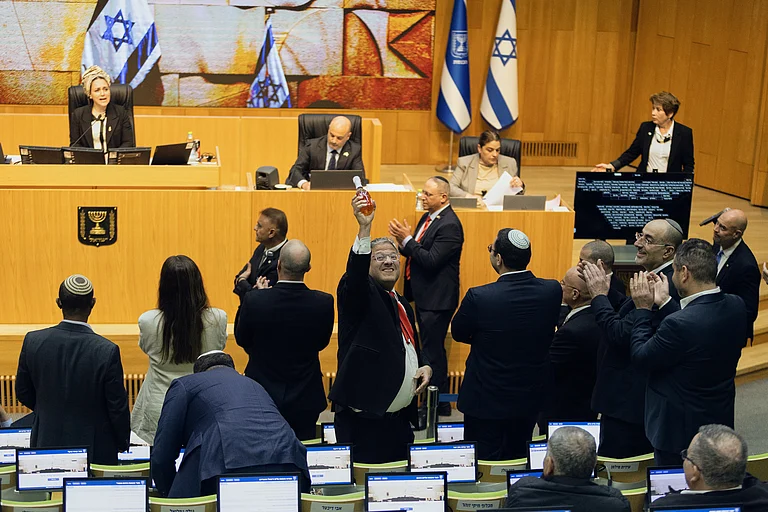
Minister of National Security Ben Gvir raised a toast and danced to celebrate a new law allowing the death penalty to Palestinian prisoners
Where do you have Jews around the world running into bomb shelters five times a day because missiles are being shot at Israel?
The Promised Land: Israel Beyond Netanyahu’s Politics
How did it reach a point where descendants of Holocaust survivors face allegations of genocide and continue to wage war on their neighbours?

Summary
“Israel has spent decades investing in military capability as a substitute for political strategy. It can strike anywhere in the region. It cannot articulate what it wants the region to look like. It has the means to wage war but not the language to end one. It is politically, and diplomatically, isolated.”
This is what Israel represents today according to Yonatan Touval, a political analyst and board member of Mitvim from Tel Aviv. So how did it reach this position, in which the descendants of Holocaust survivors face allegations of genocide, and continue to wage war on its neighbours?
In 1947, while the British partitioned India to create Pakistan, the newly born United Nations partitioned the formerly British-ruled area of Palestine. The map can be best described as a jigsaw puzzle. A curving, haphazard line, running vertically through the land mass, putting the Palestinians and Israelis at great risk of conflict over the confusing borders.
Before that British Foreign Secretary Arthur Balfour had written to Lord Rothschild in 1917, expressing Britain’s support for the creation of a national home for the Jewish people in Palestine.
However, the United Kingdom, by 1948, was tired of maintaining the region, so it passed on the responsibility of the Israel-Palestine division to the United Nations which was formed after the dissolution of the League of Nations. While there was the guilt of the Holocaust, there were other ethno-religious forces at play. According to an Al Jazeera documentary, former British Prime Minister David Lloyd George reportedly claimed that gathering Jewish people in Palestine will bring back Jesus right around the time the Balfour agreement was being discussed.
Balfour reportedly wrote that there was “simply no question of consulting the ‘current residents’ of Palestine” about their freedom; only Zionists were consulted. Interestingly, before this, Britain promised the land of Palestine to France and the Arabs on two separate occasions, while establishing separate institutions for different religious groups, echoing a “divide and rule” approach.
Advertisement
But eventually, it left the UN in-charge of the Promised Land.
Some Arabs resisted, some unwillingly fell into line, some watched as boats docked on the Palestinian shores in 1939 and beyond as Jews arrived from Poland, Hungary, and more.
Cut to 2026, Minister of National Security Ben Gvir raised a toast and danced to celebrate a new law allowing the death penalty to Palestinian prisoners (and not Israelis). He toured the museum which would be the ‘hanging zone for Palestinians. A year earlier, he had joked about using the neutron bomb on Arabs on an Israeli news channel as all the panelists laughed.
Some global leaders call it apartheid or invasion or annexation or genocide, some stay silent, while Israel attacked over 100 medics just last month in South Lebanon to increase its annexation into the territory.
So how did a safe haven for the persecuted become the largest refugee creator of the region, responsible for 200,000-300,000 deaths in Palestine alone since 1948 and over seven million refugees in the region according to the UN?
Advertisement
According to Touval, “Israel today is a study in paradox. It is the most militarily powerful state in the region, a nuclear-armed country with one of the most technologically advanced armed forces in the world, backed by the full weight of the U.S. And it is, at the same time, more diplomatically isolated, more strategically exposed, and more politically fragile than at any point in its recent history.”
When asked how he would describe Israel to someone who knows nothing about it, Touval says, “I’d say it’s a small country with an outsized sense of historical consequence, though it has become pathological at times.” He adds, it’s also a country of deep internal fractures – between secular and religious, Ashkenazi and Mizrahi, Jewish and Arab-Palestinian citizens, settlers and coastal liberals – that has historically used external threat as a unifying device.

Advertisement
Gershon Baskin, another Israeli, someone who was key in hostage negotiations with Hamas in early 2000s and now one of the founders of the ‘Two State Alliance’, believes, “What was supposed to be the safe place for Jews, it's not necessarily the safest place for Jews. Where do you have Jews around the world running into bomb shelters five times a day because missiles are being shot at Israel? That's our current reality”.
However, he is aware why the Iranian missiles are raining down on Israel, defying its Iron Dome, and public sympathy against a people persecuted for centuries, due to his country’s various missteps. “These include Israel's behaviour and politics, particularly during the two-year war in Gaza. Many Jews in the world don't feel safe anymore wherever they are because they're identified with Israel and much of the world sees Israel as a criminal state.”
To understand how this happened, one needs to understand the long and complicated history of anti-Semitism in Europe. There was the Holocaust, centuries of exile, persecution, and statelessness. When Herzl proposed the homeland for Jews, he was basing that on historical evidence. In Concise History Of Israel, the authors describe multiple prosecutions in Spain, England, France, Germany, USA between 1190 to 1500s. The exodus is a living memory for most Jews; so is the massacre in Spain in 1391 and 1492 as well as 1930s Germany. They had been running for a long time; looking for the final, safe destination in the Promised Land.
Advertisement
Touval believes that feeling of vulnerability did not vanish with Israel becoming powerful, instead it morphed into something disturbing.
“Power transforms the people who acquire it. What began as a project of refuge gradually became entangled with territorial control, military occupation, and the displacement of another people. The Nakba of 1948, the occupation of 1967, the settlement enterprise, the blockade of Gaza – each step had its own logic, its own security rationale, its own political constituency. But the cumulative effect is the situation you describe: a State born from displacement that has itself produced displacement on a massive scale.”

In his 1896 booklet The Jewish State, Theodore Herzl reportedly considered Argentina as the possible location for the Jewish homeland which an Al Jazeera documentary claimed was for ‘its temperate climate and natural resources’. Herzl is regarded as the father of Zionism. The demand for a Jewish homeland predates the World Wars; it began in the 19th Century when Palestine was still under the Ottoman Empire. The Ottoman empire would fall after World War I, and come under British rule; essentially becoming another one of the British colonies from the Empire on which the sun never set.
However, Baskin says there was no other option, neither Argentina nor Uganda (which was also rumoured to be one of the considerations). It was always going to be Palestine. “Well, Palestine, or the land of Israel as we call it, is the ancestral homeland of the Jewish people. This is where the prophet Abraham was sent by God to raise his family and be fruitful and spread. Abraham, Isaac and Jacob and the history of the Jewish people to King David and the first kingdom and the second kingdom the first and second temples are all from Palestine.”
He explains, it's not only the ancestral homeland, but it's also the birthplace of the Jewish religion as such and therefore there was really no alternative to go anywhere else to reestablish a home for the Jewish people. “It was only back to Zion, and Zion is Jerusalem, and Zion is Israel. And Jews pray three times a day. They face Jerusalem when they pray,” he concludes.
According to Baskin, their festive ceremony of Passover concludes by saying ‘next year in Jerusalem’, meaning that “we all go back to Jerusalem and Jerusalem will be rebuilt. The temple will be rebuilt”.
In the book O Jerusalem!, authors Dominique Lapierre and Larry Collins claim that a Jewish state without Jerusalem would be a betrayal. A New York Times article about the book from 1972 notes, Roman Emperor Titus destroyed their Temple in 70 A.D. and drove the Jews out of Jerusalem and the Land of Zion, the exiled children of Israel have sung a psalm of promise and lament, vowing never to forget the City of David. Currently, neither side ‘legally’ governs Jerusalem, but Israel is the ‘de-facto’ occupier of the region, with its Knesset based in West Jerusalem. It was annexed after the Arab-Israeli war in 1948.

When Ben Gurion, on his way to become the first prime minister of Israel, declared the independent state in 1948, there was an obvious pushback from the Palestinians as well as the Arab neighbours. Similarly, the new State would face weakening ties (albeit monetary) with the UK and USA. According to a New York Times article published in May of 1972, “Several American officers, including Lt. Gen. Walter Bedell Smith, considered joining Israel’s army in response to Ben-Gurion’s appeals, but abandoned the plan when the Pentagon refused approval. Colonel David Marcus, however, resigned his commission and went to Israel, becoming one of its most prominent professional soldiers. Ben-Gurion appointed him a general—the first in a Jewish state since Judas Maccabaeus”.
David Ben-Gurion is perhaps one of the consequential Zionist leaders in history; after all, it was his declaration that established the State of Israel. Ben‑Gurion saw Judaism not just as a religion but as a cultural and national identity, promoting coexistence between religious and secular Jews. Under Ben-Gurion, various Israeli militia were armed with American and English help—eventually combining to form the Israeli Defence Force. These armed militia members were key in occupying the territories of Palestine and Syria before Israel even had a formal army.
Even as Palestinians remained the ethnic majority, most were not armed or militarised in these decades. In 1947, the UN voted to partition Palestine, allocating 55% of the land to a Jewish state; Arabs rejected it, but Ben‑Gurion accepted.
On April 9, 1948, a month before Ben-Gurion’s declaration, armed militia Irgun and Lehi forces attacked the Palestinian village of Deir Yassin, killing over 100 residents, including women and children, setting villages on fire according to Encyclopaedia Britannica. A documentary on the subject claims women were stripped, humiliated in Mandatory Palestine, leading to mass exodus of the Palestinians. It became the blueprint, and other villages, fearing the same fate, fled. 250,000 Palestinians fled by 1948; and Ben-Gurion extended settler occupation beyond the decided 55% to reach 78%.
750,000 are ethnically cleansed and the Palestinians name it the ‘Nakba’ or the catastrophe
According to Touval, there are three key moments which resulted in the Israel of today. The first is 1967, when the Six-Day War entrenched Israel’s reliance on military superiority and created the occupation, now approaching its sixth decade, under which millions of Palestinians live without political rights or a say in the system governing them; ever since, Israeli diplomacy has been shaped, and often constrained, by the need to sustain or justify that reality. The second is 1973, when the shock of the Yom Kippur War exposed how vulnerable Israel could be, shattering the sense of invincibility that followed 1967 and forcing a strategic turn towards diplomacy—ultimately leading to land-for-peace agreements and a much deeper, more formalised reliance on the United States for security and regional balance. The third is the Oslo process and its collapse, which in the 1990s raised the real possibility of a negotiated settlement and Palestinian self-governance, but whose failure—particularly after the violence of the Second Intifada—eroded trust on both sides and entrenched a deep scepticism within Israeli society about the viability of peace, helping to normalise more hardline political approaches.
Anne Frank’s diaries remind us of the prosecution Jews faced, apart from the publicly available evidence and testimonies of the Holocaust. But Frank, a child writing about the progress ‘live’ while being hidden by Christians, is a visceral, vivid horror to read.
Now nearly eight decades after Frank, in April of 2026, the Israeli military has warned the Christians and Druse of Southern Lebanon to ‘not hide’ Shia Muslims in their homes or buildings, like Frank once did, as the IDF annexes further portions of the village. In a move that can be described as ethnic cleansing.
Are these moves a reflection of Israel’s foundational principles? No, thinks Touval. There were multiple foundational thoughts behind Israel—There was the democratic, secular, social-democratic idea – Mapai, the kibbutz, the labour ethos. There was the revisionist Zionist idea – Jabotinsky’s emphasis on military strength, territorial maximalism, what he called the iron wall of power. And there was the religious-nationalist idea, more marginal in 1948 but now ascendant.
“What has happened over decades is that the first of these has weakened dramatically while the second and third have merged. The Israel of Ben-Gurion was not the Israel of Netanyahu, and Netanyahu’s Israel is not even the Israel of Begin. The current government includes figures – Smotrich, Ben Gvir – who represent a messianic nationalism that the founders of the state would have regarded as alien and dangerous. In that sense, the answer is no: Israel today is not faithful to the ideas of 1948,” he says.
Israel did not want to settle with just 77% of Palestinian land. The theory of ‘Greater Israel’ was rubbished by many media outlets until 2025 as ‘conspiracy’. According to Times of Israel, in 2026, ‘Greater Israel’ has never been a foundational concept of the Zionist movement. However, it is based on ‘historical and biblical evidence’ to stretch the homeland ‘from the river to the sea and even beyond’. The report adds, “After 1967, the idea of “Greater Israel” gained traction with Jewish control over East Jerusalem, the West Bank, Gaza, and the Golan Heights. Movements like Gush Emunim promoted settlement as a historical and moral duty. Realist Zionists, including Ben‑Gurion, Rabin, and Peres, saw full control as politically and demographically impossible, risking either democracy or the Jewish majority. International opposition to occupation added pressure. The tension between ideological maximalists and pragmatic leaders has shaped Israeli politics since the 1970s, from Begin’s Sinai withdrawal to the Oslo Accords, highlighting that the vision of “Greater Israel” is increasingly unfeasible today.”
Israeli settlement expansion in the West Bank has been accompanied by widespread settler violence against Palestinians, including harassment, property destruction, and physical assaults, often with little accountability, according to Norwegian Refugee Council. UN experts report that these attacks, along with land seizures, have forcibly displaced thousands of Palestinians, undermined livelihoods, and breached international human rights and humanitarian law. But Israel continues to expand, and at the head of settler expansion is a woman named Daniella Weiss. She heads the far‑right Nachala organisation, which advocates expanding settlements and has been sanctioned by Canada and the United Kingdom for its involvement in violence and intimidation against Palestinians. On news shows like Piers Morgan and BBC documentary, Weiss proudly proclaimed Israelis had a right to the land and defended the illegal capture of homes and farms of Palestinians. Many of whom have been killed by IDF for resisting.
The process, for reference, looks like this. One day, you are planting olive seeds in your farm or sweeping the cobwebs off your window. An armed group comes and tells you you are no longer the owner, and have to vacate or face the gun. Most families pick up their kids and leave instead of facing the gun.
According to Baskin, the Jewish leaders, the Zionist leaders, did not want conflict with the Arabs. However, most of Israeli history is coloured by the Arab-Israeli war.
He recalls that since 2002, the Arab world decided that it was willing to recognize Israel and make peace with Israel in exchange for Israel giving up the territories that it occupied in 1967 and allow a Palestinian state to be created.
But the governments of Israel since 2002 never responded to the Arab Peace Initiative. “And what's very significant to the Arab Peace Initiative is that they could have said, if Israel goes back to the partition borders of 1947, which would have given Israel about 50 % of the land, but they agreed to the 1967 borders, which gives Israel 78 % of the land, and demanded for the Palestinian state only 22% of the land.” It must be noted that Baskin was closely involved in the events during this period, as he was a key negotiator bringing back captured soldiers abducted by Hamas.

He adds, “We were at the failure of the Oslo peace process we were keeping to the sixth second in default uh... on the day that they issued the air peace initiative in march of two thousand and two the biggest terrorist attack of the second in default it took place it was like now during the past over holiday where a suicide bomber blew himself at a festive gathering of Jews for since that time, the governments of Israel, with two exceptions, have become more more right-wing and extreme.” One of the exceptions, according to him, were during the time when Ehud Omer was prime minister, when he actually tried to negotiate with Mahmoud Abbas an agreement. “But Mahmoud Abbas made a fortunate decision not to agree with Umar at the time. Since then, since 2009 basically, we've had Netanyahu with one small exception. Netanyahu has dedicated his political life to preventing a Palestinian state from being created.”
But what is Israel, apart from these negotiations and wars and dreams of a promised land? Well, nothing else, most experts concur. “The deepest problem, though, is not external. It is that Israel has never resolved the question at the center of its existence: what kind of state it intends to be, on what borders, and with what relationship to the millions of Palestinians whose lives it controls. Until that question is answered, everything else – the alliances, the military operations, the diplomatic initiatives – is improvisation,” says Touval.
He says the intelligence services are formidable. But none of this compensates for the absence of a political horizon. “You cannot bomb your way to a diplomatic outcome if you refuse to define what that outcome should be.”
But Israel, for a majority of the young population today, is defined by its current Prime Minister, Benjamin Netanyahu.
Netanyahu had been waiting for a President like Donald Trump who would attack Iran; having spent nearly four decades fear-mongering of an ‘imminent’ nuclear attack by Iran.
Is the average Israeli like Netanyahu or Gen Gvir? According to Touval, the answer is both yes and no as the average Israeli may not even know what is actually happening in Gaza. The intense surveillance and surveillance means the visuals the world sees of Gaza destruction may not be reaching the average person in Israel. The news is heavily controlled, framing every attack as a ‘defence’, and every reciprocation by Iran or Hamas as an anti-semitic and existential threat to the Israelis, to the Jews.

But what the world sees of Israelis online is very different than this misguided, misinformed population. In the aftermath of October 7, 2023 Hamas attack, Israel escalated the decades-long conflict to a new level; levelling the cities of Gaza and Rafah to the ground.
Women and children were allegedly bombed indiscriminately, and every attack was framed as an attack on a ‘Hamas terrorist’. Yet the world saw the visuals of blown up babies and burned women.
Israeli Tik-Tok blew up with memes on the genocide. Men and women put shoe-polish on their faces to portray a missile blast, smoke effect and some limped, some threw ‘babies’ (dolls) up in the air to mimic the explosions. Almost all such Tik-Toks ended with laughter.
Another video gained virality, in which a women’s aerobics class is playing a song about burning Palestinian villages and ending their bloodline as the women dance along.
‘Death to the Arabs’ is another popular song sung at concerts and events.
One YouTuber had conducted a vox pop on the streets of Tel Aviv to ask residents how they felt about Gaza genocide. Many replied it was not genocide because Arabs are not humans. At least four videos as seen by Outlook promoted nuking Gaza to ‘eradicate’ the world of Paletinians. When pushed by the host, even children? The women in these videos respond yes, they are not human anyway.
What births this kind of hostility and hatred against another group? According to Baskin, “Both sides have committed violent acts: Israeli settlement expansion and attacks on Palestinians, and Palestinian support for armed actions against Israelis. These actions fuel mutual distrust and make peace seem impossible.”
Netanyahu is also a big driving force, according to Touval while he is not the cause of the dehumanisation of Palestinians, he is an ‘accelerant’ of this phenomenon.
“Netanyahu has dominated Israeli politics for three decades, making occupation, settlements, and disregard for Palestinian life central to governance. He empowered the far right, normalized corruption and incitement, and eroded institutional checks—judiciary, media, and military independence. The crisis is both cultural and structural, but Netanyahu has acted as the accelerant.”
Baskin says Netanyahu has faced long-running corruption charges, including the “Cuttergate” scandal, where “top advisors to Netanyahu were being paid by the Qataris while working in his office.” Despite calls for a national inquiry into the October 7 attacks—“up to 80 percent” of Israelis support it—Netanyahu “refuses to take responsibility” and mainly addresses English-speaking media rather than the Israeli public.
He retains a loyal base of about 30 per cent, described as “like the Trump base in America… in rain or snow or fire.”
Under Netanyahu, Israel is now ‘expanding borders’ into Southern Lebanon, basically annexing the territory illegally. Since March of 2026, over one million have been displaced, according to UNHRC, and over 1200 killed in direct attacks. These people are now refugees, with no way back home.
“This is what I’ve been calling the illiteracy of this war: a leadership class that speaks fluently in the language of targets, ordnance, and operational tempo, but has no vocabulary for the political, cultural, and human dimensions of the conflicts it wages,” claims Touval
Published At: