Shia and Sunni Muslims in India organised joint mourning after Khamenei’s killing.
Processions, prayers and social media tributes reflect rare cross-sectarian solidarity.
Many supporters link the response to his support for Palestine and calls for Muslim unity.
Khamenei’s Death Brings Rare Shia–Sunni Unity On Indian Streets
The killing of Iran’s Supreme Leader led to rare joint processions, prayers and tributes by Shia and Sunni Muslims in India, reflecting cross-sectarian solidarity

Summary
Young men ride through narrow lanes holding Ayatollah Ali Khamenei’s portrait aloft, with shopkeepers placing his photograph on their counters. On social media, status messages and display pictures reflect a shared sentiment of loss and solidarity.
Khamenei, the former Supreme Leader of Iran, has in death come to occupy a space that extends well beyond his country’s borders. Killed in a coordinated United States and Israeli attack, his sudden demise has not only escalated tensions in West Asia but has also stirred an emotional and political response among Muslim communities worldwide.
In India, however, the reaction has taken on an unusual dimension. In several towns and neighbourhoods, Shia and Sunni Muslims, communities that often observe religious life separately, have come together to mourn Khamenei’s death. Joint processions, prayer gatherings and social media tributes have emerged across localities, with people from both sects sharing messages of grief and placing his photographs in shops and homes.

A young man holds the image of Khamenei rallying through Zakir nagar. Saher Hiba

Mourning Across Communities
For many of his supporters, the killing is not being seen simply as a military outcome, but as a moment tied to questions of faith, power and resistance.
Khamenei’s stature in recent years was closely linked to his open support for the Palestinian cause. At a time when many leaders in West Asia chose careful language, he spoke directly against Israel’s military actions in Gaza, calling them unjust and urging Muslim unity. His speeches were widely shared, clipped into short videos and circulated across social media platforms, especially among young Muslims.
This consistent stance made him stand apart from other regional leaders. He was seen as a leader who did not soften his stance under Western pressure. That is why news of his death has hit hard in communities that followed him closely. For them, it feels like the loss of a political figure who spoke plainly about Palestine when others remained cautious.
Advertisement
In India, the reaction carries a particular intensity. Among Shia Muslims, Khamenei was widely regarded as the living link to the 1979 Islamic Revolution and to an idea of political defiance against Western dominance. His killing during Ramadan sharpened the sense of loss. Clerics in local masjids have referred to him as a martyr, while mourning gatherings in community halls and homes have drawn people across age groups.

Poster of Khamenei pasted on the front of a restaurant in Shaheen Bagh, Chalees Futa. Saher Hiba
SQR Ilyas, Former National President of the Welfare Party of India, argues that the reaction cannot be understood purely through a sectarian lens. “Since 1979, Iran has had an Islamic Revolution. Sectarian differences exist, but fundamentally that does not change the fact that an Islamic Revolution took place there,” he says.
According to him, Iran consistently worked towards Muslim unity, regularly inviting Sunni scholars and leaders to conferences and engaging on issues common to the wider Muslim world. “Now that their Supreme Leader has been martyred, it has naturally created unrest and a protest sentiment among Muslims. They do not see this as just Iran’s loss, but as a collective loss.”
Advertisement
What stands out, however, is the visible participation of Sunni Muslims. In towns where sectarian distinctions often shape religious observance, joint processions have been organised and statements of condolence have carried endorsements from both communities.
Journalist Ashraf Zaidi, who writes on West Asian politics, says the cross-sectarian response reflects how Khamenei positioned himself in the region. “Imam Khamenei was not only the Supreme Leader of Iran or a leader of Shias. He supported Hezbollah because it was fighting Israel, but he also supported Hamas, which is Sunni. For him, the struggle against oppression mattered more than whether a group was Shia or Sunni.”

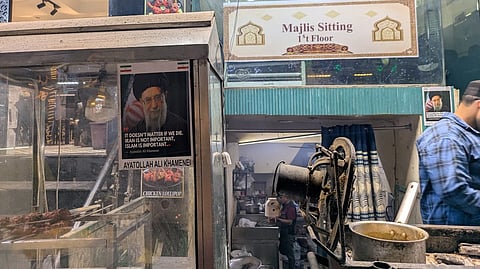
Poster of Khamenei pasted on the front of a restaurant in Shaheen Bagh, Chalees Futa. Saher Hiba
He adds that sectarian conflict itself has often been politically driven. “Shias and Sunnis may have differences in belief, but turning those differences into political violence is exactly what the enemies want. Zionism, America and Israel benefit when Muslims fight among themselves.”
Advertisement
Zaidi says that if Iran had stepped back from supporting Gaza, its economic condition might have been very different, with the possibility that its currency could have been stronger than those of countries such as Kuwait or Saudi Arabia. However, he added that standing firmly against Israel for nearly five decades had been one of Khamenei’s defining positions.
“That is why I believe anyone who stands against oppression, whether they are Hindu, Shia, Sunni or Christian, can see Ayatollah Ali Khamenei as their leader. His position was always against injustice and against those who commit it.” says Zaidi.
Ilyas believes this moment could reshape relations beyond Iran. “My personal view is that Khamenei’s martyrdom will strengthen the resistance within Iran. At the same time, in India, Pakistan and Bangladesh, I believe Sunni-Shia relations will improve further.”
At the same time, he expresses regret over the broader regional response. “In the conflict between Israel and America, the entire Muslim world should have opposed the West. But unfortunately, instead of opposing them, they provided America with bases and space to operate,” he says, referring to US military installations in Arab countries.
Advertisement
Yet Ilyas is not uncritical of Tehran. “Regarding Syria, we have had reservations about Iran’s stance from the beginning,” he adds, noting that these concerns were conveyed to Iranian leadership in the past.

Shopkeepers in Zakir nagar placing the image of the late Supreme leader. Saher Hiba
Debate Over Legacy and Global Politics
Political analyst and writer Zainab Sikander believes the moment has altered the terms of internal Muslim debate. “There is nothing like Sunni-Shia anymore. It is more about an outrageous attack against the Muslim civilisation and the community,” she says. Sikander argues that the current political climate has pushed many to reassess Khamenei’s legacy, noting that he had previously issued religious rulings protecting the Sahabas mentioned in the Qur’an from insults, which, in her view, demonstrated that his leadership was not framed as anti-Sunni.
Addressing the legality of the strike, Sikander questions what she calls double standards in global conduct. “The US cannot act like a global vigilante and assume it can enter any country and kill a leader. Can they do that with Putin? They would never dare,” she says. She argues that if international law were the concern, mechanisms such as the United Nations existed to address grievances rather than unilateral military action.
She also rejects the framing of the conflict as sectarian. “They are not bombing Sunni countries; they are bombing the countries that host American bases. It has nothing to do with religion and everything to do with fighting back politically,” Sikander says, adding that portraying it as a Shia country attacking Sunni nations risks deepening divisions.


Poster of Khamenei pasted in the streets of Jamia nagar. Ainnie Arif
Sikander, however, believes the conflict has taken on a broader moral dimension. “This entire war has turned into a war based on morality. Western imperialism has always tried to teach the East what is right and wrong,” she says, describing the current moment as one in which many Muslims view the confrontation as extending beyond territorial politics.
Iran remains under sustained attack while launching retaliatory strikes of its own, with tensions stretching across parts of the Gulf, including Oman, Qatar and the United Arab Emirates. Yet on Indian streets, the conversation appears to move between geopolitics and identity, between anger at foreign intervention, western oppression and a renewed emphasis on Muslim unity at home.
Published At: