The BJP has renewed its focus on the Krishna Janmabhoomi-Shahi Idgah dispute in Mathura.
The party's Mathura messaging comes amid its political confrontation with Akhilesh Yadav over his proposed visit to the Ram Mandir and attempts to challenge the SP's PDA coalition.
With the Mathura dispute still pending before the courts, the BJP's new slogan has brought the temple issue more prominently into UP's electoral discourse.
'Ayodhya Hui Hamari Hai, Ab Mathura Ki Baari Hai,' Is BJP Preparing A New Hindutva Campaign For UP?
The emergence of the "Radhey Radhey, Kamal Khila De", signalling a possible Krishna-centric campaign for the forthcoming elections

Summary
Decades ago, the Bharatiya Janata Party (BJP) jumped from the fringes of Indian Politics to the mainstream riding on the backs of the Ram Janmabhoomi Movement and the Rath Yatra. A few years later, the movement's protagonist, Lal Krishna Advani, became the country’s Deputy Prime Minister and the BJP became a mainstay in Indian Politics storming to a full majority in 2014.
But, a temple in Ayodhya was only a part of the demands. A slogan popularised among Hindutva supporters after the demolition of the Babri masjid perfectly encapsulated their position, "Ayodhya to jhanki hai, Kashi-Mathura baaki hai."
Now, with the Uttar Pradesh Assembly elections fast approaching, the BJP is renewing their temple pitch, this time it’s about the Krishna Janmabhoomi in Mathura.
"Ayodhya hui hamari hai, ab Mathura ki baari hai," UP Deputy CM Keshav Prasad Maurya said after an internal strategy meeting of the party.
The meeting also saw the emergence of the slogan "Radhey Radhey, Kamal Khila De", signalling a possible Krishna-centric campaign for the forthcoming elections. The renewed emphasis on Mathura comes as the BJP and the Samajwadi Party (SP) are engaged in a political confrontation over Ayodhya and SP chief Akhilesh Yadav's proposed visit to the Ram Mandir. It also brings the Krishna Janmabhoomi dispute into the state's electoral discourse, raising questions about whether the BJP intends to extend the political mobilisation associated with the Ram temple movement to another prominent religious site.
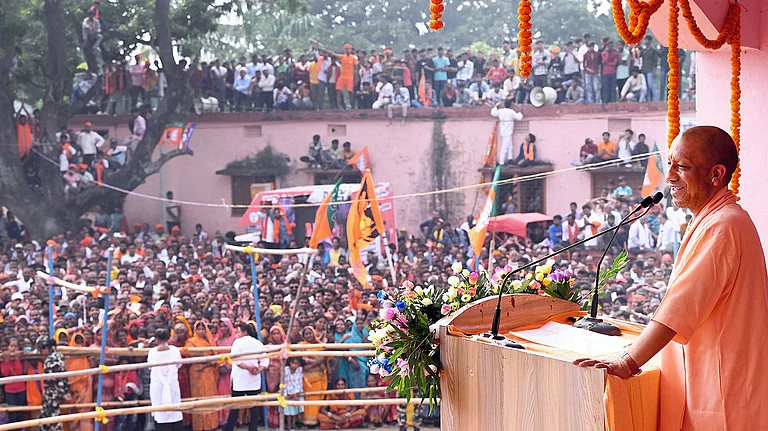
From Ram Mandir To Krishna Janmabhoomi
The Krishna Janmabhoomi-Shahi Idgah dispute concerns a 13.37-acre religious complex in Mathura, where the Shahi Idgah mosque stands adjacent to the Krishna Janmasthan temple. Hindu petitioners have sought the removal of the mosque, claiming that it stands on land associated with Lord Krishna's birthplace. They have also challenged a 1968 agreement between the temple management and the mosque trust that allowed the two places of worship to coexist.
The dispute has been the subject of multiple civil suits and proceedings before the Allahabad High Court. Unlike Ayodhya, where the Supreme Court delivered its final verdict in 2019, the Mathura dispute remains unresolved. The legal proceedings have therefore provided a continuing political reference point for organisations seeking a grand Krishna temple at the site.
The BJP's renewed emphasis on the issue became particularly apparent during its Mathura strategy meeting. Maurya invited Akhilesh Yadav to join the proposed kar seva for a grand Krishna temple, saying that the construction could be pursued through judicial proceedings or mutual discussions.
Advertisement
The political timing is significant. The BJP and SP have recently been sparring over Akhilesh's proposed December 12 visit to the Ram Mandir. The SP chief had announced his intention to visit the temple after its consecration in January 2024. The BJP, however, has invoked the 1990 police firing on kar sevaks during the tenure of Mulayam Singh Yadav, Akhilesh's father, and demanded an apology from the SP leadership.
The SP has countered by raising allegations of irregularities involving donations to the Ram temple. Akhilesh has also indicated that his proposed religious visits would include Vrindavan and a temple project in Etawah.
The BJP's Mathura pitch also fits into its broader attempt to challenge the SP's PDA (Pichhda, Dalit, Alpsankhyak) social coalition. The party has been seeking to consolidate Hindu voters across caste groups, while the SP has attempted to build a broader coalition of backward castes, Dalits and minorities.
Advertisement
The Yadav community's association with Lord Krishna adds another dimension to the confrontation. Traditionally regarded as descendants of Krishna, Yadavs form an important part of the SP's support base. By inviting Akhilesh to join the Mathura temple campaign, the BJP is seeking to connect the religious issue with the SP chief's community identity, and put him in a difficult position.
The BJP's strategy is also directed towards western Uttar Pradesh, where Mathura is located.The party won 111 of the 121 seats in the region, a tally the party would be eager to repeat. The renewed Krishna Janmabhoomi emphasis could help the party reinforce its religious messaging in the Braj region while attempting to bring different Hindu caste groups under a shared cultural identity.
Can Mathura Become The BJP's Next Ayodhya?
The BJP's renewed Mathura campaign draws on a political strategy that has been central to its growth over several decades: combining religious symbolism with electoral mobilisation. The Ram Janmabhoomi movement helped the party establish a wider political identity around Hindutva, culminating in the construction and consecration of the Ram temple in Ayodhya in January 2024.
Advertisement
The party also created a brand around NaMo, a word usually assosciated with Lord Shiva, to identify with Prime Minister Modi, going so far as to contesting an election from Varanasi, a city with a deep connection to Lord Shiva.
The party's emerging slogan, "Radhey Radhey, Kamal Khila De", suggests another similar attempt to translate the religious symbolism of the Braj region into a broader electoral message. Hindustan Times reported that a senior BJP leader indicated the slogan could be carried beyond the organisational meeting and become part of the party's public campaign ahead of the 2027 elections.
The BJP's focus on Mathura also comes at a time when Akhilesh Yadav is attempting to engage more directly with religious symbolism. His proposed visits to Ayodhya and Vrindavan, alongside the inauguration of the Kedareshwar temple in Etawah, indicate an effort to prevent the BJP from monopolising the religious narrative.
Whether the Mathura campaign develops into a sustained statewide movement remains to be seen. The BJP's strategy meeting, Maurya's remarks and the new slogan indicate that Krishna Janmabhoomi is being brought more prominently into its political messaging.
Advertisement
For now, the BJP appears to be combining its established Hindutva narrative with organisational mobilisation, welfare outreach and attacks on the SP's political record. Mathura's emergence as a campaign centre suggests that the party is looking beyond the completed Ram temple project in Ayodhya to keep religious identity central to the 2027 Uttar Pradesh election discourse.
Published At: