Akhilesh Yadav turns Yogi Adityanath’s 80:20 formula against the BJP-led NDA, suggesting it may contest only 80 seats in the 2027 UP Assembly elections.
Yadav questions Adityanath’s claim that 1.27 crore Hindu voters listed on panchayat rolls are missing from the Election Commission’s electoral rolls.
Adityanath also claims Muslim voter numbers rose by 1.65 per cent after the SIR, while 55 lakh welfare beneficiaries and 4.5 lakh young voters were missing from the rolls.
UP Elections 2027: Akhilesh Yadav Turns Yogi’s ‘80:20’ Formula Into BJP’s Problem
The SP chief suggests the BJP-led NDA may be left contesting just 80 seats in Uttar Pradesh and questions Adityanath’s claims about Hindu voters missing from electoral rolls.

Summary
Samajwadi Party (SP) chief Akhilesh Yadav on Tuesday used Uttar Pradesh Chief Minister Yogi Adityanath’s ‘80:20’ formulation to take a swipe at the BJP-led NDA, suggesting that the ruling alliance would be able to contest only 80 seats in the state. He also questioned Adityanath’s claim that 1.27 crore Hindu voters were absent from the Election Commission’s rolls despite being listed on panchayat electoral rolls.
Yadav’s remarks came in response to a television interview in which Adityanath claimed that 1.27 crore Hindu voters whose names appeared on Uttar Pradesh’s panchayat electoral rolls were missing from the Election Commission’s rolls. He also claimed that the number of Muslim voters had increased by 1.65 per cent after the SIR. Sharing a clip of the interview on X, the SP chief challenged the chief minister to repost an earlier statement from his official social media account if he genuinely believed that 1.27 crore votes had been deleted.
"Only the wearer best knows when the shoe pinches," Yadav wrote, suggesting that Adityanath was now experiencing the concerns that the opposition had repeatedly raised over the voter revision exercise.
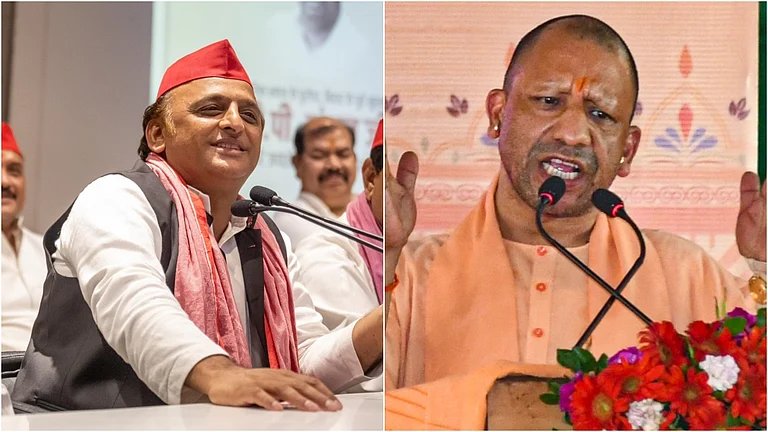

Taking another swipe at the chief minister, Yadav said, "What is the difference between you and us now, neither in the complaints nor in the sorrows that you and we share."
According to PTI, Adityanath had also claimed during the interview that around 55 lakh Hindu beneficiaries of government welfare schemes and 4.5 lakh voters in the 18-19 age group were among those whose names were missing from the electoral rolls.
Akhilesh Yadav turns '80:20' remark against BJP-led NDA
In a separate post on X earlier on Tuesday, Yadav responded to Adityanath's ‘80:20’ formulation for the upcoming Assembly elections. Turning the chief minister's formulation against the BJP, Yadav said the BJP-led alliance would be able to contest at most 80 seats, while the PDA (Pichhda, Dalit, Alpsankhyak) would prove to be “20” against the NDA.
Advertisement
Adityanath had described the 2027 Assembly election as an ‘80:20’ contest, arguing that 80 per cent of voters supported nationalism, cultural nationalism, good governance, security and prosperity, and would back the BJP and NDA. The remaining 20 per cent, he said, would support those opposed to these issues.
The ‘80:20’ formulation also featured prominently in the run-up to the 2022 Uttar Pradesh Assembly elections, when Adityanath's remarks were widely interpreted as referring to the state's Hindu-majority and Muslim-minority population. He had maintained that he was referring to political support rather than religion, PTI reported.


SIR controversy in Uttar Pradesh
The voter revision exercise has remained a point of contention between the SP and the BJP. Yadav has repeatedly questioned the conduct of the SIR, alleging irregularities in the inclusion and deletion of names from electoral rolls. The SP has also raised objections through party delegations and representations to election authorities.
Advertisement
The Election Commission published the final electoral rolls following the SIR on April 10, 2026. Separately, Uttar Pradesh Chief Electoral Officer Navdeep Rinwa said the voter lists of panchayats and urban local bodies would be compared with Assembly rolls to identify eligible people who had not registered as Assembly voters. He also said he would address queries concerning the voter revision exercise on November 17, after publication of the draft electoral roll under the Special Summary Revision (SSR).
However, a discrepancy between the two sets of electoral rolls does not, by itself, establish that all voters missing from the Assembly rolls are eligible electors who were wrongly excluded. The religion-wise figures cited by Adityanath have also not been independently established by the overall change in the electorate.
The next Uttar Pradesh Assembly elections are due in 2027, although the Election Commission has not announced the schedule. The BJP-led NDA has been in power in the state since 2017, with the SP widely regarded as its principal political challenger, PTI reported.
Advertisement
Published At: