In the everyday life of India’s metropolitan service economy, the Northeastern body occupies a peculiar position: constantly visible, routinely interacted with and yet, persistently misread. One encounters it at hotel reception desks, airline counters, cafés, malls and salons with such frequency that its presence appears almost structural to urban modernity. Politeness, efficiency and service professionalism are readily associated with it. Yet the same individuals who sustain the front-facing civility of metropolitan life often encounter intrusive questions, casual suspicion, food-based mockery and racial slurs once they step outside these regulated commercial spaces. The dissonance is neither accidental nor episodic. It reflects a deeper social pattern in which economic visibility coexists with fragile recognition.
Service Economy, Caste Memory And The Racialisation Of Northeastern Bodies In Urban India
The labour of Northeastern workers is indispensable to urban service infrastructures, yet their identity remains subject to everyday interrogation. This dissonance reflects a deeper social pattern in which economic visibility coexists with fragile recognition.

Duncan McDuie-Ra’s ethnographic work, Northeast Migrants in Delhi: Race, Refuge and Retail (2012), provides one of the most grounded accounts of how this pattern takes shape in practice. His field research in malls and retail environments demonstrates that migrants from the Northeast are disproportionately concentrated in customer-facing sectors such as hospitality, retail and service work. Employers frequently describe them as adaptable, presentable and well-suited for front-facing roles. Such language circulates as professional praise, yet it quietly performs another function: it sorts labour through perception. Hiring becomes shaped by how a worker’s appearance, accent and comportment align with the aesthetic expectations of a globalised service environment. The worker is not only evaluated for competence, but for how their presence is read by customers.
Over time, this sorting produces occupational familiarity. Repeated visibility in hospitality, aviation, retail and salon work gradually stabilises into a social association between Northeastern identity and service labour. What begins as a labour market pattern slowly enters everyday common sense. The Northeastern worker is recognised, but within a narrow occupational imagination. Recognition, in this sense, is conditional upon role.
Dolly Kikon’s scholarship on Northeastern migration helps illuminate the social life of this conditional recognition. Her work shows that migrants from the region often experience economic incorporation alongside persistent social marking in mainland cities. Their labour becomes indispensable to urban service infrastructures, yet their identity remains subject to everyday interrogation. Questions about origin, nationality and belonging appear in ordinary settings, housing arrangements, workplace conversations, neighbourhood interactions and public transport encounters. These interactions rarely register as dramatic incidents. Their sociological weight lies in their repetition. Over time, they cultivate a quiet awareness of being present, yet not fully legible within the social imagination of the city.
The texture of these experiences is documented in the Bezbaruah Committee Report (2014), which records recurring accounts of Northeastern individuals being stereotyped as service workers regardless of profession, mocked for their food practices in shared living spaces and treated as foreigners in public interactions. These are not always moments of overt hostility. They are everyday micro-encounters that accumulate into a climate of conditional belonging. Their normalcy, rather than their intensity, makes them structurally significant.
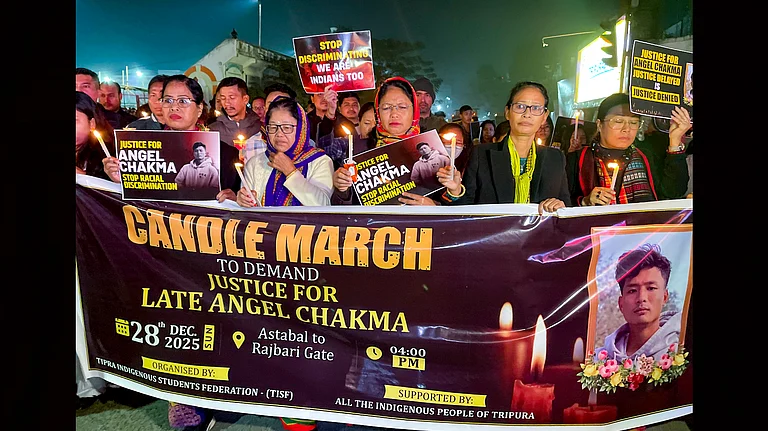
When instances of racial abuse become publicly visible, the language deployed often follows a recognisable pattern. Remarks invoke profession, food, lifestyle and belonging in quick succession. The insult does more than mark ethnic difference. It implicitly assigns a place within an imagined hierarchy of social worth. The target is racialised, but also ranked.
Gopal Guru’s reflections on dignity and humiliation offer a useful entry point into understanding this ranking. Guru has argued that Indian social life has long attached moral value to labour and embodied difference, producing hierarchies of dignity that operate even in informal interactions. When Northeastern individuals are casually presumed to belong to specific service occupations and then demeaned through that association, the insult does not emerge in an ideological vacuum. It draws upon a historically sedimented habit of linking occupation with social worth. The vocabulary appears contemporary; the evaluative impulse is older.
At this juncture, the role of caste memory becomes analytically relevant, even when caste itself is not explicitly invoked. Suraj Yengde’s writings on caste as an enduring structure of social cognition suggest that caste persists not only as an institutional arrangement, but as a classificatory instinct embedded in everyday perception. It informs how bodies, professions, and lifestyles are intuitively read and ranked. Northeastern migrants often arrive in social environments where such classificatory instincts remain active, yet their identities do not fit within established caste hierarchies. They are neither easily placed within dominant social grids nor culturally familiar to the mainstream imagination. In such contexts, racialisation becomes a convenient mode of differentiation. The language shifts to race, but the instinct to rank remains shaped by older hierarchies of dignity, purity, and social worth.
Food-based ridicule reveals this layering with particular clarity. The Bezbaruah Committee documented repeated instances in which Northeastern individuals faced derision for their dietary practices in hostels, workplaces and rented accommodations. In the Indian sociocultural context, food has historically functioned as a marker of discipline, purity and respectability, themes deeply embedded in caste-shaped cultural norms. When unfamiliar cuisines become objects of mockery, the reaction expresses more than cultural distance. It reflects a moral evaluation shaped by inherited hierarchies of acceptable consumption. The insult appears racial in tone, yet its structure resonates with a longer cultural history of regulating difference through notions of refinement and social propriety.
Sanjib Baruah’s formulation of the Northeast as an “internal frontier” situates these everyday perceptions within the broader national imagination. In India Against Itself: Assam and the Politics of Nationality (1999) and In the Name of the Nation (2020), Baruah notes that the region has been politically integrated into the Indian state while remaining imaginatively peripheral in national consciousness. Migration to metropolitan centres collapses geographic distance without necessarily dissolving this imaginative boundary. Northeastern migrants participate in the economic life of the nation as workers, students and professionals, yet they are frequently perceived through a lens of cultural distance that marks them as socially external within internal space.
Within the service economy, this imaginative distance acquires a specific emotional dimension. Customer-facing roles demand sustained composure, politeness and emotional discipline in interactions that may range from courteous to intrusive. Northeastern workers often navigate comments about their appearance, accent or identity within professional settings where institutional norms prioritise customer satisfaction. The response, more often than confrontation, is restraint. Over time, this produces a form of silent accommodation, in which professionalism absorbs the emotional cost of everyday misrecognition.
Gendered experience further complicates this landscape. Documentation referenced by the Bezbaruah Committee and subsequent advocacy reports indicates that Northeastern women in metropolitan cities frequently encounter hypersexualisation, moral scrutiny and intrusive assumptions about lifestyle. Their visibility in public-facing occupations intersects with racialised stereotypes, producing a gaze that is at once ethnic, gendered and moralising. The vulnerability here is not episodic but patterned, shaped by how visibility, mobility and difference are interpreted in urban social spaces.
Urban India’s self-representation as cosmopolitan often obscures these layered hierarchies. Cities project diversity through consumption spaces, global brands and multicultural aesthetics. The Northeastern presence in malls, hotels and airlines becomes part of this visual cosmopolitanism. Yet, paradoxically, consumption-driven familiarity does not translate into social literacy.

Historical representation contributes to the durability of this paradox. Colonial ethnographic narratives frequently racialised hill communities of the Northeast as culturally distinct from the plains. Postcolonial educational and media representations have only partially disrupted these inherited perceptions. Migration produces physical proximity, yet cultural understanding remains uneven. Misrecognition becomes routine, expressed through casual inquiries about nationality, origin and identity that signal an underlying uncertainty about who fully belongs within the national social imagination.
The language of racial hostility directed at Northeastern individuals must therefore be read as part of a broader moral economy of perception. It is shaped by labour segmentation, historical unfamiliarity, and hierarchies of dignity embedded in social cognition. When insults invoke profession, food, or lifestyle, they draw from an inherited repertoire of ranking differences.
India’s expanding service economy depends increasingly on internal migration, including labour mobility from the Northeast. This dependence creates a structural tension between economic incorporation and social recognition, pointing toward a deeper question about the relationship between the state’s formal framework of citizenship and society’s lived grammar of belonging. Politically, Northeastern migrants are citizens with equal constitutional status. Socially, their presence is often filtered through perceptions shaped by distance, unfamiliarity, and inherited hierarchies of recognition. The gap between legal belonging and social legibility becomes particularly visible in urban service economies where interaction is frequent, but understanding remains shallow.
What emerges is a subtle hierarchy of citizenship consciousness: formal inclusion at the level of the state, conditional recognition at the level of society. When a group becomes essential to the service economy yet remains socially misread in everyday life, inclusion risks being practised as labour incorporation rather than as equal belonging. The question that follows is not merely about discrimination, but about how the nation recognises difference within itself. Until this disjuncture between economic reliance and social recognition is confronted, the visibility of Northeastern bodies in India’s service economy will continue to coexist with a fragile, conditional, and hierarchically mediated place within the lived imagination of the republic.