For nearly a decade, the Bharatiya Janata Party (BJP) appeared to have solved Uttar Pradesh’s (UP) caste puzzle. By stitching together non-Yadav Other Backward Classes (OBCs), non-Jatav Dalits, upper castes and Hindutva mobilisation into a formidable electoral coalition, the party transformed India’s most crucial state into its political fortress. But the 2024 Lok Sabha elections exposed the first visible cracks in that social alliance.
Representation vs Reservation in UP Politics: BJP, SP and the New Backward Caste Battle Before 2027
Uttar Pradesh may be entering a second-generation Mandal moment

With the 2027 Assembly elections approaching, a new political battle is unfolding in UP over backward caste representation, reservation, welfare and identity. At stake is whether Samajwadi Party (SP) chief Akhilesh Yadav’s PDA (Pichchda, Dalit, Alpsankhyak) coalition can sustain the successful parliamentary experiment through the coming state Assembly polls, or whether the BJP can once again redraw the state’s caste equations before the next big electoral test.
Last week, UP Chief Minister Yogi Adityanath’s government approved the constitution of a dedicated OBC commission to conduct the “triple test” survey for local body quotas, directly countering the SP’s PDA narrative. The commission, headed by retired Justice Ram Avatar Singh, will determine reservation for rural local bodies. The move is politically significant for the ruling party because it is crucial to the BJP’s plans to woo the backward caste groups ahead of the 2027 Assembly elections. Village pradhans and panchayat representatives remain deeply embedded in UP’s electoral machinery. They shape local caste alignments, influence voter mobilisation and often form the backbone of booth-level campaign organisation.
Hours after the announcement, Yadav launched a sharp attack on the BJP government, aiming to counter the BJP’s strategy to woo back its OBC votes. He accused the BJP government of orchestrating an “aarakhshan ki loot”, a systematic “loot of reservation” by denying backward communities their constitutionally mandated share in government jobs and representation.
This confrontation captures the shape of the political battle currently unfolding in UP.
Reasons for the BJP’s Anxiety
The SP-led INDIA alliance won 43 of the state’s 80 Lok Sabha seats in the 2024 general elections, reducing the BJP-led NDA to 36 and puncturing the aura of invincibility the saffron party had built in the state over the past decade. For the Opposition, the results validated Yadav’s PDA strategy, which sought to consolidate backward castes, Dalits and minorities into a broad anti-BJP social coalition. More significantly, the results suggested that sections of the non-Yadav OBCs and the non-Jatav Dalits, communities the BJP had successfully cultivated since 2014, were no longer voting as cohesively for the party.
Advertisement
“The urgency behind this recalibration stems from the BJP’s unexpectedly weak performance in UP during the 2024 parliamentary elections,” says Sharat Pradhan, co-writer of Yogi Adityanath: Religion, Politics and Power: The Untold Story. He notes that the BJP has been worried about the gradual movement of backward and Dalit votes toward the Opposition since at least the 2022 Assembly elections.
According to the CSDS-Lok Niti post poll survey of 2024 India alliance got 56 per cent of the non-Jatav votes. The BJP which had won 48 per cent of the non-Jatav votes in 2019 got 29 per cent in 2024. Similarly, the India alliance got 25 per cent of the Jatav votes, 34 per cent of other OBC groups, 34 per cent of Kurmi-Koeri votes, 82 per cent of Yadav votes and 16 per cent of the upper-caste votes. The NDA got 24 per cent of Jatav votes, 59 per cent of other OBC groups, 61 per cent of the Kurmi-Koeri votes, 15 per cent of the Yadav votes and 79 per cent of the upper-caste votes. Number of reserved seats BJP won came down from 15 in 2019 to just eight in 2024, for the SP, the seats went up from zero to seven.
Advertisement
The shift was visible electorally too. The BJP’s tally in reserved constituencies dropped sharply, while the SP registered major gains among Scheduled Caste seats and among non-Yadav backward caste voters. The SP tally went up from five to 37, the Congress from one to six. More than 86 per cent of the SP’s winning candidates are SC, OBC and Muslim candidates. Of the 20 OBC SP MPs, only five are from the Yadav community.

Icons: Photos of B.R. Ambedkar at a protest at Jantar Mantar in Delhi | Photo: Vikram Sharma
Mandal 2.0
The BJP, meanwhile, has accelerated its own backward caste recalibration. Earlier this month, Adityanath expanded his cabinet by inducting ministers from several non-Yadav OBC and non-Jatav Dalit communities, a move widely interpreted as an attempt to consolidate caste groups that drifted away from the party during the 2024 Lok Sabha elections.
Pradhan, a Lucknow-based political analyst, says that choices made in the reshuffle reveal the anxiety driving that preparation.
Of the six ministers inducted into the Adityanath government, five belong to backward or Dalit communities. Three are from OBC groups, Bhupendra Chaudhary from the Jat community, Kailash Rajput from the Lodhs and Hansraj Vishwakarma from the Lohar caste. Two others, Krishna Paswan and Surendra Singh Daler, represent non-Jatav Dalit communities, particularly the Pasi and Valmiki groups.
Advertisement
Pradhan says that “the exercise of the cabinet reshuffle ultimately reveals a deeper recognition within the BJP that Yogi Adityanath’s personal popularity may no longer be sufficient, on its own, to neutralise caste arithmetic in UP.”
Several political analysts think that together, these moves point to a larger political reality: UP may be entering a second-generation Mandal moment.
“Unlike the Mandal politics of the 1990s, which revolved around implementing reservations and empowering backward caste elites, the emerging battle is centred on competing claims over representation, welfare delivery, state resources, dignity and symbolic recognition among non-dominant OBC caste blocs,” says Lucknow-based political analyst Asad Rizvi.
Senior SP leader Sudhir Panwar argues that the party is now trying to convert the PDA formulation from an election slogan into a durable social alliance by reaching out to smaller caste-based parties which have district-level clout in order to consolidate marginal vote blocs that can decide tightly contested seats.
Advertisement
Among the organisations the SP is said to be in touch with are Apni Jeevan Apna Dal, Rashtra Uday Party, Bharatiya Manav Samaj Party, Mahan Dal Pichhda Dalit Vikas Mahasangh, Gandhian People’s Party, Rashtriya Bhagidari Party and Ati Pichhda Samaj Mahasabha.
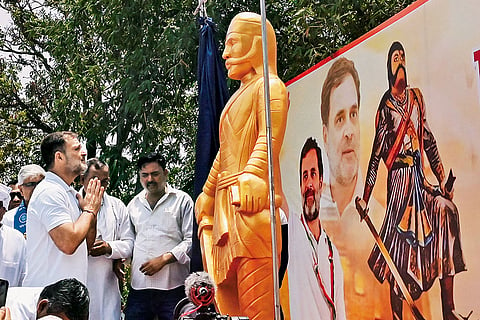
Leader of Opposition Rahul Gandhi unveils a statue of Dalit freedom fighter Mahabali Veera Pasi in Lodhwari, UP | Photo: PTI
The BJP’s Counter
The BJP, however, believes that reports of the collapse of its backward caste coalition are premature. BJP spokesperson Rakesh Tripathi points to the BJP’s performance in subsequent by-elections in UP, where the party won eight out of ten seats, including the politically symbolic Milkipur assembly constituency in Ayodhya.
Since coming to power in UP in 2017, the BJP’s dominance has rested not only on Hindutva mobilisation or Narendra Modi’s popularity, but also on a sophisticated model of micro social engineering that cultivated smaller caste clusters. “The BJP consistently built leadership among communities like the Rajbhars, Nishads, Kurmis, Lodhs and the non-Jatav Dalits,” says Rizvi.
But the BJP’s political model extends beyond caste representation. Over the past decade, the party has also attempted to construct what many analysts describe as a cross-caste “beneficiary class” through an expansive welfare architecture built around free ration distribution, housing schemes, Ayushman Bharat health insurance, Ujjwala LPG connections and direct benefit transfers.
Many experts point that the Adityanath government has increasingly begun framing this welfare delivery in explicitly backward caste terms, highlighting the participation of OBCs, Dalits and economically weaker communities in government schemes, and alleging denial of these schemes to Dalits and non-Yadav OBCs during the SP regime.
The BJP has also continued investing heavily in symbolic incorporation of backward caste icons into a broader Hindu political narrative. Over the past several years, the party has celebrated figures such as Nishad Raj and Maharaja Bijli Pasi, while simultaneously expanding alliances with smaller caste-based organisations representing non-Yadav OBC groups like Suheldev Samaj Party and Apna Dal.
For the BJP, this serves two purposes: it weakens the Opposition’s monopoly over social-justice politics while also embedding caste aspirations within a wider Hindutva framework.
Rizvi says this synthesis of welfare delivery, symbolic recognition and Hindu consolidation remains the BJP’s biggest structural advantage over the Opposition. “The BJP is offering the backward caste groups political representation and also an opportunity to be Sanskritised and be a part of the Hindu fold with the promise of respect and honour. So the INDIA alliance leaders need to come up with a narrative which can counter that,” he adds.
SP’s Inhibition and Inflexibility
Questions remain over whether the PDA coalition can survive the transition from a parliamentary election to an Assembly contest. Several INDIA alliance leaders privately acknowledge that while backward-caste voters may support a broader anti-BJP alliance in a national election, sustaining that coalition behind a Yadav-led regional party in a state election presents a more complicated challenge, especially if they are being asked to support a Yadav-led government, given the history of oppression and atrocities by the Yadavs against Dalits and other OBCs.
Rizvi says one cannot underestimate the behemoth that the election machinery of the BJP is, and if the SP does not sincerely reach out to the non-Yadav OBCs, and continuously work on the ground mobilising them against the BJP, the SP risks overestimating the durability of the PDA coalition.
Political analyst Ram Dutt Tripathi says, “The RSS and a dozen of its affiliates are going door-to-door. The chief minister himself is quite active. The SP has no connect with society at large. The party is no match for the BJP’s ideologically driven election machinery.”
He notes that there is anger against the state government among people because of issues related to farmers, students, law and order, but the Opposition is not raising these. For instance, he recounts, CM Adityanath is seen as patronising and promoting only a particular caste (read Thakurs) because of which BJP workers do not feel empowered and part of the government, but the Opposition is not able to mobilise society against the state government. According to him, the SP has declared upper castes its enemy so the secular section of it, which is not happy with the BJP, feels disconnected with the SP.
Mohammad Ali is an award-winning journalist, based in Delhi. He is senior associate editor with Outlook
Published At: