PM Modi constituted a six-member high-powered task force on examination reforms on July 26.
The Nilekani panel is the second exam-reform committee in two years. The K. Radhakrishnan committee, constituted after the 2024 NEET leak, produced 101 recommendations.
The presence of former IB director Tapan Deka signals that the government now treats the organised paper leak network as an intelligence and organised crime problem.
Nandan Nilekani, Ex-ISRO Chief, Former IB Director: Why This Is Not A Conventional Exam Reform Panel
PM Modi announced a six-member high-powered task force on July 26, 2026, chaired by Nandan Nilekani, that includes a former ISRO chairman and a former Intelligence Bureau director alongside education administrators. The combination is deliberate — and tells you what the government now believes the exam crisis actually is.

Summary
On July 25, 2026, Education Minister Dharmendra Pradhan resigned — the most senior political casualty of the Cockroach Janta Party protests that had gripped Jantar Mantar for seven weeks. The next morning, Prime Minister Modi announced its successor action: a six-member high-powered task force on examination reforms, chaired by Nandan Nilekani, to make recommendations that would future-proof the NTA.
The panel's composition immediately drew attention — not for who was on it from the education sector, but for who was on it from everywhere else.
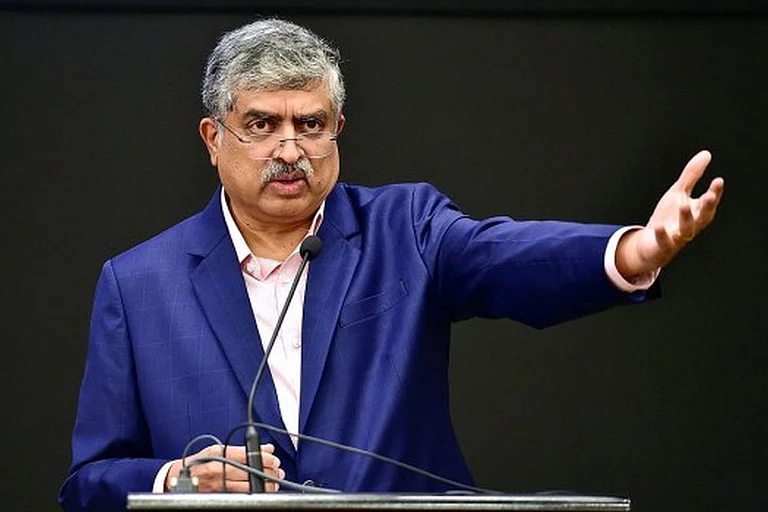
What Does Nandan Nilekani Bring To The Panel?
Nilekani has previously delivered one of the most ambitious national technology projects in democratic history. Aadhaar, the biometric identification system that enrolled more than a billion Indians, was conceived during the Manmohan Singh government, and Nilekani was the founding chairman of the Unique Identification Authority of India (UIDAI) from 2009 to 2014.
His relevance to the exam crisis is structural. The NTA's failure is partly a technology failure — question papers are stored, transmitted, and handled through systems with insufficient encryption, insufficient access controls, and insufficient audit trails. Nilekani brings both the technical fluency to diagnose those failures and the government credibility to push reforms past institutional resistance.
He also brings something rarer: bipartisan acceptability. He has served under Congress and is being appointed by BJP. That crossparty legitimacy matters when the recommendations will need to withstand political scrutiny from an opposition already asking hard questions.
Why Has A Former ISRO Chief Been Included?
S. Somanath served as ISRO chairman from January 2022 to January 2025, leading the agency through its most celebrated recent period — including the Chandrayaan-3 mission that made India the first country to land near the lunar south pole in August 2023. He joined Skyroot Aerospace as an honorary technical adviser in 2026 before this appointment.
Advertisement
His inclusion in an exam reform panel is not as anomalous as it appears. ISRO conducts and manages technically complex operations requiring precise security protocols, system integrity, data confidentiality, and organisational discipline.
The question of how to design a system in which question papers can be stored, distributed, and administered to millions of candidates across thousands of centres without being compromised is, at its core, an operational security problem. Somanath brings expertise in exactly that domain.
Why Does India's Examination Crisis Now Have An Intelligence Angle?
Former Intelligence Bureau director Tapan Deka served as IB chief from 2021 to 2024. His inclusion is the panel's most politically and institutionally significant appointment — and the one that most clearly reveals what the government now understands the exam leak problem to be.
Paper leaks in India are not the work of opportunistic individual cheaters. They are organised criminal operations with institutional enablers. The NEET-UG 2026 leak involved networks operating across multiple states, with question papers moving through exam centres, printing facilities, and state-level exam administration in ways that required coordination and advance knowledge.
Advertisement
Multiple arrests have been made, but the organised network behind the leaks has not been dismantled. Deka's expertise in counterintelligence, source-network mapping, and organised crime infrastructure is the skill set needed to recommend what surveillance, infiltration, and enforcement architecture could actually disrupt these networks — as opposed to merely prosecuting individual couriers after each leak.
The Logistics Problem Behind Conducting Exams For Millions
Amrit Lal Meena, the panel's logistics expert and a senior IAS officer, addresses a dimension of the exam crisis that technology alone cannot solve: the physical supply chain of examination materials. NEET-UG is taken by approximately two million students across more than 4,000 centres in hundreds of cities. Each centre receives sealed question papers that must arrive undamaged, uncompromised, and on time. The logistics of that distribution is where many actual leaks occur. Though the NEET examination from next year will switch to the Computer Based Test (CBT) model, logistical expertise remains important.
Advertisement
Meena's role is to recommend whether that logistics chain can be redesigned with the same rigour applied to high-security material distribution — pharmaceutical cold chains, election material transport, currency movement — and what institutional changes at the NTA are needed to make distribution integrity a core operational competency rather than an administrative afterthought.
What Can Education Administrators Contribute?
Anita Karwal has served as education secretary before her retirement, which means she has seen from the inside how ministries interact with autonomous bodies like the NTA, where the lines of accountability sit, and where reform proposals tend to get lost in implementation.
IIT Madras director V. Kamakoti contributes technical computer science expertise specifically relevant to questions of how examination software, question-paper encryption, and digital delivery systems can be designed to be both secure and scalable. IIT Madras has been involved in national digital infrastructure projects and brings an academic-technical perspective on what is technically feasible within India's current digital infrastructure.
Advertisement
Why Technology Alone Cannot Fix The Exam System
Congress general secretary Jairam Ramesh made the most pointed political observation about the new panel on July 26: the previous K. Radhakrishnan committee had produced 101 recommendations after the 2024 NEET leak, the Centre had told the Supreme Court it would implement all of them, and yet most remained unimplemented when the 2026 leak occurred. The new panel is being constituted to address a crisis that the previous panel's recommendations, had they been implemented, might have prevented.
Published At: