The Mumbai metropolitan region is being remade at a pace unseen in decades. Elevated metro corridors now cut across suburban neighbourhoods, the Coastal Road has reshaped the city’s western edge and the Atal Setu has drawn Navi Mumbai closer to the island city. Further north, along Palghar’s Arabian Sea coastline, the foundations of the mammoth Rs 76,220-crore Vadhvan Port are taking shape even as the Mumbai-Ahmedabad bullet train project pushes its tunnels through the Western Ghats.
Maharashtra’s Double-Engine Government: Big-Ticket Infrastructure, Vadhvan Port And The Battle For Central Support
As metro corridors rise and bullet train tunnels bore through hardy landscape, the Mahayuti alliance is asking whether the Centre is keeping pace with the state’s infrastructure ambitions.

This burst of infrastructure appears to have become central to Maharashtra’s political messaging. For the ruling Mahayuti alliance of the Bharatiya Janata Party (BJP), Eknath Shinde’s Shiv Sena and the late Ajit Pawar’s Nationalist Congress Party (NCP), each project milestone is presented as evidence of a state moving ahead, and at speed. Yet behind the public celebration, a quieter conversation is unfolding across Mantralaya, party offices and New Delhi’s corridors of power: whether central support is keeping pace with Maharashtra’s economic ambitions.
Infrastructure Canvas
The centrepiece of Maharashtra’s infrastructure ambitions is the Rs 76,220-crore Vadhvan Port near Dahanu in Palghar, around 140 kilometres north of Mumbai.
Being developed as an all-weather greenfield deep-draft major port, Vadhvan has a natural depth of 20 metres, making it suitable for large container and bulk vessels. The project is being executed through a special purpose vehicle, jointly formed by the Jawaharlal Nehru Port Authority (JNPA) and the Maharashtra Maritime Board. Scheduled for completion by 2034, it is projected to rank among the world’s ten largest ports.
Alongside it, the Mumbai-Ahmedabad High-Speed Rail project, popularly known as the Bullet Train project, is crossing significant construction milestones. In February 2026, Railways Minister Ashwini Vaishnaw announced the breakthrough of the project’s second mountain tunnel in Palghar, a 454-metre stretch designed to accommodate both up and down tracks. He added that high-speed rail operations are expected to reach Thane by 2028, with the corridor extending to Mumbai by 2029.
For the BJP leadership in Maharashtra, these are not merely engineering milestones but political achievements to be showcased.
For now, the double engine is running. The question Maharashtra’s leaders are asking is whether both engines are firing at equal power.
Parag Alavani, BJP MLA from Vile Parle and among the party’s more vocal Mumbai leaders, is emphatic about the significance of what is underway. “There has been a lot of development happening in Mumbai and its periphery. The Coastal Road, several metro lines, the ongoing Mumbai-Ahmedabad Bullet Train project and much more. There are plans to build a ‘fourth’ Mumbai near the upcoming Vadhvan Port in Palghar district. The central government has been developing Mumbai and its surrounding region in close partnership with the state government. The PM Surya Ghar Yojana has also been successful in the state,” he says.
Advertisement
Alavani’s reference to a fourth Mumbai aligns with the state government’s own articulation of the Vadhvan-Palghar region’s potential.
Chief Minister Devendra Fadnavis has said the region will host India’s largest port and a new international airport, for which Prime Minister Narendra Modi has already given the green signal. He has also indicated that plans are underway to extend both the bullet train corridor and the Coastal Road further north into the region.
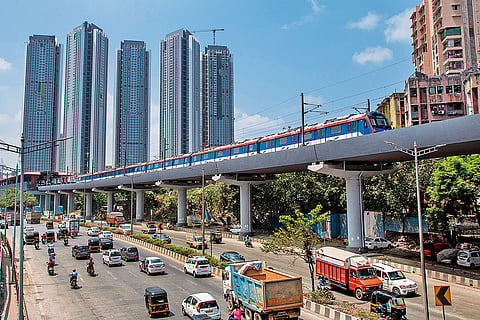
The Peak Time: A metro passes by while vehicles move on the Western Express Highway in Mumbai | Photo: Shutterstock
The Double-Engine Compact
The BJP and its Mahayuti partners have consistently framed Maharashtra’s development through the prism of what they describe as a double-engine government—the idea that political alignment between the State and Centre enables faster project clearances, greater fiscal support and smoother administrative coordination. Modi himself invoked this framework during the 2024 Maharashtra election campaign, presenting new airports, expressways and rail projects as outcomes of this political alignment.
Speaking at the Confederation of Indian Industry (CII) Annual Business Summit 2026, Fadnavis described Maharashtra as a $660-billion economy, contributing nearly 15 per cent to the national gross domestic product (GDP), while outlining a roadmap to transform it into a $1- trillion economy by 2030. He noted that Maharashtra accounted for 49 per cent of the country’s big-ticket infrastructure projects in 2020, a trajectory he said has continued and added that his government had identified 100 reforms to improve ease of doing business, of which 25 have already been implemented.
Advertisement
That confidence was also reflected in January 2025, when Maharashtra signed investment agreements worth Rs 6.25 lakh crore on the opening day of the World Economic Forum in Davos, setting a new single-day record for investment commitments. During the summit, Fadnavis met executives from Tata group, Carlsberg, LuLu Group International, ReNew Power, Schneider Electric, Mastercard and Cognizant, among others.
The renewable energy dimension of this Centre-state compact is equally significant. The PM Surya Ghar: Muft Bijli Yojana, a centrally approved rooftop solar scheme for households, has been cited by BJP leaders as an example of co-operative federalism in practice. Maharashtra has emerged among the better-performing states under the scheme, which aims to provide rooftop solar power to one crore households in the poor and middle-income categories.
Launched in 2024, the scheme has already benefited 1.25 lakh households in the state. According to data available on Maharashtra’s Energy Department website, subsidies worth Rs 800 crore have been transferred to beneficiary consumers so far.
Advertisement
The Unresolved Questions
Yet beneath the visible partnership lies a thicker layer of political anxiety, one that Mahayuti leaders are careful to voice in measured tones, but which nonetheless shapes their private lobbying in New Delhi.
The most persistent grievance concerns projects that critics allege were diverted to Gujarat. The opposition has repeatedly flagged projects that moved out of Maharashtra, including the Tata-Airbus C-295 aircraft manufacturing plant, originally proposed for Nagpur but eventually inaugurated in Vadodara and the Vedanta-Foxconn semiconductor project that was initially planned for Talegaon in Pune district.
Congress general secretary Jairam Ramesh has accused the Mahayuti government of surrendering Maharashtra’s interests, while also pointing to the establishment of the country’s only International Financial Services Centre at Gujarat International Finance Tec-City (GIFT City) as evidence of skewed central priorities.
The ruling alliance has pushed back strongly against these allegations, but the political wound has refused to close entirely. When the Vedanta-Foxconn and Tata-Airbus projects shifted to Gujarat, then chief minister Eknath Shinde publicly said that Modi and Union Home Minister Amit Shah had personally assured him that other major projects were being planned for Maharashtra. The episode exposed the uncomfortable reality that even within a double-engine arrangement, state governments must actively lobby New Delhi for their share, and do not always win.
Advertisement
This dynamic has only intensified as Maharashtra gears up to fulfil its trillion-dollar economy ambitions. Mahayuti leaders have been quietly but persistently pushing for quicker central clearances for key projects, larger allocations under the National Infrastructure Pipeline, stronger incentives for renewable energy investment and a resolution to delayed central disbursements for education and skill development schemes. In private conversations, state leaders have also voiced concerns that funds under centrally sponsored schemes have not moved with the consistency suggested by the alliance’s public messaging.
The late Ajit Pawar, while presenting the Maharashtra Budget for 2025–26, had acknowledged the fiscal balancing act before the state. He said Maharashtra had succeeded in keeping its fiscal deficit below three per cent of gross state domestic income and that the budget had been framed around the vision of ‘Viksit Bharat-Viksit Maharashtra’. The formulation was politically telling, binding the state’s economic aspirations to the Centre’s national development narrative and signalling Maharashtra’s expectation that this alignment should translate into proportionate central support.
Competitive Federalism
Fadnavis has spoken openly about what he sees as Maharashtra’s edge in competitive federalism. He has identified “trust” as the state’s biggest differentiator, arguing that investors look not just at incentives but at a government’s ability to honour them. He has noted that Maharashtra has never defaulted on incentives, has cleared all 2025 commitments and is now processing first-quarter incentives for 2026.
But competitive federalism cuts both ways. The same framework that allows Maharashtra to pitch itself to global investors also places it in implicit competition with Gujarat, Telangana, Tamil Nadu and other states for central government attention, project allocations and investment facilitation. Maharashtra’s leaders are aware that the BJP’s national political strategy sometimes prioritises states where elections are imminent or where political consolidation remains fragile and that Maharashtra, having delivered a thumping Mahayuti victory in 2024 and a subsequent sweep of civic polls in early 2026, may paradoxically find itself taken somewhat for granted.
The proposed fourth Mumbai near Vadhvan Port, the extension of the Bullet Train Corridor and the Dedicated Freight Corridor connecting the port to the national hinterland all require not just state willpower but also sustained and timely central funding, regulatory clearances and land acquisition support.
Railways Minister Vaishnaw has highlighted that the East-West Dedicated Freight Corridor will connect Vadhvan Port to the hinterlands of Madhya Pradesh and Chhattisgarh, a connectivity dividend that could transform northern Maharashtra’s economic geography. But the devil lies in execution timelines.
The Road Ahead
The relationship between Mahayuti government and New Delhi remains, for now, one of outward solidarity and private negotiation. But the larger political question—whether Maharashtra’s loyalty to the BJP-led national alliance will be rewarded with commensurate central support for its economic ambitions—is becoming harder to defer. As Vadhvan Port takes shape on the Palghar coast, as bullet train tunnels break through Maharashtra’s mountains and as the blueprint for a fourth Mumbai takes form on planners’ desks, the state’s political class is watching closely to see whether New Delhi’s commitments translate into rupees and clearances on the ground or remain grand promises awaiting full momentum.
For now, the double engine is running. The question Maharashtra’s leaders are asking, with growing urgency, is whether both engines are firing at equal power.
Jinit Parmar is a senior correspondent, Outlook India. He is based in Mumbai.
Published At: