Several college messes find LPG cylinders harder to procure, forcing kitchens to simplify meals and drop fried or high-heat dishes from daily menus.
Student-dependent eateries around campuses have shrunk menu items, raised prices or temporarily shut operations as cylinder costs soar.
While the government denies any shortage, students and leaders like Supriya Sule claim commercial LPG supply disruptions are already affecting campuses and local businesses.
LPG Shortage Hits Pune’s College Kitchens, India's Students Hub Feels The Pinch
From Pakoda Curry without the pakoda and Dahi Vada with just the curd, the LPG crisis has taken a toll on student life as the eateries face the risk of shutting down

Summary
The deepening LPG shortage crisis that has engulfed every kitchen of India has begun to dig its claws into student life in Pune. Several college kitchens across the nation and eateries that are dependent on student clientele have crumbled under the steep prices of cylinders and have been forced to alter their menus and, in some cases, even close shop.
Pune, known as the ‘Oxford’ of the East, has long been one of India’s biggest education hubs. As per 2016 estimates, the city hosts over two lakh students from outside its geographical boundaries, a number that has only grown in the past decade. This large student population has created an entire ecosystem around colleges, extending to cafés and food services on and off campus. Now, the ripples of the crisis in West Asia are being felt even in Pune’s student neighbourhoods.
With the government denying the shortage, students and college administration have had to fend for themselves in the LPG crisis.

Downsized Menus
A student from the Symbiosis Institute of Management Studies says that the reality of the crisis is being witnessed on campus.
The management student adds that as a measure to combat cylinder scarcity, the college has downsized the daily menu of the on-campus kitchen.
He explains, “We are opting for more rice options such as biryani and pulao. We have started using pressure cookers more, and stopped any fried food in the mess or the canteen. The phulkas that we cook should not be put directly on the burners. Additionally, “the canteen is only allowed to serve food that can be made on induction heaters.”
Harshvardhan Sain from the Tolani Maritime Institute claimed certain items have been struck off the menu. The shortage has primarily affected the preparation of fried and specialised items, leading to significant alterations in the weekly mess menu”.
Advertisement
From Pakoda Curry with no pakodas, dahi vada with just the dahi, to biryani being replaced by plain rice, and the removal of dosas from the menu entirely, the merchant navy student notes how the mess has had to make compromises.
He adds, “The consistent theme across these changes is the elimination of any dish requiring high-heat oil preparation or complex frying processes, resulting in a significantly more restricted and simplified diet for the student body”.

While some colleges have been able to efficiently adapt to this change, others have not been able to maintain their students' tastes.
A student from SMBT Medical College, Nashik, reports that the downsizing in the menu has been accompanied by reduced quality.
He claims, “It has been noticed that the food they have served has been stale on several occasions, and students have discovered flies and ants dead inside the food. One such incident is enough to label the food inedible.”
Advertisement
Pune’s ongoing heatwave and the strenuous hours of study were already taking a toll on the well-being of students. On top of it, the drop in quality of food is a double whammy. “It would be understandable if the quality of the food they were providing was up to the mark. The least we can expect from the management is satisfactory food, and that doesn’t seem likely. We haven’t been informed when things will go back to normal.”

Challenges for off-campus eateries
Local small eateries around Pune's campuses have been the worst impacted. No longer able to afford cylinders, many businesses have had to lay off employees or even shut down.
Lakshya Purohit, a final year student at MIT Art, Design & Technology University, Pune, noted that a popular South Indian eatery in their college district has recently stopped serving over half of its regular menu. Additionally, the restaurant has temporarily sent home dozens of its waiters.
Advertisement
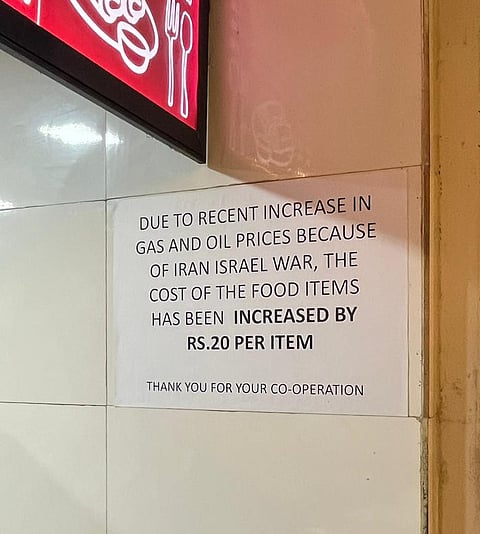
Purohit adds that another eatery near their college campus has put up a poster informing customers of a Rs. 20 hike on all items due to the war in Iran.
Bigger businesses, too, have not been spared from the effects of the LPG shortage.
Pune’s beloved Garden Vada Pav Centre, in Camp area, frequented by college students, schoolchildren and even office workers, has temporarily ceased operations due to an unexpected shortage of cooking gas. It will now only resume services once the gas supply is restored.
Crisis is All Around
Amid the manifestation of the crisis on the ground, the government has stood firm, claiming that there is no shortage in LPG supply to cause panic among the people.
However, the management student claims, “Though the government has mentioned that the LPG supply to colleges will not be hampered, the ground reality is very different. It's difficult to get the same number of cylinders.”
Advertisement
NCP (SP) Baramati MP Supriya Sule has voiced Maharashtra’s concerns, claiming that both the Centre and the Maharashtra Government are trying to hide the LPG shortage and has called for an all-party meeting to address the growing crisis. While interacting with reporters on Monday, Sule said, “I was in Baramati on Saturday and Sunday. I took a review of the availability of LPG cylinders in Baramati. People are struggling to get LPG cylinders.”
Speaking about the IT parks in Pune’s Hinjewadi, Sule noted that a private group in Dhayari that supplies rotis to the companies here had had to cut down their business by 50 per cent due to the LPG crisis.
She adds, “The same situation exists in Baramati. I met several businesspeople in Baramati. They all complained that commercial cylinders are not available in Baramati. Small-scale industries have been hit, and restaurants have shut down,” she added.
Earlier this week, the Revolutionary Workers’ Party of India (RWPI) organised a protest at Dandekar Bridge in Pune against the severe shortage of LPG cylinders and the inflation of gas.
RWPI noted that people are being forced to buy cylinders for up to Rs. 4000 to Rs. 5000, a price that is not affordable to many who are dependent on this service.
Lalita from RWPI addressed that the imperialist attack in Iran has led to the crisis. She further criticised the Modi government for siding with imperialism by not condemning the attack on the country. Another party worker, Jayvardhan, added that the Modi government were caught napping and were “asleep like Kumbhakaran” by the war. By ignoring the warning signs, the administration has led the country to this crisis, he claimed.
With no signs of when the Strait of Hormuz will once again open, India’s LPG crisis continues to impact vulnerable classes and sections of society. With many colleges not informing student bodies of the changes in campus kitchens, much less when normalcy will return, students and eateries dependent on LPG continue to struggle.
Published At:
Tags