Proliferation of CCTV camera and smartphones fuels leopard sightings
Data does not support claims of a sudden or exceptional increase in leopard population
Translocation isn’t an ideal solution to curb human-leopard conflict, as it increases leopard attacks on people in the vicinity of release sites
Enemy Of The State? Leopard Sightings In Maharashtra, Decoded
Without credible monitoring systems, designed specifically to track population trends over time, assertions of a population boom remain speculative.

Summary
At midnight on October 18, an elderly couple was killed in a leopard attack near Kadvi Dam in Maharashtra’s Kolhapur district. On November 2nd, a 13-year-old boy in the Shirur area of Pune district was killed in a similar attack. On December 15, an eight-year-old boy was killed by a leopard in Junnar, marking the third child fatality due to human–leopard conflict in that area within two months. On the same night, a four-year-old boy was found mauled to death by a leopard in Ahilyanagar. Most recently, on 27th December, an eight-month-old infant was found mauled to death in a suspected leopard attack.
These are just a few examples of leopard attacks in Maharashtra.
In Pune, six human deaths were confirmed between April 1 and December 24, according to official data from the Maharashtra Forest Department. This data also shows that 120 leopards have been held in captivity in 2025. Meanwhile, the number of deaths across Maharashtra has yet to be confirmed. Media reports and social media posts are now not only circulating news on the leopard attacks, but also simple sightings of the big cat. Leopards have now become news.
With public panic and misinformation increasing, a perceived ‘spike’ in leopard population has been blamed. “The available data does not support claims of a sudden or exceptional increase in leopard populations in Maharashtra”, clarifies Neha Panchamiya, Founder and President of RESQ Charitable Trust, an NGO that worked with the Maharashtra Forest Department during the capture of the leopard repeatedly sighted at Pune Airport.
Panchamiya says the last credible scientific study on leopard numbers was in 2022. She adds, “From what we know through publicly available scientific and official assessments, the most recent comparable estimate for leopards in Maharashtra comes from the national WII–NTCA exercise of 2022, which places the state’s population at roughly around 2,000 animals".
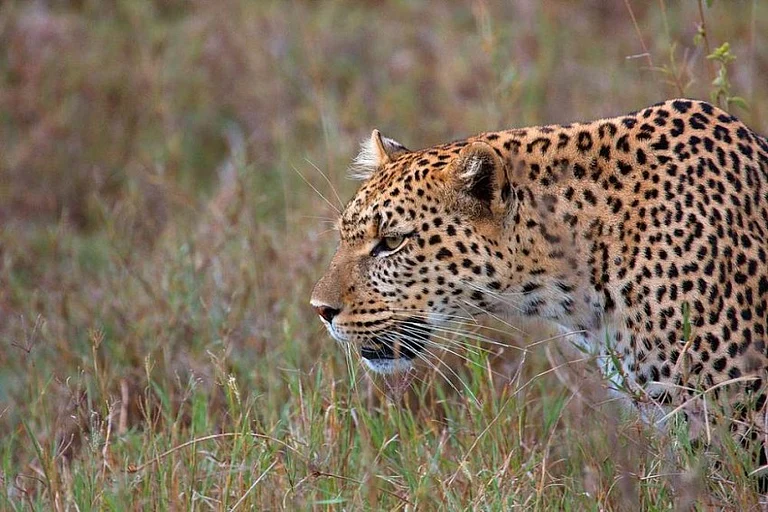
Since then, there has been no publicly released, state-wide census that gives a precise headcount across all landscapes. However, while a spike in leopard population cannot be scientifically accounted for, a sudden spike in posts and reports on leopards can be observed. Spotting of leopards goes viral on the Internet, with the recent sighting of the big cat in a residential colony in Mumbai's Bhayander and the latest sighting in Thane serving as examples of this frenzy.
Advertisement
Panchamiya warns that, despite the gaps in data, public perception is being driven by improved detection via technology, which has heightened visibility.
When Leopard Sightings becomes a Spectacle
Maharashtra has always held a chunk of the leopard population, housing the second-highest number of leopards in the country after Madhya Pradesh.
However, an exact census of the species in Maharashtra is a complex task, especially in non-forest habitats and sugarcane fields. Prashant Khade, deputy conservator of forest of Junnar division, confirmed this, “No agency in the country, as per our records, has ever done a leopard census in sugarcane fields. It is mainly because of the difficulties at various levels.”
Khade’s explanation aligns with Panchamiya’s observations. She adds, “India does have periodic national-level leopard population estimates conducted by the Wildlife Institute of India in collaboration with the National Tiger Conservation Authority, including the most recent 2022 assessment. These exercises provide broad population estimates and distribution patterns at the state scale.
Advertisement
However, they are not designed to function as fine-resolution, year-on-year monitoring tools capable of detecting short-term population increases or sudden spikes, particularly outside protected areas.
”Comparison of year-on-year data is difficult due to differences in the methodologies, spatial coverage, and objectives of these national exercises across assessment cycles", adds Panchamiya.
"As a result, state-level figures from different years are not strictly comparable in a way that would allow one to confidently conclude a real population increase or decrease over time. In that sense, there is no robust baseline that allows us to state that leopard numbers in Maharashtra have increased dramatically or are at a historic peak,” she says.
Outlook spoke to leopard experts from Maharashtra to further investigate the mass reported ‘spike’ in leopard attacks and sightings.
“This is a total chance event,” said Nikit Surve, Leopard researcher and Project Manager with the Wildlife Conservation Society- India. Acknowledging the recent attacks, he says, “There has been a spike in attacks. We can say this because within a short duration, there have been leopard attacks reported in Junnar, Pune, Nashik, Alibaug, Nagpur, Kolhapur and most recently Mumbai.”
Advertisement
Busting popular misconceptions, he adds, “This is a chance event, nothing in particular happened where leopards are behaving in a strange manner and suddenly attacking people. It's a chance event where everything is happening together. Out of the areas, at least Junnar and Nashik have experienced fatal attacks.”
A wildlife biologist who spoke to Outlook debunks this perceived myth, “People keep claiming that the population of leopards and animal sightings have shot up. However, from a scientific perspective, we don’t know that for certain. This is because we don’t have data from the past on leopard populations.”
While the ‘spike’ in leopard sightings and population remains a tricky topic, what can be confirmed is the massive spike in online searches on leopards.
As per Google Trends, Google searches for leopard-related topics have steeply shot up towards November end and peaked on 19th December, the day a leopard was spotted in Maharashtra’s Thane district.
Advertisement
Now this “chance event” has become a spectacle as social media got involved. With easy access to social media, anyone can capture something on their phone and circulate it on the internet. Leopards have become a trending topic on X and Instagram in recent weeks.
Dipti Humraskar, a wildlife biologist and a conservation practitioner with Wildlife Conservation Society-India, says, “Leopards have always been around; they are being noticed more often now because we have CCTV cameras everywhere, smartphones with cameras with almost everyone, and the ease of sharing it publicly through social media and WhatsApp in seconds.”
Panchamiya concurs with Humraskar on the role of technology in sightings. “What has clearly increased, especially in cities like Pune, is detection (sightings) and reporting. In recent years, many leopard “sightings” in Pune have been recorded on CCTV cameras. In the absence of such surveillance, these animals would likely have passed through unnoticed, as they probably did in the past.”
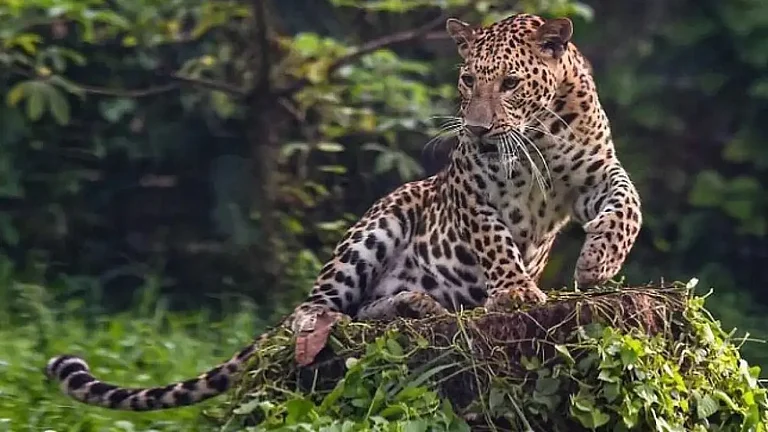
Surve says, “The leopard-related social media feed is building public perception. As a person from this field, I can pick up when these posts are incorrect; however, the general public, through this circulation, can form a perception that can be misinformed.”
The regurgitated and not fact-checked posts on social media have added to public panic and the creation of an incorrect perception of how frequent the sightings are. Social media frenzy is one of the causes for the reported sudden ‘spike’ in leopards.
Politics behind leopard attack optics
With Municipal Elections going on in Maharashtra, the leopard has found its way into the political field. Among the many statements of the state’s ministers, perhaps the most absurd could be by Sharad Sonawane, the MLA from Junnar, who arrived at the Maharashtra legislature to protest against the rising leopard-human conflicts dressed in a full-body leopard costume.
Sonawane called for an emergency, stating, “An emergency should be declared for leopard attacks in the state. I have been raising this issue since 2014, but the government keeps ignoring me.”Weeks before the MLA, it was Chief Minister Devendra Fadnavis who directed that a proposal to declare the increasing problem of leopard attacks on humans in the state as a “state disaster” should be presented in the next cabinet meeting.
Fadnavis also called for the scheduled status of leopards to be decreased from Schedule 1 (highest order of protection) to Schedule 2.
Surve explains, “This is not a drastic shift. However, Schedule 2 status would allow for leopards to be hunted. Currently, the norm for any Scheduled 1 animal cannot just be captured or shot; you would need permission from the state’s Chief Wildlife Warden.”
Among talks of leopard sterilisation and birth control, the Maharashtra government made a proposal in early November to relocate 50 leopards to Vantara in efforts to curb human-leopard conflict.
Maharashtra Forest Minister Ganesh Naik has made the leopard the enemy by not only calling for sterilisation but also calling for the big cat to be “shot on sight”. On 19 November, following leopard-related deaths in the previous month, Naik said, “Shoot the leopard on the spot if it has become a man-eater. We cannot be silent spectators to the hostile environment created due to rampant leopard attacks.” Calling for their capture, he added, “We will install 200 cages immediately and procure 1,000 additional cages to trap the leopard and relocate it to deep forests. Also, we are in touch with Vantara authorities and Forest department representatives of other States, discussing the possibility of transferring leopards.”
Among the other solutions proposed by the forest minister, he suggested that forest department officials should release herds of goats into forests to prevent leopards from wandering into human settlements for food. Experts and conservationists have called this proposal by Naik “unscientific” and “regressive”.
An expert who chose to be anonymous told Outlook that the Municipal Elections are another reason why this debate is still ongoing, with stunts like dressing up as a leopard and making bold statements on the human-leopard conflict being used to increase public traction to a particular political agenda.
Mumbai: Who’s encroaching on whom?
The leopard sighting and rescue from a residential area, the Bhayandar East area in Mumbai, went viral on the internet, with locals being shocked that the big cat entered a densely human populated area.
However, it must be noted that Mumbai borders Sanjay Gandhi National Park, the city with the highest density of not only humans but also leopards. Leopards are highly adaptable cats who wander and hunt at night. They are known to exist in urban areas as well, in search for food, which, according to several studies, is often stray dogs or searching in garbage.
“No wild animal understands these political boundaries made by humans,” Surve responds to encroachment allegations.
He explains, "a human-dominated space is just like a game of Pac-Man for the leopard”. Just like Pac-Man has to go through a maze to find food, so does a leopard in an urban area in search. Leopards will be familiar with these places because they have wandered here at night. Similar to Pac-Man being chased in the video game, the leopard, too, will avoid human encounters and wander into random alleyways. This is how the leopard loses its path and ends up stuck in human-populated areas. Similar to how the Mumbai leopard was found. It is a misconception that leopards ‘stray’ into human areas; this is their normal behaviour.
Humraskar furthers this: “Ask anybody who lives on the periphery of the park, and they will tell you that they have seen leopards ever since they have lived there. Leopard sightings in residential areas in Mumbai along the periphery of the park are not new or unheard of.”
As leopard-human encounters receive more coverage and social media continues to shape public opinion on the topic, locals have started to view the big cat in a different light as compared to the past. Leopards have now become news.

Is translocation the solution?
While the Maharashtra government looks towards capture to relocate the cats into forest areas, past research by veteran leopard ecologist Dr Vidya Athreya has proven that translocation cannot be considered a solution to curb human-leopard conflict, as it increases leopard attacks on people in the vicinity of the release sites.
Experts agree that finding a long-term solution in areas such as Junnar and Nashik is particularly complex. Leopards find these sugarcane fields conducive for them to mate and raise cubs, as these fields are not disturbed until it is time for harvesting. Agricultural records show substantial expansion of sugarcane cultivation in several districts, particularly around Pune, Ahilyanagar, and Nashik, creating a dense cover that leopards readily use within human-dominated landscapes.
Urban expansion, peri-urban sprawl, and infrastructure growth have significantly increased the interface between people and wildlife, creating a shared landscape. Panchamiya says, “Inadequate or improper waste management in developing areas (peri-urban) which attract free-roaming domestic animals (easy prey) is as good as an invitation for leopards to stray in.”
This further contributes to increased visibility and interaction without necessarily indicating a rise in leopard numbers. Without long-term, standardised, state-wide monitoring systems, designed specifically to track population trends over time, assertions of a population boom remain speculative rather than evidence-based, a gap in conservation that Panchamiya agrees must be addressed.
Humraskar remains optimistic that in urban areas like Pune, implementation of a solution is possible and should begin with awareness, crowd management in cases of sightings, and garbage management. Both
Both Surve and Humraskar believe collaboration is the way forward. All stakeholders, from the forest department, conservationists, media and police, often first responders to sightings, must have a say in this venture. This can bring the state a step closer to not making the leopard our enemy.
Published At: