India wants Bangladesh's army to fly Hasina home, reports say.
Dhaka must also guarantee her an appeal and fresh trial.
Sentenced to death in absentia, Hasina has vowed to return in December.
Sheikh Hasina's Ticket Home: India Wants Dhaka To Fly Her Back And Give Her A Fair Trial
After two years of exile and a death sentence in absentia, Delhi is reportedly ready to part with Bangladesh's ex-PM, but conditions apply

Summary
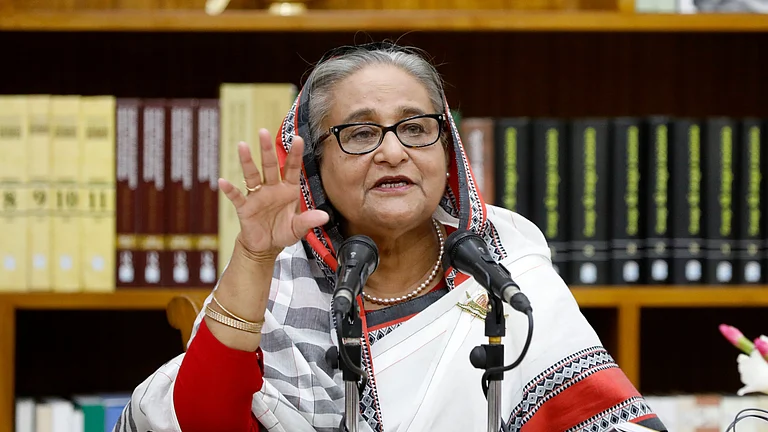
After more than two years in exile in New Delhi, Sheikh Hasina may be heading home, but not on her own terms. India is reportedly looking to send the former Bangladeshi prime minister back to Dhaka, provided the government of Prime Minister Tarique Rahman meets two conditions, according to a BBC Bangla report.
The proposal lands at the most sensitive point in one of the key geopolitical relationship in South Asia. The BBC Bangla report says that India, as the host country, has given hints to Hasina that her return to Bangladesh to face legal procedures might be the best way forward. The report adds that such a communication took place in an usual briefing.
A Military Aircraft, And A Very Public Handover
The first condition is both symbolic and logistical. India wants the Bangladesh army to take responsibility for bringing Hasina back, preferably aboard a military aircraft. This is because on 5 August 2024, she fled the country on a Bangladeshi military plane as a student-led uprising ended her 15-year rule.
The message is hard to miss: the institution that facilitated her departure should be the ones to bring her back.
The Second Condition: A Right To Appeal And A Fresh Trial
Bangladesh must also guarantee Hasina the chance to appeal her death sentence and face a fresh trial over the killings of July 2024.
On 17 November 2025, Dhaka's International Crimes Tribunal sentenced her to death in absentia for crimes against humanity, finding her guilty of incitement, ordering killings and failing to stop atrocities during the crackdown on protesters. Her former home minister, Asaduzzaman Khan Kamal, received the same sentence; a former police chief who turned state witness got five years.
Hasina has called the verdict biased and politically motivated, and Amnesty International has described the trial and sentence as neither fair nor just. A Bangladeshi lawyer told BBC Bangla that she could still file an appeal by explaining to the Supreme Court why she missed the deadline.
Advertisement

Why Delhi Wants Out
The BBC Bangla report says Hasina's continued stay has become an uncomfortable issue for the Indian government, straining ties with Bangladesh and drawing international criticism. India's preferred exit was a third country, but repeated efforts to find one failed.
Dhaka, meanwhile, formally asked India to extradite her under the bilateral treaty within hours of the verdict. India said it had noted the judgment and would engage constructively, without addressing extradition. In August 2026, its foreign ministry said the request was being examined under established procedures. The treaty allows refusal for offences of a political character, which is how Hasina and her supporters describe the case.
The standoff has frozen a diplomatic reset. India invited Rahman to Delhi, both for a bilateral visit and for the BRICS outreach session on 12–13 September, but the trip stalled over Hasina. Behind it sit bigger stakes: the expiring Ganga Water Treaty, energy dependence, and a Bangladesh that has been rebuilding ties with Pakistan and courting Beijing.
Advertisement
Dhaka's Dilemma
Rahman, sworn in as prime minister in February 2026 after a landslide for his BNP, says he wants good relations with India. Before taking office he warned that India would face public resentment in Bangladesh if it kept sheltering an autocrat. His government says Hasina should return through legal procedures, and a lawmaker from the National Citizen Party says she must face the judiciary.
The two conditions complicate that line. A fresh trial would reopen a verdict that interim leader Muhammad Yunus hailed as historic, and some victims' families have demanded she be brought back to face her sentence. An army aircraft would make Bangladesh's military the face of a return that many Bangladeshis want to see as punishment, not repatriation.
"I may Be Arrested The Moment I Arrive"
Hasina says she intends to come back, and has told Reuters she planned to return in December 2026, though she has named no date. She has acknowledged the risks of arrest, prison, even an attempt on her life, pointing out that she also returned in 1981 and 2007 under hostile governments.
Advertisement
She has also accused the Rahman government of persecuting Awami League leaders and workers, and she has said her return depends on a ban on her party being lifted. Some analysts read her vow as a morale-booster for demoralised Awami League activists rather than a travel plan.
What To Watch For
Neither government had publicly confirmed the two conditions. So far, the information that has come out rests on the BBC Bangla account. Three questions will decide what happens next: whether Dhaka accepts a retrial and an army-facilitated return, whether Delhi follows through on extradition, and whether Hasina's December timeline survives in the coming days.
Published At: