India and Pakistan peace activists, academics, feminists and civil society leaders came together in a PIPFPD webinar to highlight the human cost of ongoing conflicts, from West Asia to South Asia, and renew calls for dialogue.
Speakers stressed that war’s deepest costs are borne by ordinary people through grief, displacement, trauma and shrinking democratic freedoms, while warning against rising nationalism and militarised rhetoric.
The discussion reaffirmed peace as an active political practice rooted in justice, democratic survival and people-to-people solidarity, rather than merely the absence of war.
Peace as Resistance: India-Pakistan Forum Warns Against the Human Cost of War
At a time when militarisation is intensifying, public discourse is increasingly soaked in nationalism, and the spectre of conflict looms from West Asia to South Asia, the Pakistan India People’s Forum for Peace and Democracy (PIPFPD) convened a cross-border webinar titled “Counting the Costs of Conflicts — Why Peace Matters”.

Summary
In an evening thick with memory, poetry and warning, voices from India and Pakistan came together across a virtual border to ask a question that feels both urgent and almost radical in this moment: why does peace still matter?
“In these dark times of lies, treacherous diplomacy and absolutely brutal warfare on people, the ability to talk about and sing about the dark times is indeed important,” remarked MJ Vijayan, a prominent Indian peace activist who is also the general secretary of the India chapter of Pakistan India People’s Forum for Peace and Democracy (PIPFPD).
At a time when militarisation is intensifying, public discourse is increasingly steeped in nationalism, and the spectre of conflict looms from West Asia to South Asia, PIPFPD convened a cross-border webinar titled “Counting the Costs of Conflicts — Why Peace Matters”.
But the discussion was never merely academic. It opened with poetry.
The session brought together some of the most recognisable voices in the cross-border peace movement, including, Dr Sayeeda Hameed, co-chair of the India chapter, and Rita Manchanda, founding member and moderator of the webinar.
They were joined by Islamabad-based academic Sabahat Gul Khattak, filmmaker and feminist activist Vani Subramanyam, senior Pakistani human rights defender Tahira Abdullah, and Delhi-based writer and researcher Navsharan Singh.

War as something felt in the body
What emerged through the discussion was a powerful insistence that war cannot be understood only through military strategies or state interests. The costs, several speakers argued, are carried most heavily by ordinary people.
One of more compelling interventions came from Islamabad-based academic Sabahat Gul Khattak, who spoke of war not as an event confined to battlefields, but as something deeply embodied.
“Wars are felt, they are emotionally experienced,” she said. “They are memorialised in each and every cell of our body.”
Khattak described modern warfare as increasingly distant and sanitised, resembling a video game.
“You click a button and you wreck a country, you wreck homes, you wreck lives… but you don’t see the gory blood, the cries, the limbs scattered,” she said.
Advertisement
Her remarks pushed the conversation beyond casualty numbers and destroyed infrastructure to what she called “irreplaceable losses that cannot be measured” — the grief of parents, displaced families, and children growing up amid trauma.
The ongoing war in West Asia has claimed thousands of civilian lives. Israeli airstrikes have killed civilians across Iran, Lebanon, and Gaza. Although a ceasefire agreement was announced, it did not extend to Lebanon, where more than 300 civilians were killed in airstrikes in a single day, even as strikes continued in Gaza.
As diplomatic efforts gather pace, with regional leaders arriving in Islamabad and Pakistan positioning itself as a mediator, uncertainty continues to loom large. The loss of life, widespread displacement, and deepening humanitarian crisis remain unresolved, which is what the webinar wanted you to focus on — the human cost of these never-ending wars.
‘Peace versus the seduction of jingoism’
A recurring theme through the discussion was also how war is no longer confined to battlefields.
Advertisement
Filmmaker and feminist activist Vani Subramanyam spoke about the way conflict bleeds into everyday life; neighbourhoods, classrooms, cinema, and citizenship itself.
She described jingoism as an “almost sexy tool for mobilisation”, warning that nationalism often becomes a powerful distraction from shrinking livelihoods, democratic rights and social justice.
“What peace is,” she said, “really hard, grungy, slow-burn work.” For Subramanyam, peace is not merely the absence of war but the presence of justice, dignity, equality and everyday security.
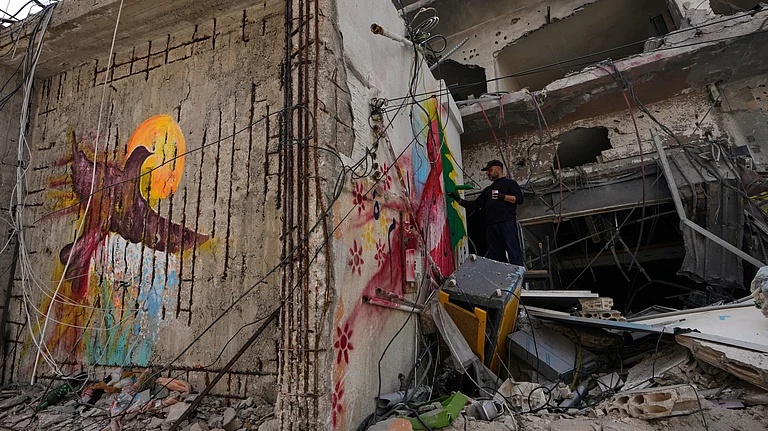
Several speakers warned that militarised rhetoric within both India and Pakistan is increasingly being used to justify curbs on dissent, strengthen authoritarian tendencies and divert resources from welfare.
“We need peace for democratic survival,” said Navsharan Singh, a feminist researcher and writer based in New Delhi, arguing that external conflict often becomes a pretext for internal repression.
Where are the women?
If there was one question that cut sharply through the discussion, it came from veteran Pakistani human rights defender Tahira Abdullah.
Advertisement
“Where are the women?” she asked, referring to global peace tables and conflict negotiations.
Despite two decades of the UN’s women, peace and security framework, Abdullah pointed out that women continue to remain absent from negotiations around conflicts in Palestine, Afghanistan, Iran, Ukraine and South Asia.
Her intervention widened the frame from war to what conflict does to social structures: education, poverty and public life.
In a particularly telling line, she warned that textbooks themselves can become sites of conflict.
“Education is our last hope for building peace between India and Pakistan,” she said, cautioning against “textbooks of hate, not peace.”
A movement older than the moment
For PIPFPD, now over three decades old, the webinar was also about institutional memory.
Speakers repeatedly invoked the founders and earlier conventions of the forum, recalling a time when cross-border people’s movements challenged war hysteria, pushed for visa relaxations, fishermen’s release, cultural exchanges and dialogue on Kashmir.
Advertisement
In one poignant anecdote, Abdullah recalled a child meeting a Pakistani delegate at a previous convention and simply saying: “They are like us.”
That perhaps became the evening’s quiet thesis.
Beneath the noise of states, armies and propaganda, the forum sought to recover the idea that ordinary people on both sides of the border share grief, aspirations and vulnerability.
With around 74 participants joining from both sides of the border, the discussion brought together civil society leaders, students, peace activists and veterans of a movement that has, for more than three decades, challenged war hysteria and state-driven nationalism in South Asia.
In a region where borders have too often been defined by distrust, grief and militarised memory, the evening’s conversation returned to a simple but radical proposition: peace cannot remain a memory of better times; it must be a political practice of the present. As Manchanda puts it, “Peace is not just a way, it is the way.”
Published At: