Bangladesh’s measles outbreak has grown to nearly 1,000 suspected and confirmed deaths, exposing major immunity gaps among children
Vaccine shortages, declining routine coverage and the absence of nationwide catch-up campaigns allowed more children to remain unprotected
The emergency vaccination campaign has reached millions, but sustained routine immunisation will be crucial to prevent another outbreak
Bangladesh’s Measles Outbreak: How Vaccine Shortages And Missed Campaigns Fueled The Crisis
Bangladesh’s deadly measles surge has exposed how vaccine shortages, missed campaigns and weak routine coverage allowed immunity gaps to grow

Summary
Bangladesh’s measles outbreak has reached a new scale, with 166,461 suspected cases, 19,835 confirmed cases and 999 suspected and confirmed deaths recorded till Tuesday, according to the Directorate General of Health Services (DGHS).
The toll includes 899 suspected deaths and 100 confirmed deaths, while 146,359 hospital admissions have been recorded. Yet the scale of the outbreak is not simply a story of rising transmission in 2026. It reflects immunity gaps that had accumulated before the current surge.
Young Children Bear The Brunt
Children have carried most of the burden. The World Health Organization (WHO) found that 91% of reported cases were among children aged one to 14.
By April, 79% of reported cases were among children under five, 66% among those under two and 33% among infants under nine months. Most suspected deaths at that stage were among unvaccinated children under two.
Some children were infected before reaching the vaccination eligibility age of nine months, showing that transmission was reaching infants who were not yet eligible for routine measles vaccination.
A substantial proportion of cases also involved children who were either unvaccinated or had received only one dose of measles-containing vaccine.
Malnutrition has added to the risk, with UNICEF identifying it as a critical factor in severe illness, complications and death among children with measles.
Routine Immunisation Gaps Built Up Before The Outbreak
Bangladesh had previously made substantial progress towards measles elimination. First-dose measles-containing vaccine coverage increased considerably between 2000 and 2016, while second-dose coverage improved after its nationwide introduction in 2012. Confirmed measles incidence subsequently fell sharply.
That progress was followed by recent declines in MR1 and MR2 coverage.
Those declines, combined with routine immunisation gaps and suboptimal population immunity, increased the number of children who remained susceptible to infection and contributed to the outbreak.
The present crisis developed in the context of an immunity gap that had been building over time.
Advertisement
MR Vaccine Shortages Added To The Gap
One of the clearest disruptions occurred in vaccine supply itself.
Bangladesh experienced a nationwide measles-rubella vaccine stockout during 2024–25, contributing to declining MR1 and MR2 coverage. UNICEF’s April assessment separately linked disruptions in routine MR vaccination during 2024 and 2025 to the gradual accumulation of immunity gaps.
The disruption was therefore not only a question of whether families sought vaccination; the routine system itself was facing supply constraints.
The government subsequently allocated about $49.3 million, for emergency vaccine procurement. However, restoring supply after a disruption does not automatically restore the protection that was missed. Those children still have to be identified and reached.

Missed Campaigns Deepened The Immunity Gap
The shortage was compounded by the absence of repeated opportunities to catch up children who had fallen outside the routine programme.
Advertisement
Bangladesh had not conducted regular nationwide supplementary measles-rubella campaigns since 2020. Such campaigns provide an additional opportunity to reach children who have missed routine doses and raise immunity rapidly among vulnerable age groups.
The absence of those campaigns meant there were fewer opportunities to identify and vaccinate children who had slipped through routine immunisation.
Zero-Dose Children Exposed The Scale Of The Problem
A WHO field report from Gopalganj illustrates how those gaps can persist at community level.
During the emergency campaign, health workers identified a mobile and marginalised family whose three-year-old and one-year-old children had never received routine vaccines. A subsequent monitoring visit identified at least 16 eligible children from “floating” families who had missed the campaign.
The case also showed that being unvaccinated did not necessarily mean parents had refused vaccination. Mobility and difficulty accessing routine services had left some children outside the system.
The episode shows how national coverage figures can conceal pockets of children with little or no protection. Where communities are mobile or poorly connected to fixed health services, children can remain outside the system for years.
Advertisement
Hospitals Came Under Pressure
The immunity gap quickly translated into pressure on the health system.
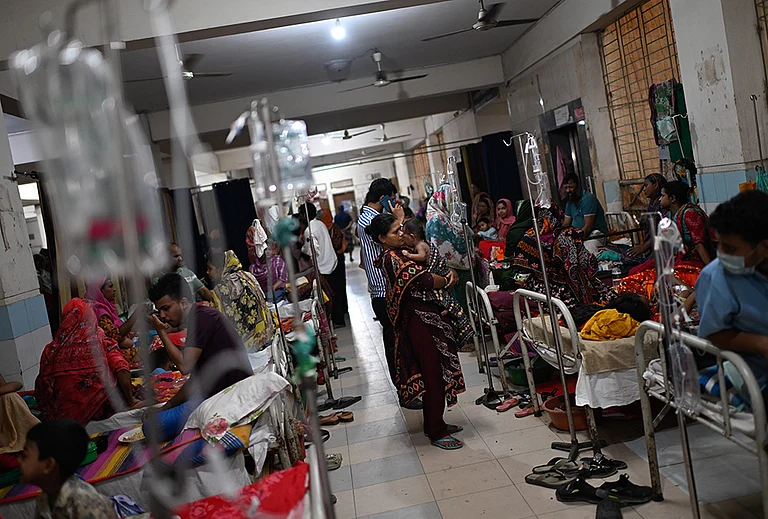
UNICEF reported escalating caseloads, overcrowding and limited isolation capacity during the early phase of the outbreak. At Dhaka’s Infectious Diseases Hospital, more than 90 patients were admitted in a single day, while Kushtia Medical College Hospital recorded 84 paediatric admissions despite having 57 beds.
In Cox’s Bazar, an eight-bed isolation unit was managing 30–40 children at a time. Other facilities also faced staff shortages, limited diagnostic capacity and constrained surge capacity.
By June, UNICEF had supported the distribution of 14,700 units of respiratory, clinical and monitoring equipment across 18 hospitals and deployed a 25-member medical surge team to the Infectious Disease Hospital in Dhaka. It also supported additional paediatric intensive-care and isolation capacity.
Emergency Vaccination Targets Missed Children
Bangladesh began its emergency vaccination response as transmission accelerated.
Advertisement
The campaign was approved in March and began in April comprising 30 upazilas across 18 priority districts. The nationwide campaign commenced on April 20.
The initial phase sought to protect more than 1.2 million children, while the wider response focused on reaching children who had missed routine immunisation, including zero-dose and under-immunised children.
Alongside vaccination, the response involved strengthening surveillance, case management and isolation capacity. Vitamin A supplementation and accelerated vaccine procurement were also part of the wider response.
Campaign Surpasses Its Target
By September, the vaccination effort has expanded considerably.
On Tuesday, DGHS recorded 19,740,254 vaccinations against a national target of 18,015,064, equivalent to 109.6% of the target.
The figure demonstrates the reach of the emergency campaign, but it does not mean the immunity gap has disappeared. Vaccination at this scale is intended to rebuild protection among children who had already been missed, but transmission can continue while existing chains of infection remain active.
UNICEF’s June assessment reported that cases had begun to stabilise following the campaign, while stressing that the outbreak remained active. Continued cases and deaths reflected the accumulated immunity gap and the time required for a large-scale vaccination response to affect transmission.
The Challenge Now Is Routine Protection
The emergency campaign has demonstrated that Bangladesh can mobilise millions of vaccinations quickly. The harder task is ensuring that children do not become vulnerable again once the emergency response ends.
Bangladesh needs to restore and sustain routine immunisation, achieve at least 95% coverage with both measles-containing vaccine doses, strengthen surveillance and maintain adequate vaccine stocks.
Reaching mobile, marginalised and otherwise hard-to-reach communities is also central to preventing new gaps from emerging.
Emergency campaigns can help close accumulated immunity gaps after they emerge. But preventing another outbreak will depend on sustained routine immunisation, reliable vaccine supplies and the ability to reach mobile and marginalised children before those gaps accumulate again.
Published At:
Tags