In neighbourhoods such as Sundar Nagri, Seelampur and Bawana, children are abandoning study sessions because cramped, poorly ventilated homes become unbearable during summer afternoons and nights.
Students report headaches, dizziness, exhaustion and poor concentration, while doctors and teachers say prolonged heat exposure and sleep deprivation are impairing children's cognitive abilities and classroom performance.
While some families can escape the heat through air-conditioning and better housing, poorer households are forced to adapt with makeshift cooling methods, exposing a widening gap in how climate change is shaping children's futures and educational opportunities.
Outlook InDepth | The Heat Gap: Why Children Are Losing Sleep, Focus And Study Time
As temperatures and humidity soar in the capital, children in Delhi's most vulnerable neighbourhoods are struggling to sleep, study and stay healthy, turning extreme heat into an emerging crisis of educational inequality.

Summary
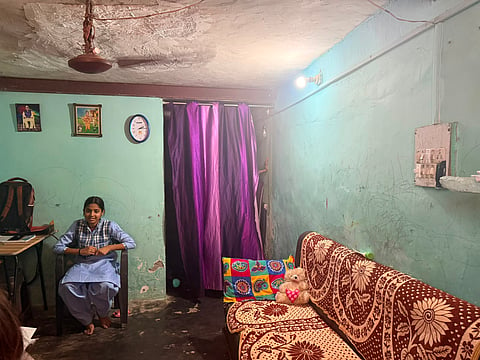
By the time the afternoon sun beats down on Sundar Nagri, 19-year-old Arshi has already abandoned the idea of studying. The single-room house she shares with six family members is too hot to stay in. Sunlight pours in from three sides, turning the cramped space into an oven. There are no windows, only two doors. The kitchen is in the same room. A cooler, repaired after the family somehow scraped together money, offers little relief.
To bring down the temperature, the family pours water on the floor and blocks the drain so it stays longer. Sometimes, they add ice to the water. Mattresses are avoided because they trap heat. Yet, when Arshi sits down with her books, sweat drips from her hands and wets her notebook.
"I have headaches, dizziness, sweat, heat and can not even sit comfortably," she says. "Eventually, I put my books away and tell myself, 'I have studied enough; now let's see what happens.'"
In December, she could study for three to four hours at a stretch. This summer, she manages barely an hour.
As the capital experiences longer and more intense periods of extreme heat, children living in vulnerable neighbourhoods are finding it harder to learn. The heat is not merely making them uncomfortable; it is disrupting sleep, shortening study hours, making classrooms unbearable and leaving children too exhausted to concentrate.
The result is unequal learning conditions during periods of extreme heat, with some children able to study in cooled spaces while others contend with high indoor temperatures. Notably, it extends far beyond Sundar Nagri. Similar conditions exist in large parts of northeast Delhi, in settlements across Bawana and Narela and in densely packed neighbourhoods such as Sangam Vihar and Seelampur, where poor ventilation, overcrowding and patchy access to cooling make homes nearly uninhabitable during peak summer afternoons.
Over the past week, the capital has repeatedly recorded temperatures above 40 degrees Celsius, with Safdarjung, Delhi's base weather station, touching 41.8 degrees Celsius on June 29, while the minimum temperature climbed to 31.1 degrees Celsius, the warmest morning in the city in two years. The delay in the southwest monsoon's arrival kept both daytime and nighttime temperatures unusually high, creating a prolonged spell of hot and humid conditions across the city.
Advertisement
The monsoon, which typically reaches Delhi by the end of June, arrived days later this year after stalling over parts of north India. The delay left residents enduring an uncomfortable combination of heat and humidity, with meteorologists warning that below-normal rainfall and above-normal temperatures could persist across much of the country in July.
The rains did not immediately ease the discomfort. Instead, they were followed by the humid conditions that are common during Delhi's summer months. The India Meteorological Department (IMD) has noted that while recent showers have brought down temperatures, humidity levels have remained high, with morning humidity touching nearly 77% in parts of the city. The result is hot and humid weather that makes it harder for the body to cool itself, causing temperatures to feel higher than they are.
For families living in densely packed neighbourhoods, where homes often lack ventilation and cooling facilities, that humidity lingers indoors long after the rain has stopped.
Advertisement
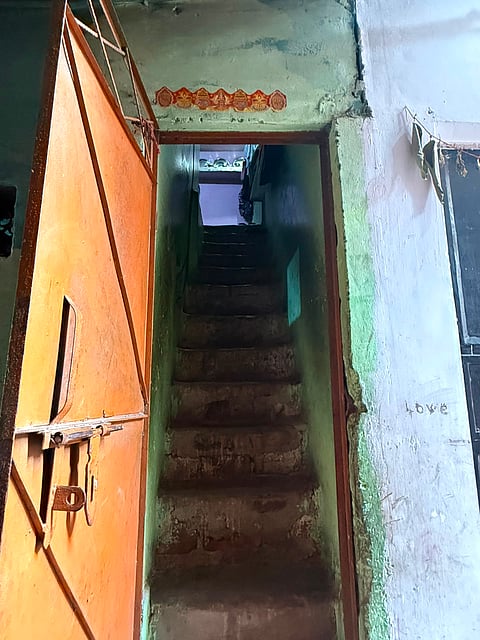
A narrow, dimly lit staircase leads to the cramped home in Sundar Nagri, East Delhi. Mrinalini Dhyani
A Crisis That Is Not Equal
The effects of Delhi's summer are not being felt equally.
For families in air-conditioned apartments, heat often means higher electricity bills and reduced outdoor activity. In neighbourhoods like Sundar Nagri in northeast Delhi, it means homes becoming uninhabitable, disrupted sleep, illness and children losing precious study time. The difference is not simply about temperature. It is about housing, ventilation, electricity, water and money.
Raja Sharma, who just completed his graduation in Political Science from Delhi University this month and sells vegetables to support his family, used to study in a room on the terrace, as the rest of his family lives downstairs. He stayed there from 8 a.m. to 10 a.m. and then returned during the peak hours of 1 p.m. to 4 p.m. On exam days, he would take turns with his brother to look after the vegetable cart
While stacking his books on one side of his kaccha pucca room on his terrace, Sharma says that even with a cooler running, he still feels hot there. He would typically dedicate four to five hours each day to his studies. This summer, it dropped to barely an hour.
Advertisement
"The heat directly affects the mind. I am irritated most of the time," he says. "Sometimes even simple things become difficult to understand." On some of the hottest days in late June, he says he did not study at all.
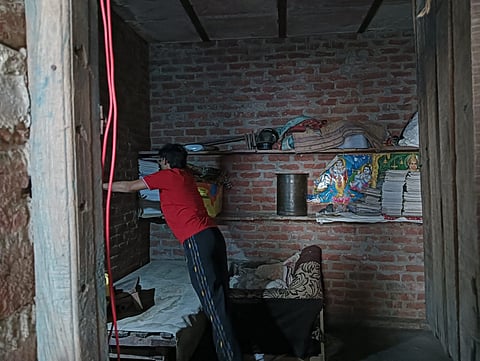
Raja Sharma, a 22- year-old political science student in his room on the terrace Special Arrangement
Many of these kids living in the same neighbourhood developed a geography of survival. They spend entire days at friends' houses that have air conditioners or coolers. Others sit on platforms outside their homes or wander through the neighbourhood because remaining indoors is impossible.
Abhishek, who is 18 years old, hopes to attend college but had to take a gap year because of financial difficulties, spends almost the entire day outside. "We cannot stay inside the house. The floor starts burning," he says. "I only go home to eat and sleep."
He tries to study in the morning, but the sounds of household chores and the heat quickly derail his concentration. "I think about studying, but I can not do it," he says. "I become extremely irritated and agitated"
Advertisement
At night, sleep offers little respite. He wakes up repeatedly to drink water and wets his body several times to cool down. The next morning begins with exhaustion.
The cycle repeats.
A Generation Studying Through Headaches
For schoolchildren, the consequences are already visible. Khushi, a Class 10 student at Sarvodaya Kanya Vidyalaya (SKV), Janta Flats, who is preparing for her board examinations, says she recently failed to solve mathematics problems in class that she had practised many times before.
“I could not focus on anything. It is not like I had not solved these questions before, but I just could not,” she says.
Her classroom has 57 students and only three fans. Sometimes, three or four children sit at one desk. "We are constantly sweating the whole day,” she says.
On her way home from school, she carries a cotton dupatta, as instructed by her teachers and keeps it damp to shield herself from the heat. Draped over her head and almost covering her eyes, it offers only fleeting relief as she shuttles between school and her tuition classes.
The heat also intensifies existing health issues. Khushi says she develops headaches and often becomes irritable, particularly during her periods.
“I am already in pain and because of the sweat, the sanitary napkin sometimes leaves painful rashes, which I have to bear until I come back home from school. It's too much,” she says.
Ayushi, a class 10th student has been experiencing headaches and other health issues due to hot weather making it difficult for her to focus in her studies. Mrinalini Dhyani
Ali, who runs a small tea stall and also sells ice, says his daughter, a Class 3 student, was sent home from school at least three times last month after her nose started bleeding because of the heat. She also had a fever for a few days. “How can you expect children to concentrate on their studies like this?” he says.
For Arshi, the effects have been more pronounced. During one of her university examinations, she became so dizzy that she could no longer write. Her blood pressure had dropped significantly and she had to be taken to the medical room.
"I keep thinking, 'My head hurts. Should I lie down or not?' Then even easy things slip out of my mind," she says.
Extreme heat can significantly affect a child's brain function and learning ability, says Dr Vikas Taneja, Director and Unit Head of Pediatrics and PICU at Max Super Speciality Hospital, Dwarka.
"Even mild dehydration caused by prolonged heat exposure can reduce attention span, slow information processing, impair memory and make it difficult for children to concentrate in classrooms," he tells Outlook.
Children may appear irritable, fatigued and less engaged in learning activities. The impact, he adds, is considerably greater among underprivileged children who often lack access to cool environments, adequate hydration and proper nutrition.
"Protecting children from excessive heat is essential not only for their physical health but also for their cognitive development and academic performance."
Teachers are also witnessing the effects firsthand. An economics teacher at Government Boys Senior Secondary School, Model Town in Delhi, says children have become lethargic and display noticeable “attention deficits".
"You can teach them only for a short time," he says. "After that, they themselves refuse because they stop understanding things after a while." He estimates that roughly 20% of students are absent every day, with attendance fluctuating constantly.
“Every effort is made to ensure proper ventilation for children. But when class sizes are large, some discomfort is inevitable. Schools try their best to maintain a conducive environment in classrooms, but such situations can arise simply because of the number of students,” he says.
He also points out how a child's socio-economic background plays a significant role and that the school environment is only one part of the picture.
“A lot depends on the kind of water children drink and the food they eat. What they have for breakfast and what they bring for lunch can also have an impact on how they cope with the heat,” he says.
A recent global report by UNICEF estimates that around 392 million children in India, roughly 92% of everyone under the age of 18 in the country, are exposed to extreme heat. Of these, about 89 million also face recurring heatwave conditions, showing the growing risks that rising temperatures and increasingly frequent and intense heat events pose to infants and young children.
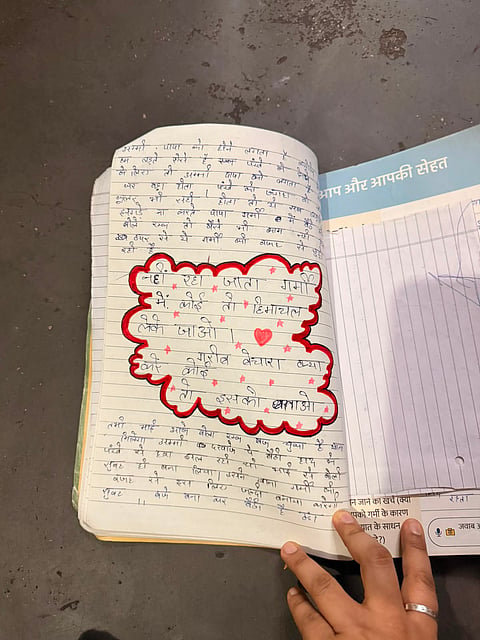
Arshi's entry in the heat register that she has been maintaining with guidance from Greenpeace India. Mrinalini Dhyani
Writing As Evidence
Nasreen, a class 9 student, lives in a single, cramped room in Delhi's Sundar Nagari with her parents, four sisters and a younger brother. She rarely complains to her parents about the heat. Instead, she writes about it.
She writes about how the heat makes it difficult to sleep, how her younger siblings keep avoiding school, saying that "it is hot", and how her elder sister failed class 9 after struggling to focus on her studies while also helping the family with its home-based piece-rate work, assembling toy lights, fitting batteries and tightening nuts. "For every 100 pieces, we get ₹50, and the work is a lot," she says.
In a household where exhaustion often leaves little room for conversation, Nasreen has become an observer. She notices her mother waking up drenched in sweat even while sleeping and watches her siblings grow increasingly irritable as temperatures rise.
All of it goes into the 'Garmi Khata'.
The Greenpeace India Heat Registry is a people-powered, handwritten record documenting the lived realities of extreme heat. Developed primarily across vulnerable neighbourhoods in Delhi, it captures how rising temperatures are affecting everyday life, health, livelihoods and incomes. Residents maintain the registry themselves, physically mapping their communities to identify heat hotspots and cooler zones. The exercise also reveals how extreme heat is deepening the hardships faced by informal workers, from daily wage labourers to home-based workers, while making already difficult living conditions even more unbearable.
At night, Nasreen says, there are nine people in the family. Her father and younger brother sleep on the roof, while the rest stay inside the room. Her mother and one younger sister sleep directly under the fan, and everyone else spreads bedding on the floor.
Nasreen says she sleeps in the narrow space between a machine and the wall, where the fan's air never reaches. On most nights, she remains awake until 2.30 or even 3 a.m., repeatedly stepping out to the balcony because "at least there is some cool air there". However, the relief is temporary. Whenever she begins to feel sleepy and returns to the room, "I can not sleep because of the heat," she says.
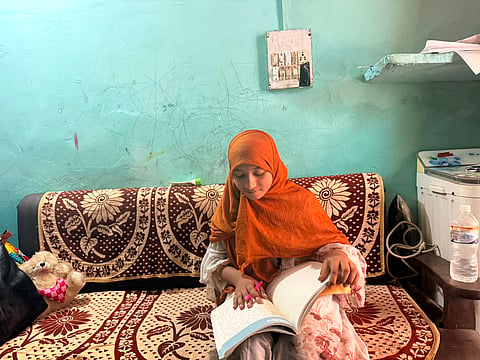
Nasreen, a class 9th Student who maintains the heat register for her whole family. Mrinalini Dhyani
Deepali, a campaigner with Greenpeace India who works in neighbourhoods across northeast Delhi, says that the educational outcomes in places like Sundar Nagari remain modest, with pass percentages usually hovering between 60 and 70%.
"When children cannot sleep, cannot remain inside their homes and cannot concentrate, it changes how they learn and what futures become possible," she says.
Families, she adds, are increasingly investing in coolers and refrigerators, often purchasing them in installments, hoping for relief from the heat. Yet, in poorly ventilated homes, these appliances offer little respite.
Climate and disaster management experts are pushing to declare heatwaves a national disaster in India to unlock full funding for state response funds. Currently, extreme heat is not classified as a "Notified Disaster" under the Disaster Management Act of 2005, which severely restricts how much financial assistance states can access for relief and mitigation.
The Delhi Health Minister Pankaj Kumar Singh, in an interview with Outlook India, said that there is no long-term plan for a heatstroke since a heatstroke patient needs instant relief.
Singh said that there is no long-term plan for a heatstroke since a heatstroke patient needs instant relief. “Instant relief can not be a long-term thing. If you were affected this year, it is not guaranteed you will [be affected] next year too.”
He added, “There is no long-term plan as such. What matters is that the patient gets immediate relief. Whether it is through cooling measures, hydration or emergency medical support, the focus is on stabilising the patient quickly.”
"The government sees heat as a seasonal illness, but it is no longer seasonal. It is a climate issue and completely violates people's human rights," Deepali says.
Meanwhile, as Delhi's summers become hotter and more humid, children in its most vulnerable neighbourhoods are paying the price. For many, extreme heat is no longer just a seasonal hardship but a growing barrier to learning, sleep and opportunity.
Published At: