According to estimates, Dalits make up around 20 per cent of Tamil Nadu’s population. Yet in several districts, caste prejudice thrives.
This persistence of caste consciousness, many argue, reveals the paradox within the Dravidian movement itself.
Anti-Brahminism of the Dravidian movement brought power to new groups, but it could not end caste as such. Annihilation of caste is a collective social activity that requires everyone’s participation, including Brahmins.
The Big Blind Spot: How Caste Still Shapes Tamil Nadu's Society
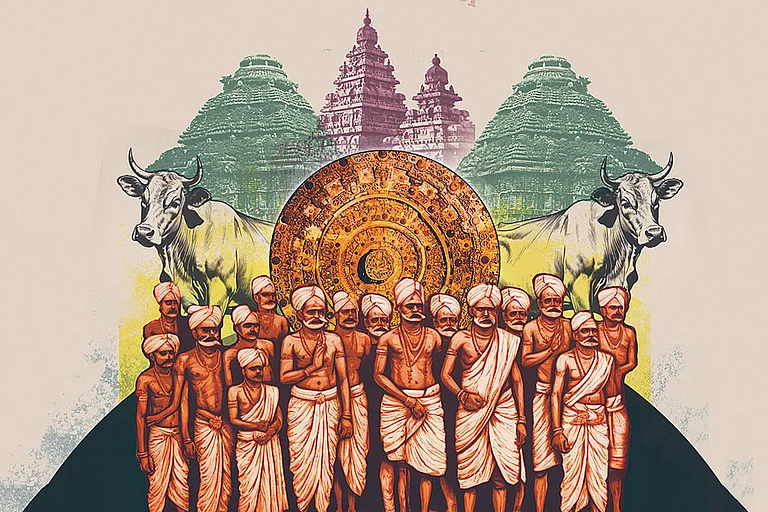
Although the state of Tamil Nadu has been long rooted in the politics of self-respect, caste boundaries still shape social relations

Indifference tinged with helplessness was writ large on Adi Laxmi’s face as she recounted her life story. A tailor by profession, she lives with her partner and two children in a cramped, single-room house on the outskirts of Thenpalanchi village.
“Last week, when my son, who studies in Class IX, walked through the temple street wearing sandals, some of the backward-caste youths mocked him. They don’t beat us anymore for such things; that’s the only change I’ve seen in recent times,” she says. Her words carry the weight of resignation rather than anger. The boundaries of caste, though blurred in official narratives, still shape her everyday life.

She lives in a dilapidated Dalit colony near Madurai, comprising 32 run-down homes isolated from the main settlement. “We don’t usually mingle with them,” says Muthu, another colony resident. “Whenever someone dies in their family, we are called to wash the body. Things have changed a little, but we are still not fully accepted among them.” The hesitation in his voice shows how caste boundaries still shape social relations in a state long rooted in self-respect politics.

Chinnakannu | Photo: Subash Sagar
The experiences of Adi Laxmi, Muthu and many other Dalits raise a stark question about the Dravidian movement. Did its anti-Brahmin push for equality also help intermediate castes entrench their own dominance, leaving Dalit aspirations blocked? Despite decades of reform, caste violence persists in Tamil Nadu. Brutal murders in the name of caste honour continue, leading the state to set up a panel headed by retired judge KN Basha to draft a law against such crimes.
Our visits to several remote villages show that caste identity still shapes everyday life in many places, resisting the egalitarian aims of successive Dravidian governments.
Chinnakannu, a revenue inspector in Dindigul and a member of the Arunthathiyar community, once believed education could lift his family beyond caste prejudice. With one son holding a postgraduate degree in statistics and the other an engineering graduate, he believed the family had earned stability through hard work.

Advertisement
Tragedy struck when love crossed caste boundaries. Shivgurunathan fell in love with a nurse from the Maravar community, categorised among the Backward Castes. “We had no objection to their relationship. My child only wanted to live with the person he loved,” Chinnakannu recalled.

The killing of Karuppammal’s daughter was an alleged case of honour killing | Photo: Subash Sagar
One day, the girl’s father invited Shivgurunathan to their Tirunelveli home. “He sounded happy but later I came to know that the girl’s father and his relatives took him to a nearby Aiyya temple and strangled him to death,” alleges Chinnakannu.
The girl’s parents later surrendered. The trial is over, and the family awaits judgement. The state granted Rs 8.25 lakh compensation and offered a government job to Shivgurunathan’s brother.
Another alleged instance of honour killing relates to Selvam and his wife, Karuppammal. Their elder daughter, Remya, completed a nursing diploma and took a job at a private nursing home, where she met Satheesh, an ambulance driver. Though her Parayar family are Dalits and he belongs to the Kallar community, they married despite opposition and began living separately. According to Selvam, Satheesh allegedly started abusing Remya, taunting her for belonging to a “lower caste”. Remya attempted suicide and was hospitalised. After recovering, she moved back to her parents’ home.
Advertisement
It was then that she discovered she was pregnant. When Satheesh learnt of this, he came to Selvam’s house and persuaded Remya to return with him. “We believed he was happy about becoming a father,” Selvam recalled. He alleged that his daughter was assaulted and killed because she refused to terminate the pregnancy. “He called us saying Remya was unwell. When we reached there, she had already been taken to the hospital. There was a pool of blood in the room. The neighbours told us she had been brutally attacked and murdered,” claims Selvam.

Muthu, who lives in a Dalit colony near Madurai, in front of his dilapidated house | Photo: Subash Sagar
“In Chinnakannu’s case, it was caste that overshadowed every other social marker,” says Kathir, an anti-caste activist who runs Evidence, an organisation that helps victims of caste-based atrocities and their families seek justice. “The perpetrators believed that preserving caste purity was more important than their own freedom. That is why they killed his son and then went straight to the police station to surrender. In Remya’s case, it was the same obsession. Satheesh’s family could not bear the thought of their lineage being ‘polluted’ by a child from a lower caste,” he alleges.
Advertisement
According to estimates, Dalits make up around 20 per cent of Tamil Nadu’s population. Yet in several districts, caste prejudice thrives. Data compiled by Evidence shows that between 2017 and 2021, at least 24 people were murdered in the name of “caste honour”. The Tamil Nadu government provides compensation of about Rs 8 lakh and offers a government job to the next of kin of Dalit victims killed in such crimes.

That these grotesque killings persist even as the Self-Respect Movement marks its centenary is a tragic irony. The political parties that trace their roots to that movement, which once vowed to dismantle caste hierarchies, now preside over a state still haunted by killings committed to uphold caste pride. Even in 2025, at least three such murders have been reported from different districts in Tamil Nadu.
“The social reform movement in Tamil Nadu began even before Periyar EV Ramasamy,” says Kathir. “Reformers like Pandit Iyothee Thass and Rettamalai Srinivasan dedicated their lives to dismantling caste hierarchies. But the later Dravidian movement, despite Periyar’s remarkable work, did not engage with caste oppression in its entirety. Instead, it empowered the intermediate castes. In Tamil Nadu, anti-Brahminism did not translate into anti-casteism.”
Advertisement
This persistence of caste consciousness, many argue, reveals the paradox within the Dravidian movement itself. While it dismantled Brahminical dominance and widened access to education and public life, it could not entirely uproot caste hierarchies among non-Brahmin communities. “There are very few Dalit leaders in the Dravidian parties and that lack of representation makes these parties less sensitive to caste realities on the ground,” points out one observer.
Yet the Dravidian parties have not been indifferent to the question of caste. Over the years they have attempted to confront social prejudices that continue to fester beneath Tamil Nadu’s veneer of progressivism. Ahead of the last Assembly election, for instance, the DMK announced that it would introduce measures to encourage inter-caste marriages involving Dalit men and women. The idea was radical in intent but met with strong opposition. Critics denounced it as an invitation to social unrest and caste violence, a reaction that revealed how fragile the state’s claims of social harmony remain.

Though leaders like M. Karunanidhi publicly championed inter-caste marriages, critics point out that their silence at crucial moments exposed the limits of political commitment to social reform.
One such moment came in 2003, when a young couple, Kannagi, a woman from a backward caste and Murugesan, a Dalit, were brutally murdered in Vridhachalam in Cuddalore district. The two were reportedly force-fed poison and set ablaze before a large crowd of villagers in what was later recognised as one of Tamil Nadu’s most horrific caste crimes. The incident received limited attention until the Dalit Panthers, now the Viduthalai Chiruthaigal Katchi (VCK), and the CPI(M) organised protests, forcing the state to take note. It was in the aftermath of this tragedy that the term “honour killing” entered Tamil Nadu’s social vocabulary, giving a name to violence rooted in caste pride and patriarchal notions of purity.
K Samuvelraj, General Secretary of the Tamil Nadu Untouchability Eradication Front (TNUEF), a CPI(M)-affiliated body campaigning against caste discrimination, believes that the persistence of caste divides cannot be divorced from the rise of identity-based social groups and parties such as the PMK. “These caste organisations are busy manufacturing glorious pasts for their communities through the process of Sanskritisation,” he observes. “They appeal to a sense of pride among the youth, but what they nurture is a sectarian identity that hardens social walls instead of dismantling them.”
Policy analyst N. Sathya Moorthy, author of J2J: Justice Party to Jayalalithaa and After, argues that the resurgence of caste consciousness is not merely a reflection of the Dravidian movement’s limitations but also the outcome of post-Independence social and political shifts. “The decades after Independence saw community identities solidify in new ways, transforming what were once social markers into political instruments. That, more than ideology, has kept the embers of caste prejudice alive,” he notes.
Yet despite the persistence of honour killings and caste-based discrimination, Sathya Moorthy strikes a cautiously optimistic note. He believes that the upward mobility of both Dalits and backward communities is gradually eroding caste animosity. “Urbanisation and access to education and employment are enabling people to shed caste prejudices,” he says. The generational divide, however, remains stark. “Caste animosity is far less pronounced among the younger generation. But it continues to thrive among the older ones. If you look at most honour killings in recent years, the victims, the young couples, are educated, while the violence is instigated by their families,” he observes. He adds that even as the Dravidian movement did not directly confront caste hierarchies, it helped to soften their grip by enabling social mobility.
But despite the fact that since the last century, the formation of the Justice Party, the Self-Respect Movement and then the formation of Dravida parties, caste hierarchy has remained an important issue in Tamil Nadu’s history.
“Justice Party and the Self-Respect Movement under Periyar’s leadership worked the productive versus unproductive castes dichotomy to reveal the exploitative basis of caste relations and hierarchies”—write Kaliyarasan A and Vijayabhaskar in their book Dravidian Model: Interpreting the Political Economy of Tamil Nadu. But there were differences in approach. “Justice Party did not see caste in relational terms but as a separate non-Brahmin group that is trying to compete with the Brahmins. Such an approach fails to recognise that the claim to Brahminhood simultaneously produces Shudrahood and Panchamahood. But Periyar stressed the dignity of the individuals, which transcends political material domination.”
Some scholars argue that despite the Dravidian movement’s concerted effort to forge comprehensive anti-Brahmin unity, it ultimately failed to materialise because of deeply entrenched caste hierarchies within the system.
Dr Karthick Ram Manoharan, political scientist and research fellow at the University of Cambridge, says that the Dravidian movement aimed for comprehensive non-Brahmin unity, but was unable to achieve it even among the so-called intermediary castes. “There are 252 backward castes in Tamil Nadu, generally referred to as intermediary castes. Is there unity among them or a sense of common social or political purpose? And which of these are dominant? Anti-Brahminism is a crucial component of caste annihilation, just as anti-capitalism is a crucial component of class struggle. But we see around the world that many anti-capitalist movements have only produced new capitalists. Anti-Brahminism of the Dravidian movement brought power to new groups, but it could not end caste as such. Annihilation of caste is a collective social activity that requires everyone’s participation, including Brahmins.”
Despite ongoing issues plaguing Dalit society, such as political under-representation, discrimination and targeted violence, social mobility has strengthened the community and made it more resilient.
When we met V Saranraj in Karadipatti village, he was busy at work in his modest art studio. A graduate of the Government College of Fine Arts in Chennai, Saranraj recalls how his attempt to pursue postgraduate study was thwarted by a casteist professor. Returning home, he soon faced another ordeal when members of a dominant caste tried to implicate him in a false case. “It was a traumatic time. But thanks to like-minded people, I survived,” he says. Saranraj represents a new generation of Dalits emerging in Tamil Nadu—assertive, self-reliant and unwilling to be subdued by entrenched caste animosity or political indifference.
N.K. Bhoopesh is an assistant editor, reporting on South India with a focus on politics, developmental challenges, and stories rooted in social justice.
This story appeared as The Big Blind Spot in Outlook’s December 11 issue, Dravida, which captures these tensions that shape the state at this crossroads as it chronicles the past and future of Dravidian politics in the state.
Published At:
Tags