Mahad reminds us that history does not always turn through grand upheavals. Sometimes, it turns out through quiet, tiny decisions
A movement against discrimination lies in the decision to stop inheriting discriminatory beliefs and start creating new possibilities.
It is in avoiding the drama and reclaiming the ordinary acts of being.
Rethinking Mahad Satyagrah: The Bacteria of Caste And The Walk To Resistance
Caste survives by regulating organic movement; it thrives by dramatising the ordinary; and it spreads by normalising the scripted norms

Summary
To walk is to lack a place. It is the indefinite process of being absent and in search of a properMichel De Certeau (The Practice of Everyday Life, 1980)
A Revolution That Almost Wasn’t
A homogenous account of history often remembers revolutions as inevitable—as if they were always meant to happen. But a closer look suggests otherwise. In March 1927, people gathered in Mahad for what was meant to be a conference, the Kulaba District Depressed Class Conference. Some came on foot, others in bullock carts, carrying little more than expectation and curiosity. They had gathered for a conference, to listen, to think, to imagine perhaps a life slightly different from the one they knew. It could have ended there—another inspiring meeting, another set of resolutions, another moment absorbed quietly. There was no guarantee that the meeting would produce anything beyond words.
Instead, these people walked. It was a fragile moment, shaped by hesitation, choice, and circumstance.
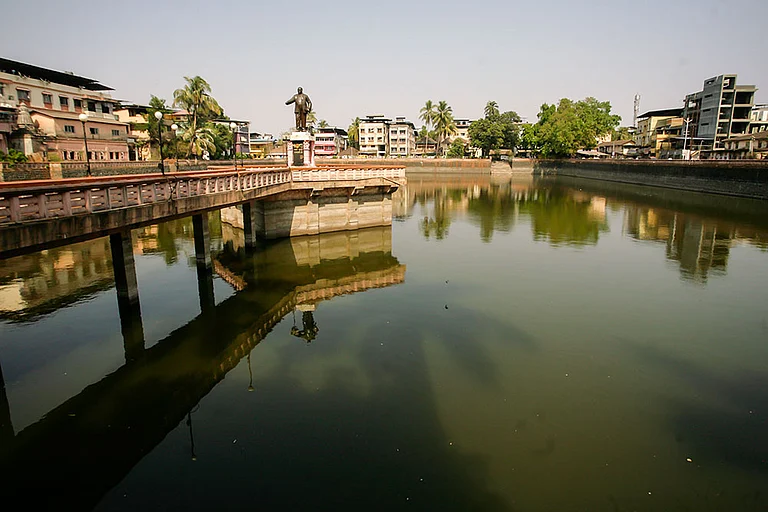
That walk to the Chavdar tank was not planned. It emerged in a moment of practising the mundane desire for equality. I call it mundane because the desire for equality is as normal as breathing. Dr Ambedkar did not even want to be the chairperson of this conference. In fact, he had considered other locations—such as Pandharpur—as possible starting points for spreading awareness about the oppressive caste system.
As the conference ended, someone suggested that the gathering should walk, and the rest agreed. It is interesting to note that the suggestion did not come from Dr Ambedkar. It was one of the conference members, Mr Anant Vinayak Chitre. He addressed the gathering after the vote of thanks: “Let us all, including the chairperson, enter the chavdar tank of Mahad and consume water”.
There was no grandeur in the air. No sense that history was waiting. There were no slogans or dramatic gestures. Just a collective movement toward a space that had always been denied to them. They did what had been unthinkable for generations: they drank the water.
Advertisement
Their action received violence because this was not just a walk, it was an interruption.
Caste survives by regulating organic movement; it thrives by dramatising the ordinary; and it spreads by normalising the scripted norms. Walls rarely mark these boundaries; they live in memory, in habit, in the body.
So when the crowd began moving toward the tank, they were not simply asserting a civic right. They were interrupting a script, a drama and a regulation, by reclaiming the ordinary, that is walk, water and touch.

Water and the Bacteria of Caste
Biodegradable things, as we learn in science, are those that break down and return to nature with the help of microorganisms, such as bacteria. Calling caste “biodegradable” may sound strange, but the idea helps explain how caste survives—not as something fixed, but as something that keeps changing form.
Jacques Derrida, while discussing writing systems, suggests that what we call biodegradable is not purely natural; it is often something artificial designed to disappear (unrecognisable). The caste system works similarly. It does not remain the same over time. It breaks down, hides, and reappears in new forms, blending into everyday life until it feels “natural,” even though it is not.
Advertisement
Caste survives through what we might call its “bacteria”—invisible social habits and rules. These include who we can touch, eat with, marry, or even befriend. These rules quietly regulate our behaviour and keep caste alive without always naming it.
On the surface, through legal interventions, we may think or claim that things have changed. But the practice does not disappear. It adapts, dissolves, and returns—making its presence harder to see, but no less real.
The Bole resolution had stated that the Chavdar tank was, by law, public. A municipal resolution had already opened it to those who had long been denied access. On paper, the question was settled. However, in practice, nothing had changed. Both the prohibited and the prohibitors followed the bacterial norm of caste. The bacteria of caste coded the ordinary act of drinking water with ideas of pollution and purity, touch and distance, belonging and exclusion.
When the protesters reached the tank and drank, they did something simple. No slogans. No spectacle. Just an ordinary gesture from ordinary life. And yet, this ordinary challenged the resistant caste system.
Advertisement
The backlash was swift. The rumours, almost like an infodemic, spread that temples would be next, that boundaries would collapse. The walk was met with violence because it disrupted the abstract prescription.
The bacteria of Caste spread through abstract prescriptions and are followed unquestioningly. It survives by turning everyday acts into markers of hierarchy, turning water into a test of status, proximity into a threat, and togetherness into pollution.
The walk to Chavdar Tank exposed this with brutal clarity.
Ambedkar’s call against the technics of caste:
By “technics,” which I borrow from Bernard Steigler, I mean the everyday systems that shape how we live and who we become. From family, language, and even food habits, we are taught what we “inherit.” We don’t choose these identities—they are passed on to us. The past we claim as ours is something we never lived, yet we accept it as natural because it is repeated through daily practices. Tradition and imported memory are often used to justify this, making caste feel normal and fixed.
Advertisement
These systems quietly shape our thoughts, our relations, and our minds, often in ways we don’t notice. We usually question agents of caste or its outcomes. But the core issue lies in our individual sensibilities.
Earlier that day, 20th March 1927, B.R. Ambedkar addressed the gathering. His speech highlighted these technics and problematised the reliance on traditions. Ambedkar urged his listeners to question what they had inherited; Customs, he argued, are not sacred simply because they are old. For centuries, caste had functioned not only as an external system of control but as an internalised order of belief. These beliefs endure because they are accepted and repeated.
Ambedkar targeted the blind acceptance and proposed that the repetitions can be refused.
Unlike the popular opinion, Ambedkar’s philosophy requires an intellectual rupture, and one can see in this speech as well. He shifted the struggle from pleading for inclusion to dismantling the logic of exclusion, from reforming society to rethinking the existing thoughts about reform.
His speech, in this sense, was as significant as the walk that followed. One unsettled thought; the other translated that unsettlement into action.
Resistance vs Desistance
The Mahad Satyagraha is often described as an act of resistance. In general, the ghost of resistance is always invoked when we talk about Dalit politics, Dalit literature (if it exists), Dalit identity, or fighting the caste system. But naming it resistance puts us into a paradoxical loop; a hegemonic equation whereby the Oppressed and the Oppressor are entangled in defining each other through the resistance.
Generally, resistance is seen as strength because it literally means standing firm again and again (from Latin resistere). But there’s another way to read it. If resistance means returning to the same point repeatedly, does it also mean that nothing has really changed?
To keep resisting in the same way suggests that the problem still exists in the same form. In that sense, resistance can begin to look like a cycle rather than progress. If it truly succeeds, it should make itself unnecessary. The need to resist again and again may quietly point to its own limits. This also raises an uncomfortable thought: every time we claim resistance, we are also admitting that earlier resistance did not fully work.
This does not make resistance useless—but it pushes us to rethink it. Perhaps the question is not just how to resist, but how to move beyond repetition and create change that does not need constant defence.
There is another way to understand it—through the idea of refusal that people who walked to the Chavdar Tank practised on 20th March 1927. The refusal in their walk is better described as desistance rather than resistance. Desistance, as Philippe Lacoue-Labarthe suggests, is a quiet but profound gesture: stepping away from what has been given, withdrawing from a system without necessarily overthrowing it.
In simpler words, desistance is moving between different ways of being and identifying. Instead of getting stuck in a hegemonic dynamic with the Oppressor, it opens up the possibility for change by shifting how the Oppressed understand and place themselves.
Mahad was precisely such a moment. The protesters did not dismantle the caste that day, nor did they target the practitioners. They did not seize power, rewrite laws, claim victimhood, or attack anyone. What they did was in some ways more radical: they refused to comply.
They walked where they were meant to walk.
They drank what they were meant to touch.
They acted without an intention to resist or react to an ‘other’.
It was not a dramatic spectacle imposed from above, but a minimal shift enacted from within: a simple expression of desire to refuse the internalised logic of caste.
Such moments are vulnerable. They do not guarantee transformation. But they make something visible: that the oppressive system depends on participation and that participation can be interrupted if not stopped completely.
Why the Walk Still Matters
One of the most revealing aspects of Mahad is the gap it exposes between law and society.
The right to access the tank already existed. Yet exercising that right required collective courage. It points to a deeper truth: legal change does not automatically alter social reality. Laws can declare equality, but they cannot enforce recognition. The ordinary gestures matter.
It is tempting to see Mahad Sayagarah as a completed chapter—a milestone on the way to a more equal society. But its significance lies less in what it achieved than in what it revealed.
It shows that caste is not an outside system but a habit within all of us.
It shows that change begins not with grand declarations or resistance, but with small gestures of refusal and desistance.
Mahad reminds us that history does not always turn through grand upheavals. Sometimes, it turns out through quiet, tiny decisions. In contemporary times, we hear the echoes of such desistant decisions when Rohith Vemula wrote, when the women sat in Shaheen Bagh, when the farmers marched and when people choose to vote against hate and embrace love.
A movement against discrimination lies in the decision to stop inheriting discriminatory beliefs and start creating new possibilities. It is in avoiding the drama and reclaiming the ordinary acts of being.
‘We’ are ‘us’ and ‘we’ have to take care of all, including those who call us ‘they’.
Views expressed are personal
Published At: