In a state still fractured by conflict, Nemcha Kipgen’s elevation to Deputy Chief Minister reflects the uneasy politics of navigating both power and grievance.
Nemcha Kipgen: Between Power And Faultlines In Manipur
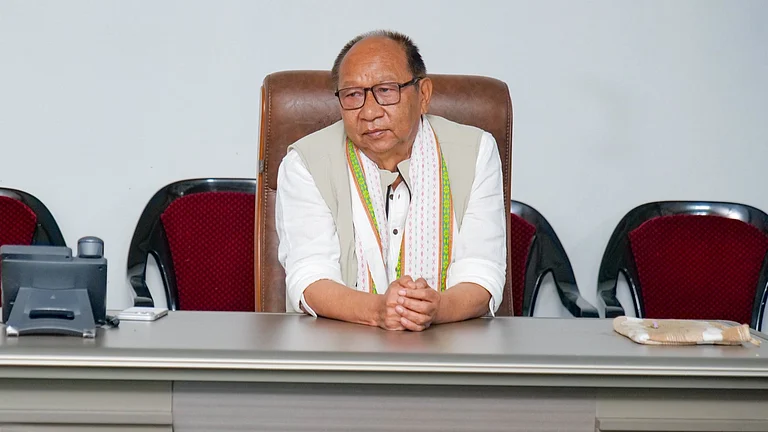
Veteran leader Kipgen is the Deputy Chief Minister of Manipur

At 60, she is both a symbol of representation and a figure of unease. The first woman Deputy Chief Minister of Manipur and the first leader from the Kuki-Zo tribal community to hold the post, Kipgen took oath virtually from Manipur Bhawan in New Delhi, administered by Governor Ajay Kumar Bhalla, even as CM Khemchand Singh was sworn in in Imphal. The optics were telling: a leader geographically and politically straddling two worlds.
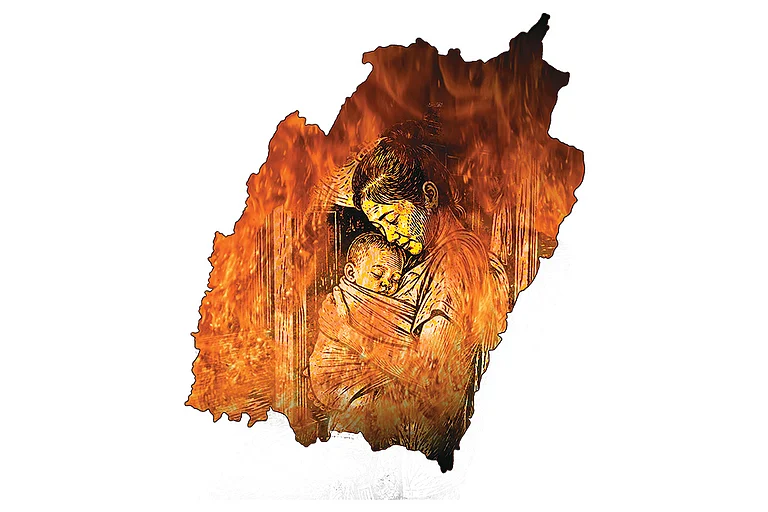
Her elevation comes nearly 21 months after the ethnic violence of May 3, 2023, which left over 260 dead, more than 1,500 injured, and displaced over 60,000 people. Kipgen herself was not untouched by the crisis. Her official residence in Imphal West was burnt in June 2023, forcing her out of the valley and into Kangpokpi, physically mirroring the rupture between the hills and the plains.
That rupture had already shaped her politics. Kipgen’s early trajectory was not built in party corridors but on the streets of the Sadar Hills district movement, a Kuki-led agitation for administrative recognition, significantly driven by women. It gave her politics grassroots, community-first grounding She was first elected to the Manipur Assembly in 2012 from Kangpokpi on a Manipur State Congress Party (MSCP) ticket. The party later merged with the Congress in 2014, before Kipgen resigned in 2017 and joined the BJP.
When she first won as an MLA in 2012, her pitch was sharply local: roads, district status, and a promise to turn Kangpokpi into a “model district.” Her shift into the BJP in 2017, and her tenure in government, softened that edge. She served as Minister for Social Welfare and Cooperation (2017-2020) in the first Biren Singh government, and later as Cabinet Minister for Textile, Commerce and Industry in his second term. Her language turned to welfare-state vocabulary–children’s rights, social schemes, youth guidance–framed in broad developmental terms rather than identity politics. It was the rhetoric of governance, not agitation.
The violence of 2023 altered that balance. Displaced and operating from the hills, Kipgen’s politics hardened into ethnic advocacy layered within administrative language. She was among 10 Kuki-Zo MLAs, including seven from the BJP, who demanded a separate administration with its own legislature, bureaucratic structure, and security control for Kuki-Zo areas. Yet, even in asserting this, her public vocabulary remained measured: “dialogue,” “healing,” “constructive action.”
Advertisement
This duality defines her politics today. On the ground, her work remains administrative—pushing infrastructure, advocating food-processing industries, and promoting livelihood programmes and youth initiatives in Kangpokpi. In the political arena, she walks a tighter rope: signalling protection for tribal identity while staying within the framework of the state government.
It is a balance that has come at a cost. Her acceptance of the Deputy Chief Minister’s post triggered protests among sections of the Kuki-Zo community. Many felt like they were betrayed by their own. Voices like Chachan, a 23-year-old displaced student now in Delhi, reflect that anger and disillusionment.
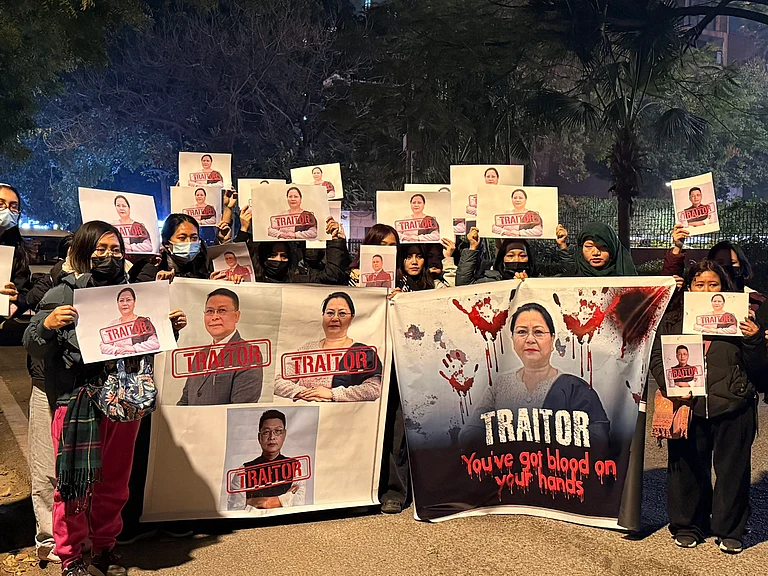
“All our people are aiming for one thing; separate administration with legislature,” says Chachan. “She went out of her way for her own profit. She wasn’t elected, she was appointed. That’s why we call her a traitor.”
Advertisement
Chachan, whose family now lives in a relief camp in Churachandpur while she searches for work in Delhi, adds that she wants Kipgen to explain “how she has the guts to betray her own people.”
The contradictions deepen further. Kipgen has not broadly condemned the violence, except in the widely reported case of two Kuki-Zo women who were paraded naked and gang-raped. But she continued to sign memorandums demanding separation and now she occupies one of the highest offices within the existing state structure.
Her approach is not based on fiery speeches, but on a balanced positioning, speaking of inclusion at the state level while signalling protection to the hills. Whether that makes her a bridge, or leaves her stranded between two sides, remains the unresolved question at the heart of her political journey.
A shorter, edited version of this appears in print
Advertisement
Mrinalini Dhyani is a senior correspondent at Outlook. She covers governance, health, gender and conflict, with a strong emphasis on lived realities behind policy debates
This article is part of the magazine issue dated May 11, 2026, called 'Khela Hobe? ' about Assembly Elections 2026 and how West Bengal may prove to be the toughest battleground for the Bharatiya Janata Party.
Published At:
Tags