The first thing Oinam Binita, a Meitei mother, asked when she opened her eyes in the ICU was simple, almost instinctive: “Where are my children?”
A Persistent Unrest: In Manipur, Grief Outlives Every Promise of Peace
Nearly three years since ethnic violence first tore through Manipur, the casualties and the cumulative toll of conflict keep accumulating. Even as the current political climate in India continues to be defined by the reverberations in mainstream poll-bound states, in Manipur, peace appears to have adopted the form of a managed illusion: one that is brittle, fragile and heavily policed

She had just survived a blast that tore through her home in Manipur’s Bishnupur district. Her body was still recovering, but her mind returned to the last memory she had, with her two children beside her.
This is not a standalone story, but the lived reality of many others like Binita across Manipur’s fractured communities. In the early hours of April 7, two children, a five-month-old girl and a five-year-old boy, were killed when an explosive projectile struck their home in Bishnupur district’s Moirang Tronglaobi village, triggering outrage across the valley.
More than two weeks later, in the hills of the Ukhrul district, located around 120 km from Moirang, violence traced a familiar arc. Fresh clashes between Kuki-Zo and Tangkhul Naga groups left three people dead and several others injured, including women, in two separate gunfights on April 24.
Across the state, protests have followed; clashes with security forces, tear gas shelling, blockades and marches towards the chief minister’s residence. This is where Manipur stands today, nearly three years into a cycle of violence that shows little sign of ending.
Elsewhere, the political calendar has remained on schedule. With five states in election mode, Prime Minister Narendra Modi has been campaigning across the country, holding roadshows and addressing rallies, including a stop in Gangtok, where he was seen playing football with local youngsters, while Manipur, barely an hour’s flight away, remains absent from that itinerary. Union Home Minister Amit Shah’s last visit to Manipur dates to April 2024, during an election rally; he has since held 66 roadshows across poll-bound West Bengal without a return trip to assess the ground situation.
Meanwhile, there has been no statement from the Prime Minister’s Office on the killing of the two young children in Bishnupur, an absence that, like much else in Manipur, has not gone unnoticed.

On the ground, however, the silence is filled with grief that refuses to settle.
Advertisement
“She kept asking again and again,” Oinam Babuton, grandfather of the two kids who lost their lives in the bomb attack, recalled. “Sometimes she would shout, saying, ‘My younger child is calling me. Why aren’t you giving them to me?’”
No one told her the truth.
Not immediately. Not when she was still drifting in and out of consciousness in the ICU. Not when the trauma of what had already happened threatened to overwhelm her. The truth, that both her children, had been killed in the blast, was held back, even as she continued to search for them.
When she was finally discharged, she did not return home.
“She went back only once,” Babuton says. “But that is where her two children died. She was deeply shocked. We were afraid… after losing two grandchildren, we cannot afford to lose her too.”
The blast, around 1.30 am, hit the house in Tronglaobi Awang Leikai, a vulnerable settlement located close to the heavily guarded “buffer zone” separating the Meitei-majority valley from the Kuki-Zo-dominated hill areas of Churachandpur.
Advertisement
“How can such an explosive reach a civilian house?” asked Mairembam Ratan Singh, who has been displaced from Churachandpur since the conflict began. “This is a very volatile area… there are multiple lines of defence by central forces on both sides.”
The children’s grandfather voiced a more personal anguish about his son and the father of two children, who is posted with the Border Security Force in Bihar.
“Our son is ready to sacrifice his life for the country,” he said, adding that the government cannot ensure the safety of his family. “It is very painful.”
The killings have since sparked widespread protests across Manipur’s valley districts, with residents demanding accountability and security.On April 25, thousands of protesters also clashed with security forces after they were stopped from marching towards Chief Minister Y Khemchand Singh’s residence in Imphal, underscoring the deepening public anger and the fragility of peace on the ground.
Advertisement
For many, the anger was not just about the blast, it was about the accumulated frustration of nearly three years of conflict. Since May 2023, official figures record over 260 deaths, 6,000 injuries and 60,000 displaced people, many of whom are still living in segregated relief camps.

“We are not living in a camp, we are living in an open jail,” says Singh, who now lives in a relief camp after he fled the violence in 2023. “We are fed up with shouting for justice.”
Despite repeated official claims of normalcy, the reality on the ground tells a different story.
As former Army officer Major Mohammad Ali Shah put it, the situation remains “fragile and tense rather than fully stable.”
What exists, he explained, is “managed peace”, held together by heavy security presence, but vulnerable beneath the surface. “The underlying mistrust between communities remains strong…without addressing the root causes, stability will likely remain temporary.”
Advertisement
Even as the valley grapples with the aftermath of the blast, violence in the hill districts tells its own story of a conflict that refuses to settle.
Among the dead in the recent clashes was 29-year-old Tangkhul Naga Horshokmi Jamang, who, according to the Tangkhul Naga Long (TNL), was killed in an ambush near Sinakeithei village. The two Kuki victims, Paominlun Haolai (19) and Letlal Sitlhou (43), were found near Mullam village.
Kuki groups alleged that Mullam came under armed attack, claiming two village volunteers were killed, at least 17 houses were set ablaze and several residents, including women and children, were injured and displaced.
“We are living in absolute uncertainty,” says Mercy Khongsai, vice president of the Kuki Students’ Organisation in Ukhrul. “We never expected a full-scale attack on a village where children and women are there,” she says, adding that trust in government had evaporated and communities had turned inward.
“It is no longer a secret,” she says. “Both communities now have volunteers. But that does not mean we want to attack others. We just want to protect our own people.”
Moreover, just days earlier, on March 12, the bodies of two Kuki men, Thenkhogin Baite and Thangboimang Lunkim (Khongsai), were recovered from a jungle in Manipur’s Kamjong district after they, according to the locals, went missing while repairing a water pipeline.
These tensions have escalated in cycles of attacks, blockades and retaliation. Rooted in disputes over land, identity and political autonomy, the Kuki-Tangkhul Naga conflict traces back decades, including major violence in the 1990s.
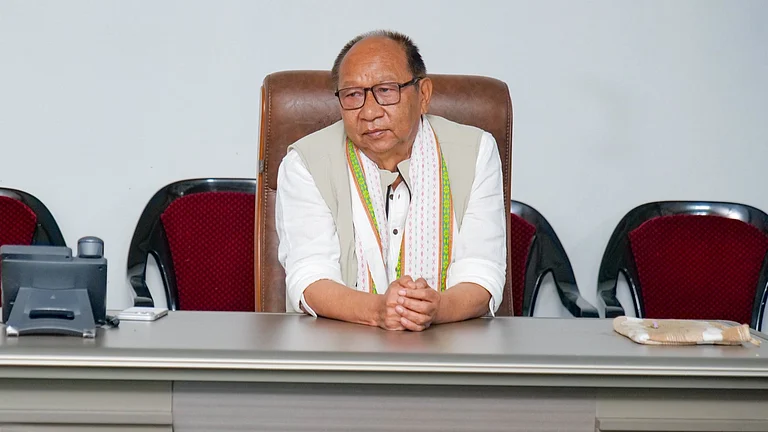
For those on the ground, the present is inseparable from that past. “This is not just about the last few months or a year,” says Khongsai. “These tensions go back decades… without proper closure.”
Chongoulen Hangshing, a displaced student from Imphal, currently living in Kangpokpi and member of the Thadou Academic Society, described a system that now sustains itself. “The conflict has created a class that doesn’t want to end the violence… it wants to keep everyone in a loop,” he said, adding that early intervention in May 2023 could have prevented escalation.
Hangshing was initially hopeful that the new government would address the crisis, but is now disillusioned as promised support has failed to reach many displaced families. “Many are still unregistered as IDPs… the new government is sadly not up to my expectations,” he says, adding that it was a deeply traumatising experience, fleeing the only place he ever knew. “It was exhausting, but over time I’ve realised that what doesn’t break us can make us stronger.”
He adds that he hopes both the state and the Centre act firmly against anti-state elements and ensure that the rule of law is applied equally in both the valley and the hills, with constitutional rights protected—particularly in the hill areas.
“In the hills, peace will prevail only when the state addresses injustices and protects the rights of the people,” he says while warning that without such steps, militancy will continue to cast a long shadow and unrest will persist.
Back in Bishnupur, the house where the blast occurred still stands, but it is no longer a home. For the mother of the two children, it became a place she could not return to. For their grandfather, it is a place where memory and grief now coexist.
That night remains etched in fragments for the family. As Babuton describes, around 1:05 am, a loud explosion jolted them awake, though at first, he didn’t think it had happened in their house.
Within moments, they stepped into rooms filling with smoke and dust, where he saw his daughter-in-law “crying, covered in blood,” holding the infant. The older child lay in another room. “Exactly as he had been sleeping—it looked like he was still asleep,” he says.
Struggling to reach him, he recalls how he tried to lift the boy before his younger son stepped in, and within minutes, they rushed both children to the hospital, but it was already too late.
For her recovery, the family has sent Binita to her natal home, something that the grandfather calls a difficult decision to avoid the risk of psychological trauma for his daughter-in-law.
“This is the situation in Manipur,” he says. “No one knows how long this will continue.”
Across the valley and the hills, the stories differ in detail, but not in essence. Families displaced, children killed, survivors carrying trauma that extends far beyond the moment of violence.
In Manipur today, the conflict is no longer just about territory or identity. It is about the slow, relentless toll on civilians, lived not in headlines, but in hospital rooms, relief camps and homes that people can no longer bear to enter.
“How long will this continue?” Babuton asks, “If the government wants, these incidents could stop within a month. But for the past three years, there has been no progress.”
Mrinalini Dhyani is a senior correspondent at Outlook. She covers governance, health, gender and conflict, with a strong emphasis on lived realities behind policy debates
This article is part of the magazine issue dated May 11, 2026, called 'Khela Hobe? ' about Assembly Elections 2026 and how West Bengal may prove to be the toughest battleground for the Bharatiya Janata Party.
Published At: