Over 700 protesters were detained during the Delhi demonstration.
Protesters demanded CEC Gyanesh Kumar’s resignation over SIR.
Delhi Police, RAF and CRPF were deployed to contain the protest.
Inside Jantar Mantar, Where Barricades Replaced Protesters And Buses Awaited Detainees
Over 700 detained as Delhi Police, RAF and CRPF personnel block protesters demanding CEC Gyanesh Kumar’s resignation
Summary
Twenty-year-old Harsh jumped from a police bus carrying detained protesters on Friday, trying to escape before it could take him away from Jantar Mantar. It was the second time he had managed to get out of the bus. But this time, he landed on his head, injuring his shoulder.
Sitting on the pavement barely 500 metres from the protest site, Harsh said he did not know where the police would have taken him. “I don't know where they would have taken me. I came here to protest, which I am within my rights to do,” he said.
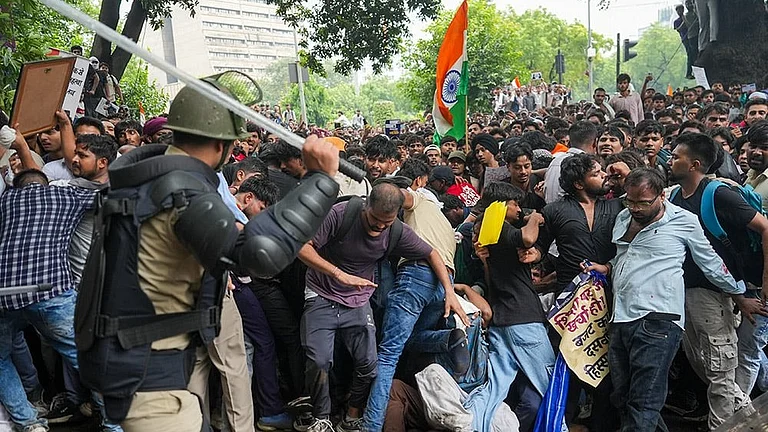
Harsh's attempt to escape was one of several scenes that played out around Jantar Mantar on Friday, as a protest demanding the resignation of Chief Election Commissioner Gyanesh Kumar was effectively stopped before it could begin.
The protesters were not allowed to enter the designated protest site. Instead, the roads around Jantar Mantar were turned into a heavily guarded zone. Delhi Police personnel, Rapid Action Force and Central Reserve Police Force personnel formed a human barricade, while DTC, government and private buses stood ready to transport those detained away from the area.

Dense ranks of police personnel hold back protesters, some raising placards, as a bus waits nearby to take away those detained near Jantar Mantar on Friday. | Mrinalini Dhyani
More than 600 protesters had been detained by the afternoon, according to the protesters, while police officials said that the number was around 700 later in the day. Among those detained were AAP leaders Atishi, Saurabh Bharadwaj and Sanjay Singh, besides members of student organisations including AISA, SFI and NSUI.
Notably, the scale of the deployment was visible from the morning. A Delhi Police officer at the spot told Outlook that more than 1,000 security personnel had been deployed in and around Jantar Mantar.
“They have no permission. We can't let them enter. We are here until all of them are gone,” the officer said.

Jantar Mantar Under Restrictions
Section 163 of the Bharatiya Nagarik Suraksha Sanhita was in force across the New Delhi district, restricting gatherings of five or more people, processions, demonstrations, dharnas, slogans and speeches without permission. Major roads leading to Jantar Mantar, including Sansad Marg, Tolstoy Marg and Jantar Mantar Road, were barricaded.
Advertisement
Rapid Action Force personnel stand behind barricades carrying a Hindi warning banner. | Mrinalini Dhyani
The restrictions extended to communications as well. Internet services were suspended in the Jantar Mantar area for several hours on Friday under an order issued by the Delhi government, while several Delhi Metro stations in the vicinity were also closed as the police moved to prevent protesters from reaching the site.
By around 3 pm, the character of the area had changed completely. Hundreds of security personnel had taken over the roads, while only scattered groups of protesters remained outside the barricades, holding placards and attempting to locate friends who had been detained.
Unlike the July 20 protest, when protesters had managed to gather in large numbers, Friday's demonstration never reached Jantar Mantar. The police did not allow the protesters to sit together at the site and began detaining them from the roads leading towards it.
‘We Are Not Criminals’
The protesters said that while water cannons and tear gas were not used on Friday, as they had been during the July 20 mobilisation, several students and women were subjected to physical force during the detentions. Some alleged they were dragged along the road and beaten with batons.
Advertisement
Nineteen-year-old Jayshree, a history student at Miranda House, had bruises on her hand when Outlook spoke to her. She said she had arrived at around 11.30 am and had been trying to reach Jantar Mantar with other students.
Jayshree, a Miranda House student, shows bruises on her arm, which she alleged came from police force during detentions near Jantar Mantar on Friday. | Mrinalini Dhyani
“We are here because we have a rightful right to protest. What is going on in our country? The constant deletion of votes and this vote-chori, our democratic right, we have come out on the streets to exercise that right,” she said.
Jayshree had also attended the previous protest led by Cockroach Janta Party (CJP), demanding the resignation of the then education minister, Dharmendra Pradhan. “I am not scared. We are not criminals,” she said while alleging that the police had dragged her during the detention.
“This is the harassment we are facing. Instead of doing their job, the Delhi Police is using force against students and citizens who come out on the streets,” said another protestor walking next to her with a placard in her hand that read, “kursi ka kya mol hai, janta ka vote anmol hai” (“What is the value of a seat of power? The people’s vote is priceless.”)
Advertisement
By late afternoon, protesters were also moving between different points in an attempt to find those who had been detained.
“They did not let anybody enter Jantar Mantar. They have been detaining our people. We are trying to get them free. We are constantly following them and we won't stop until all our friends are freed,” said another protestor.

Why Friday's Protest Was Blocked
The protest was called amid continuing Opposition and civil society criticism of the Election Commission over the revision of electoral rolls and allegations of irregularities in the electoral process. Protesters were demanding Kumar's resignation and accusing the government and poll authorities of undermining citizens' democratic rights.
The Election Commission has rejected allegations of electoral wrongdoing and maintained that the electoral-roll revision exercise is intended to identify and remove ineligible, duplicate or otherwise erroneous entries.
Advertisement
The heavy security presence on Friday was particularly striking given what happened at Jantar Mantar during the previous major mobilisation led by the CJP.
That protest, which began in June over the NEET-UG controversy and demands including the resignation of then Union Education Minister Dharmendra Pradhan, continued for 49 days. Pradhan eventually resigned from the Union Cabinet in July, after which the CJP called off the agitation.
The July mobilisation had demonstrated the political significance of what a sustained protest at Jantar Mantar could achieve. Protesters were able to remain at the site, hold demonstrations and maintain a visible presence over several weeks.
On Friday, the authorities ensured that this did not happen.
The protesters were stopped before they reached the site, and buses were positioned around the area to remove those who managed to get through the police cordons.
By afternoon, Jantar Mantar had become less a site of protest than a heavily secured perimeter. Security personnel stood in rows across the roads, buses waited nearby and small groups of protesters moved around the barricades looking for their detained colleagues.
Published At:
Tags