Monday's Sansad Chalo march marked the first known use of pellet guns and shock batons against civilians in Delhi
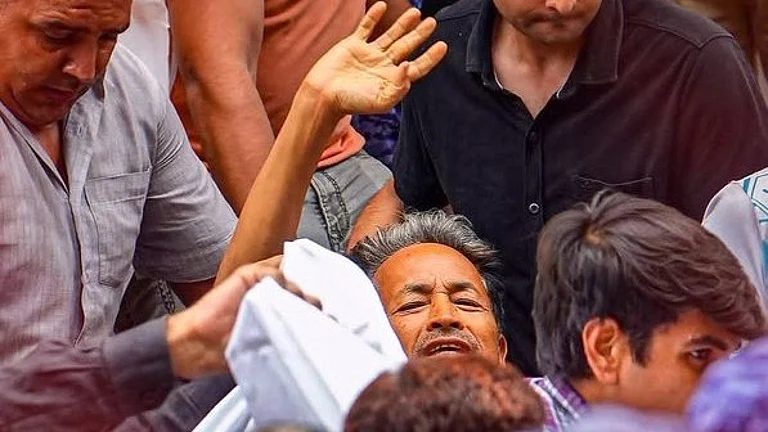
Victim Shaikh Irshad Mansoori underwent surgery for pellet injuries at the Lady Hardinge Medical College
Delhi Police denies using pellet guns.
Pellet Guns To Shock Batons: The History Of Crowd Control Weapons In India
At least one of the roughly 80 protesters injured during police action at the Cockroach Janta Party's (CJP) march to Parliament sustained pellet gun injuries, with victim Shaikh Irshad Mansoori

Summary
The use of pellet guns and shock batons against protesters in Delhi on Monday's Sansad Chalo march marks the first known deployment of these weapons against civilians in the national capital, according to The Hindu report.
At least one of the roughly 80 protesters injured during police action at the Cockroach Janta Party's (CJP) march to Parliament sustained pellet gun injuries, with victim Shaikh Irshad Mansoori, a Gurugram resident. The victim underwent surgery at Lady Hardinge Medical College to remove pellets lodged near his eye and across his upper body, The Hindu reported.
A separate video shows a woman being shocked with a "shock baton" the following day, Tuesday, July 21. The device, like the pellet gun, is standard-issue gear for the Rapid Action Force (RAF), the anti-riot wing of the CRPF that assisted Delhi Police during the march and remains deployed near the Jantar Mantar protest site.
However, the Delhi Police have denied using pellet guns against protesters, dismissing reports of such use as "false and misleading."
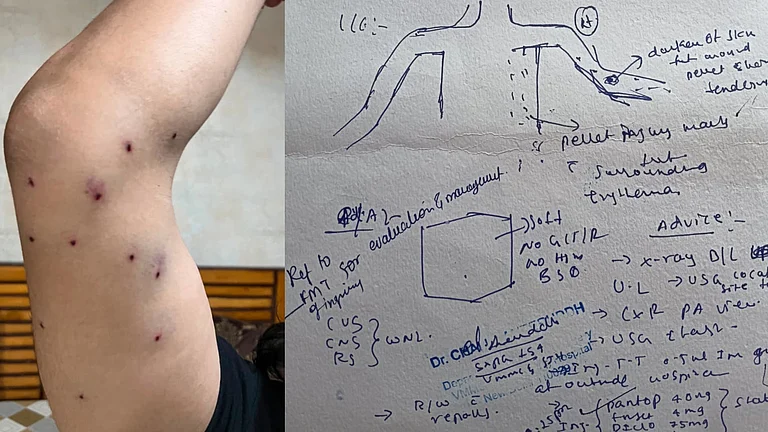
Pellet Guns and Their Usage
Pellet guns are a non-lethal crowd-control tool used by police and militaries worldwide, alongside tear gas, water cannon, pepper spray and taser guns.
Manufactured at the Ordnance Factory in Ishapore, each cartridge disperses several hundred lead pellets, either spherical or irregularly shaped, over a range that can extend up to 500 yards.
While designed to immobilise rather than kill, the pellets can penetrate soft tissue and turn lethal at close range, particularly when they strike sensitive areas like the eyes. Standing protocol calls for security personnel to aim "below the waist" when firing at protesters.
The escalation has drawn comparisons to far more frequent, and far more controversial, use of pellet guns in Jammu and Kashmir over the past decade and a half, The Hindu noted.
Advertisement
What Are Shock Batons
Shock batons are also part of standard RAF personnel gear. In 2021, the Ministry of Home Affairs, through the Border Security Force, laid down qualitative requirements for handheld shock batons meant for self-defence and operational use by security forces, The Hindu reported.
The specifications call for a lightweight device, no more than 1 kg, between 450 mm and 700 mm in length, built from high-impact-resistant material capable of functioning reliably across a temperature range of -20°C to +50°C, with at least a minimal degree of water resistance.
The devices are expected to have a service life of at least five years, run on a rechargeable battery, and deliver a minimum of 1,000 quarter-second shock bursts on a full charge.
The 2016 Supreme Court Intervention
The use of pellet guns has been contested at the highest judicial level before. In 2016, a bench headed by then Chief Justice T.S. Thakur held that pellet guns could not be used indiscriminately to control street protests in Kashmir, and that authorities could resort to them only after proper application of mind.
Advertisement
The observation came while the court was hearing a plea from the Jammu and Kashmir High Court Bar Association alleging excessive use of pellet guns during the unrest that followed the killing of Hizbul Mujahideen commander Burhan Wani.
The court sought a report from an Expert Committee constituted to explore alternatives to pellet guns, and asked the Centre and the state government to respond to the plea.
Around 100 people had died and roughly 12,000 were injured in the clashes during that period, with hundreds blinded, mostly by pellets. The plea followed a Jammu and Kashmir High Court order rejecting a separate appeal seeking an outright ban on the weapon's use.
The Shift Toward "Less-Lethal" Plastic Bullets
Facing sustained criticism after 13 deaths and over 250 injuries linked to pellet guns in 2016, the CRPF moved a year later to introduce plastic bullets as a lower-harm alternative.
The force sent roughly 21,000 rounds of the newly developed ammunition to the Kashmir Valley in 2017, with tests showing the bullets to be less lethal and expected to reduce dependence on pellet guns and other non-lethal crowd-control weapons.
Advertisement
Developed by the Defence Research and Development Organisation and manufactured at an Ordnance Factory in Pune, the plastic-headed rounds were designed to fit into the same AK-series rifles, the AK-47 and AK-56, already used by CRPF troops in the Valley, allowing units to simply swap ammunition when confronting stone-pelting crowds rather than switch weapons entirely.
The force did not abandon other non-lethal tools altogether, and was also inducting pump-action guns fitted with metal deflectors to keep pellet injuries confined below the waist.
A Recurring Pattern Across a Decade
Pellet guns were first deployed in Jammu and Kashmir following the 2010 summer unrest, in which 112 protesters died in police firing; the then Congress-led central government introduced them as a supposedly non-lethal alternative to conventional firearms.
Their use resurfaced at scale after the 2016 unrest, and has since been recorded during the 2023 Manipur ethnic violence and the 2024 farmers' protest at the Punjab-Haryana border's Khanauri and Shambhu points, where police denied using the weapon even as farm leaders alleged multiple injuries, The Hindu notes.
Advertisement
Monday's march in Delhi extends that pattern to the national capital for the first time, and now adds shock batons to the mix, raising fresh questions about whether the safeguards the Supreme Court laid down for Kashmir in 2016 apply, or have been followed, outside the Valley.
Published At: