Advertisement
X

Outlook India Reporter Suffers Pellet-Like Wounds During Police Crackdown On CJP Protest

Conflicting accounts of alleged pellet gun use during the Cockroach Janta Party protest have intensified calls for an independent probe into police action

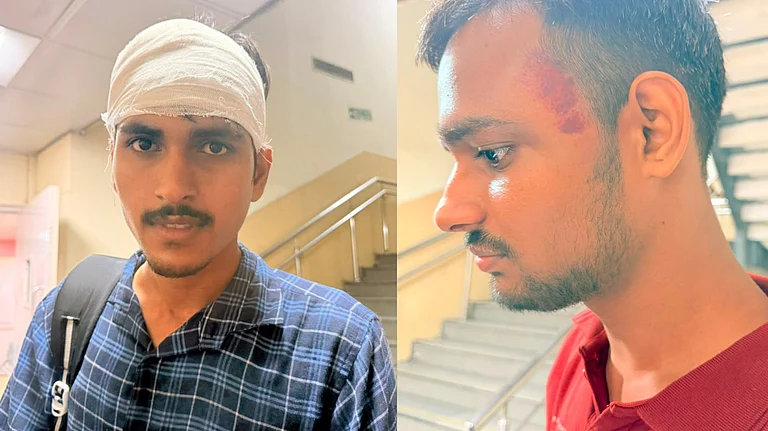
An Outlook India reporter displays multiple puncture-like wounds sustained during the CJP protest Outlook India
Summary
  • Hospital sources and eyewitnesses allege pellet gun injuries during Delhi protest.

  • Delhi Police deny using pellet guns, calling allegations false and misleading.

  • Controversy revives debate over a weapon linked to blindness and severe injuries.
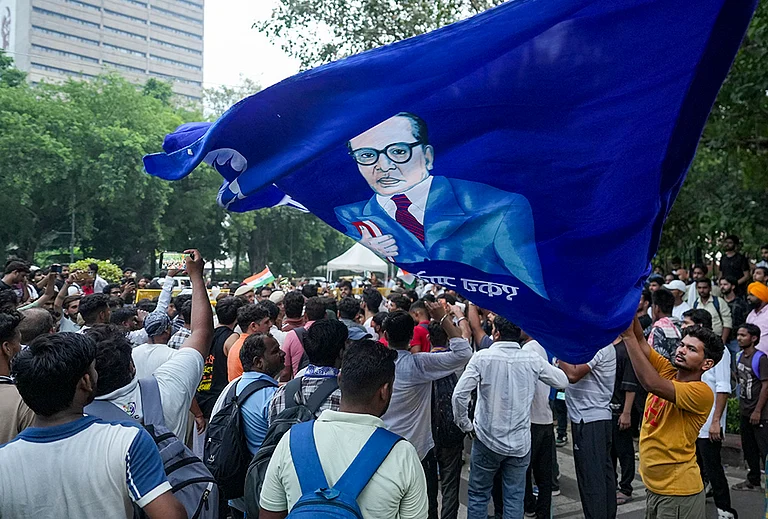
When the security personnel raised what appeared to be a gun in his direction, the Outlook India reporter instinctively turned and ran. Minutes earlier, he had been moving between different protest sites around Jantar Mantar, where students had gathered for the Cockroach Janta Party's (CJP) "Sansad Chalo" march.

Tear gas had already filled the air, burning his eyes. In one corner, protesters were hurling stones towards police. Officers responded with repeated rounds of tear gas.

At first, he observed, tear gas canisters were fired high into the air, apparently to disperse the crowd. As the confrontation escalated, however, he says some were fired directly towards protesters. He watched one canister strike a demonstrator just above the forehead, leaving blood streaming down his face.

Then he noticed an officer pointing what appeared to be a gun towards him. "I saw it aimed at me and immediately ran," he recalled. "Something struck my backpack and my arm. If I hadn't turned, it could have hit my chest or my face."

Medical records prepared after the incident documented multiple puncture wounds on his arm. Photographs reviewed by Outlook India show several small injuries resembling pellet-like wounds.

His account is now among a series of allegations that have intensified questions over whether pellet guns were used during Monday's police crackdown on the CJP protest, an allegation that Delhi Police have categorically denied.

From A Courtroom Remark To A Protest Movement

"We are not interested in videos. We don't have time to watch," said Chief Justice of India (CJI) Surya Kant on Wednesday as lawyers sought the Supreme Court's urgent intervention over the police crackdown.

The counsel urged the court to examine videos allegedly showing police brutality during Monday's demonstration, but the Chief Justice-led Bench declined to entertain the plea.

Interestingly, the protest at the centre of the controversy was organised by the CJP, a student-led movement whose name itself originated from remarks made earlier this year by CJI Kant. Earlier, he had referred to young people turning to journalism and activism "like cockroaches", a comment that triggered criticism from students and activists.

Advertisement

Protest organisers later embraced the label, naming their campaign the Cockroach Janta Party as demonstrations over alleged irregularities in the National Eligibility cum Entrance Test (NEET) expanded into a broader movement demanding accountability from the Union government.

On Monday, thousands gathered at Jantar Mantar before police stopped their march towards Parliament, leading to clashes that left protesters and police personnel injured. Three days later, the focus has shifted from the violence itself to what may have caused some of those injuries.

A Surgery Raises Fresh Questions

The controversy escalated after a media report stated that a 25-year-old Shaikh Irshad Mansoori underwent surgery at Lady Hardinge Medical College to remove multiple pellets lodged in his face and neck.

Notably, doctors successfully removed pellets embedded below his eyes but were unable to extract another lodged close to a blood vessel in his neck. The source added that another protester with an eye injury, also suspected to have been caused by pellets, had been shifted to AIIMS.

Advertisement

Photographs across social media and news outlets showed dozens of puncture wounds scattered across his face and neck. According to the report, hospital staff warned Mansoori's companion before surgery that injuries close to his eye carried a risk of blindness.

After the operation, Mansoori wrote on social media that although he remained in severe pain, "my voice will be the same. My country is way more precious than myself."

Allegations of pellet gun use first gained widespread attention after Cockroach Janta Party spokesperson Saurav Das shared videos and photographs of injuries on X.

Tagging the National Human Rights Commission and the United Nations Human Rights office, Das alleged that police had fired pellet guns at peaceful demonstrators and described the incident as "alarming goondaism".

Delhi Police rejected the allegation.

In a statement posted on X, the force said reports claiming police had used pellet guns were "completely false and misleading" and urged the public not to circulate unverified content. In a subsequent statement, police reiterated that Delhi Police neither possess pellet guns nor used them during the protest, warning that legal action would be taken against those spreading misinformation.

Advertisement

The Rapid Action Force, a specialised anti-riot unit of the Central Reserve Police Force (CRPF), was deployed alongside Delhi Police during Monday's operation. According to The Hindu, pellet guns form part of the RAF's crowd-control equipment, although neither the CRPF nor the RAF has commented publicly on whether they were deployed.

Why Pellet Guns Provoke Outrage

Pellet guns remain among India's most controversial crowd-control weapons. Unlike rubber bullets, they fire hundreds of small metal pellets in a single discharge. Although officially categorised as non-lethal, the projectiles can penetrate skin and frequently cause devastating eye injuries, facial trauma and permanent blindness when fired towards the upper body.

Their use during the 2016 unrest in Jammu and Kashmir drew widespread criticism after hundreds of civilians suffered eye injuries, with many partially or permanently losing their sight.

Allegations of pellet gun use have also surfaced during the Manipur violence in 2023 and the farmers' protests along the Punjab-Haryana border in 2024, although authorities denied using the weapons in several instances.

Advertisement

Human rights organisations have repeatedly argued that because pellets disperse over a wide area, they cannot distinguish between individuals posing a threat and peaceful demonstrators, making the weapons inherently indiscriminate in crowd-control situations.

Notably, hospital sources cited by The Hindu, eyewitness testimonies reported by The Wire, and videos shared by protesters point towards injuries consistent with pellets. Delhi Police continue to insist no pellet guns were used and have dismissed the allegations as misinformation.

No forensic report confirming the nature of Mansoori's injuries has yet been made public, and the CRPF has not commented on the allegations involving the Rapid Action Force.

As calls grow for an independent inquiry into Monday's police action, the debate is no longer confined to videos shown on social media or mentioned briefly in a courtroom.

It has shifted to a larger question with implications for policing public protests in the national capital: whether one of India's most controversial crowd-control weapons was used on Delhi's streets.

More Than Pellet Injuries

The pellet gun allegations emerged alongside broader claims of excessive force during the crackdown.

A 21-year-old Delhi University student Sakshi remains in critical condition in the intensive care unit at Dr Ram Manohar Lohia Hospital after she was trapped beneath a crush of protesters during the police action.

Eyewitnesses told Outlook that students were pushed backwards after police launched a baton charge, forcing demonstrators onto uneven ground littered with broken barricades. Many fell on top of one another, leaving several trapped beneath the crowd.

"We had nowhere to run," one student eyewitness told Outlook, recalling how protesters pulled Sakshi from beneath the pile before she was taken to hospital.

Another protester, 19-year-old NEET aspirant Abhishek Sharma, told Outlook he suffered head injuries requiring stitches after he was allegedly struck with a baton during the clashes.

Meanwhile, 32-year-old Nutan Toppo underwent emergency surgery after a tear gas shell struck near her ear, severely damaging the external structure of the ear.

Hospital sources quoted by Outlook said dozens of injured protesters and police personnel were brought to Ram Manohar Lohia Hospital throughout the day.

Police officers offered a sharply different account, telling Outlook that protesters turned violent and resorted to stone-pelting, injuring several personnel deployed at the scene.

Published At:
US