The absence of disability indicators from the NFHS-6 Fact Sheets prevents immediate comparison of health and social outcomes for persons with disabilities across survey rounds.
A devastating fire in Delhi’s Viklang Basti highlights the vulnerability of families who lost identity documents, including disability-related papers, even as disability indicators are absent from the latest NFHS Fact Sheets.
A 2024 Tamil Nadu disability-cost study found that families shoulder 70-80 per cent of required disability-related goods and services, a burden advocates say is ignored by the government’s ‘harmonisation’ logic.
India’s Persons With Disabilities Left Out As NFHS-6 Fact Sheets Omit Disability Data
As NFHS-6 highlights India’s development, the absence of disability indicators from its Fact Sheets leaves stakeholders without an immediate benchmark to measure progress or identify health vulnerabilities among persons with disabilities.

Summary
For most of his life in Delhi, Gulzar has earned what he could through zari embroidery, bag-making and fabric-cutting.
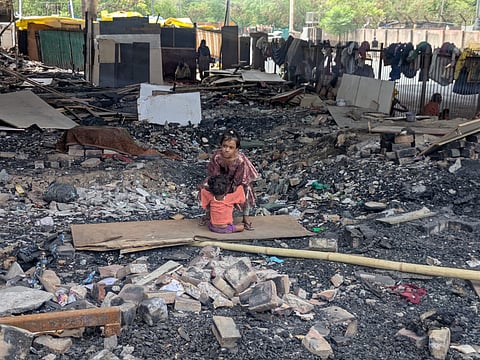
The 34-year-old came to the city when he was eight. Born with underdeveloped legs, he uses a four-wheeled mobility scooter. He describes himself with pride as a skilled worker and cutting master and says how work declined after demonetisation, eventually forcing him to move to Viklang Basti.
The settlement is located beneath a flyover near Gate 3 of the Jawaharlal Nehru Stadium. For the past few years, Gulzar had been collecting paraphernalia for his younger sister Sajda’s wedding. Whenever he earned enough, he added something to the collection: utensils, household goods and other items she could take with her after marriage.
On May 20, a fire burnt it all.
“I have never seen such a fire,” Gulzar says. “Everything turned to ash.” Gulzar’s 12-year-old son is now hospitalised, heavily traumatised after the fire.
Residents said they believed the fire began with a leak in a gas-cylinder connection and spread quickly through the jhuggis. Parents picked up sleeping children and ran, Gulzar recalls, leaving behind money, documents and belongings.
Outlook could not independently verify the official cause of the fire at the time of publication.
Thick black smoke stains remain on the underside of the flyover, eating through the concrete. It remains in use by vehicles zooming through it.

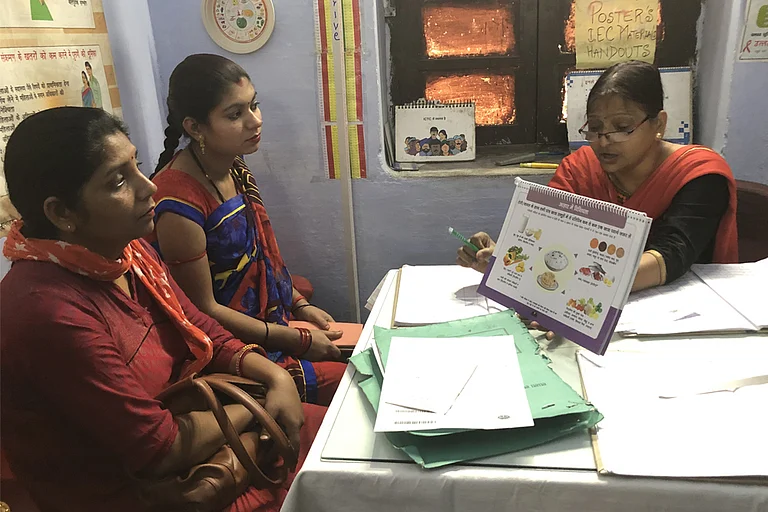
Residents recalled that Viklang Basti had existed a few kilometres away even before Covid, before authorities relocated it beneath the flyover. Now, they say they will have to move once again, with construction being cited as the reason.
Currently, of the 27 families living beneath the flyover, nine are families of persons with disabilities. “All our family’s identity documents are gone,” says Ramkishan, who uses crutches.
Advertisement
His wife suffered serious burns in the fire. According to residents, she was the only person in the settlement to be seriously injured. Ramkishan says the family has spent about Rs 5,000 on her treatment so far.
“From the Aadhaar card to the children’s birth certificates, I cannot find anything,” he says. “I wanted to get my daughter into school, but the papers I worked hard to get are ashes now.”
Residents also lost disability certificates and ration cards.
Delhi’s disability pension requires applicants to establish their disability and residence through official records. For families whose Aadhaar cards, disability certificates and address documents burnt with their homes, recovering from the fire also means reconstructing the paper trail through which the government recognises them.
Ramkishan says the pension is irregular and insufficient for his family’s daily expenses.
“Is Rs 2,500 enough for us, for a disabled person?” he asks. “My daily expenses are at least Rs 500 to Rs 600.”
Advertisement
Pratik Aggarwal, executive director of the NGO Astha, highlights the “scattered” nature of disability pensions across India, noting that there is no universalisation of support.
“The word pension itself is problematic..it’s not a charity; it’s an entitlement for a person,” Aggarwal says.

Locomotor disability was the most common type at 0.4 per cent, while reported disability prevalence rose with age, reaching 1.9 per cent among persons aged 70 and above. SURESH K PANDEY
At the grassroots level, Aggarwal says the lack of support creates profound vulnerabilities, particularly in urban slums. In many families, females are frequently abandoned by men coping with a disabled child’s needs.
Another major concern for disability-rights advocates is the absence of disability indicators from the NFHS-6 Fact Sheets.
India’s National Family Health Survey-6 (NFHS-6) 2023-24 Fact Sheets, released recently, track indicators ranging from fertility and education to internet access and financial inclusion.


Why NFHS-5 was Important
NFHS-5 (2019-21) was the first NFHS round to include disability as a dedicated household-population category.
Advertisement
While the headline figure showed that 1 per cent of the population reported a disability, the survey provided a more granular look at impairment types, including hearing, speech, visual, mental, and locomotor disabilities.
Locomotor disability was the most common type at 0.4 per cent, while reported disability prevalence rose with age, reaching 1.9 per cent among persons aged 70 and above.
Crucially, among persons aged 15 and above, NFHS-5 reported disability prevalence of 1.2 per cent in rural areas compared with 0.9 per cent in urban areas.
NFHS-5 also tracked household and welfare indicators such as health insurance coverage, preschool attendance and death registration, allowing disability data to be read alongside broader social and health outcomes.
More importantly, NFHS-5 established a benchmark against which future disability-related trends could be measured.
What The NFHS-6 Fact Sheets Show — And What They Do Not
In it's introduction, the NFHS-6 Fact Sheets state that the contents are “more or less similar” to NFHS-5 to allow comparisons over time. The latest fact sheets have expanded into several new areas.
Advertisement
Among the additions are indicators relating to digital literacy, financial transactions, direct benefit transfers and self-help group participation. Disability indicators comparable to NFHS-5, however, are not included in the Fact Sheets.
Aggarwal has raised serious concerns about the widening data gap in India’s disability sector. He notes that NFHS-5 estimated disability prevalence at 1 per cent, lower than the 2.21 per cent recorded nationally in Census 2011.
He describes the absence of disability indicators from the NFHS-6 Fact Sheets as a significant “backstep for us as a sector”, saying it leaves advocates without reliable metrics on how disability intersects with critical health issues such as malnourishment and disease patterns.
Aggarwal also argues that the current methodology relies too heavily on medical certifications of “benchmark disabilities”, those exceeding a 40 per cent impairment, rather than assessing functional limitations. He says the medical model often ignores people who have functional needs but lack formal certification.
He advocates adopting the Washington Group of Questions, a global standard that focuses on what an individual can or cannot do in daily life.
The Washington Group of Questions marks a fundamental shift from a medical model of disability to a functional one. While many Indian welfare schemes rely on a “benchmark disability” threshold of at least 40 per cent impairment, the Washington Group approach focuses on functional difficulty in daily life. It uses a set of simple questions to assess difficulty levels in six core areas: seeing, hearing, walking, cognition, self-care, and communication.
By allowing respondents to describe their limitations as "some difficulty" or "a lot of difficulty," the survey captures a far wider demographic than the medical model. This includes elderly citizens or those with progressive conditions who may lack formal documentation but still require significant support. According to people such as Aggarwal, adopting this global standard is the only way to move past the chronic under-reporting that has historically plagued India’s national data.

A devastating fire in Delhi’s Viklang Basti highlights the vulnerability of families who lost identity documents, including disability-related papers, even as disability indicators are absent from the latest NFHS Fact Sheets. SURESH K PANDEY
Smitha Sadasivan, a Chennai-based cross-disability rights activist and accessibility consultant, says the data gap predates NFHS-6. According to her, even the 2011 Census underestimated disability because enumerators were inadequately trained and sometimes avoided asking disability-related questions because of social stigma.
“Many enumerators did not ask the disability question because they are scared... if you go to a village and ask is there a person with disability in your family, then they just get atrocious and ask like, ‘How dare you ask this question to me?’” she says.
What the Missing Data Conceals
Without disability-disaggregated data, it is difficult to determine whether persons with disabilities are participating in these gains at the same rate as the broader population.
A June 2024 Tamil Nadu study led by Meenakshi Balasubramanian and supported by Sadasivan adds economic weight to these concerns. The research, which involved 21 focus group discussions and 208 people consulted, found that required disability-related goods and services could cost two to six times family income for many children with disabilities, three to six times family income for adults with low support requirements, and two to ten times family income for adults with high support requirements.
Stakeholders argue that existing pensions and maintenance allowances remain far below the actual cost of disability-related support.
The study also notes that many persons with disabilities, particularly those with high support needs, are not in regular income-generating work, while family members often absorb unpaid care responsibilities.
Caregiving is another significant cost, Sadasivan says, because government policies frequently assume that relatives will provide care without payment.
“A family member cannot afford to be a 24-hour caregiver leaving their job... They assume that parents are the caregivers. They are not thinking that the caregiver should be a trained professional who has to be employed.”
She says assistive devices also create recurring expenses when the government provides equipment without covering its maintenance.
“If the government is giving a wheelchair and the wheelchair gets repaired... one joystick, if we have to change it, costs from 15,000 rupees to 20,000. It is not just enough if you give a wheelchair; you have to give maintenance.”
The TN study found that families shoulder 70-80 per cent of required disability-related goods and services. It found government compensation covered 2-8 per cent of costs for children with disabilities and 0.1-8 per cent for adults/persons with high support needs.

The TN study found that families shoulder 70-80 per cent of required disability-related goods and services. It found government compensation covered 2-8 per cent of costs for children with disabilities and 0.1-8 per cent for adults/persons with high support needs. SURESH K PANDEY
The Government's Case
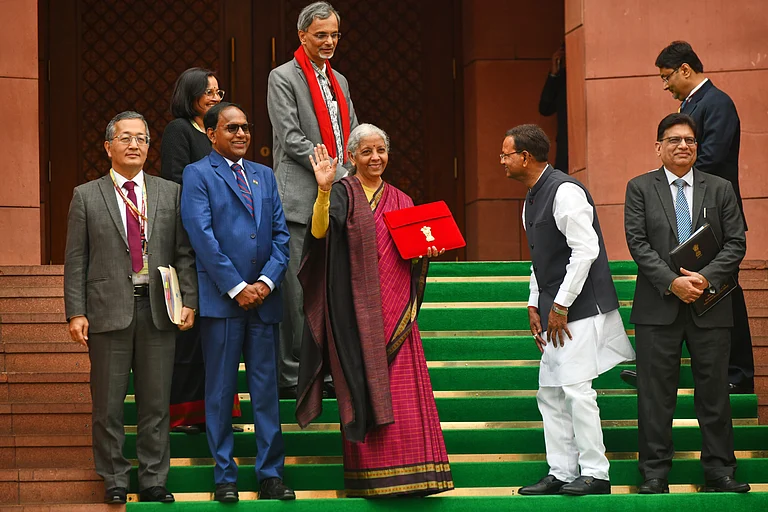
The Ministry of Health and Family Welfare has framed the absence of some indicators from the NFHS-6 Fact Sheets as part of a broader “harmonisation” of India’s statistical architecture.
Health Ministry officials have described this as a strategy to streamline reporting across a growing network of specialised surveys, ensuring that each metric is reported through its most “appropriate and authoritative source”. This approach, they say, aims to reduce duplication.
Officials have described the change as a “refinement” of the questionnaire and reporting framework to reflect emerging priorities while reducing respondent burden.
However, this logic of technical efficiency has created a distinct sense of unease among disability rights advocates. While the Ministry has clarified that the current Fact Sheets focus on 101 headline indicators and that a “far wider range” of data will appear in the forthcoming National Report, disability is not among the categories specifically mentioned in the Ministry’s clarification.
For Aggarwal, the claim that disability data is being “harmonised” elsewhere is difficult to reconcile with the fact that the Ministry’s clarification does not identify a replacement source that would provide a disability-disaggregated household-survey baseline comparable to NFHS-5.
As of June 16, Outlook wrote to the Union Health Ministry for a direct response to these specific concerns. This report will be updated to reflect the perspective of the Ministry and its nodal agency, the International Institute for Population Sciences, regarding the technical justifications for the omission if and when they respond.
Sadasivan questions why disability indicators are absent from the NFHS-6 Fact Sheets while other indicators of development continue to be measured. Saher Hiba


Sadasivan questions why disability indicators are absent from the NFHS-6 Fact Sheets while other indicators of development continue to be measured.
“I don’t know, the government may be hushing these things, and that is why they don’t want to show the real data,” she alleges, noting that disability rights advocates have filed public interest litigations in the Madras, Karnataka, and Calcutta High Courts, only to face "repeated delays" in being listed. She attributes this continued exclusion to the limited political attention given to disability rights.
For stakeholders, the concern is not only the absence of one table, but the loss of a recent national household-survey baseline that allowed disability to be compared with health, welfare and social indicators.
“We should not get lost in the data,” Aggarwal concluded. “The quality and level of services for people should also be seen. The services are too few and too fragmented.”
Published At:
Tags