Few would have guessed, in its first days at Jantar Mantar, that the Cockroach Janta Party (CJP) would grow into a movement capable of drawing in the Opposition’s tallest leaders, making its way into the national political conversation and forcing Union education minister Dharmendra Pradhan’s resignation. There were no queues of politicians waiting behind the stage then. Only fasting students, volunteers sleeping on plastic sheets and a movement still uncertain whether anyone beyond Jantar Mantar was paying attention.
InDepth | Jantar Mantar Protest: Why the Opposition Arrived Late to the CJP Movement
More important than the timing of when the Opposition showed up at the student protests is the question of whether it can sustain the momentum

The images that would come to define the Opposition’s role in the movement were not taken at the protest site. They were captured instead at police barricades outside the prime minister’s residence. Leader of Opposition Rahul Gandhi being led away by policemen, a thin streak of blood beneath his nose that he later posted online without comment. Minutes later, his sister and Congress leader Priyanka Gandhi Vadra was bundled into a police vehicle and held for nearly three hours at Mandir Marg police station while their mother, Sonia Gandhi, waited outside for her release.
For a party that had spent the movement’s first month maintaining a deliberate, calculated distance from Jantar Mantar, it was an unusual point of entry, not through a statement of support or a visit to the protest site, but through detention.
“The Congress was careful not to be overshadowed by the CJP. It waited for the right moment,” says political analyst Rasheed Kidwai. “But more important than timing now is whether the Opposition can sustain the momentum.”
A Manufactured Distance
The CJP had no organisational history to speak of. Its founder, Abhijeet Dipke, had previously worked in the Aam Aadmi Party’s (AAP) communications team. The CJP’s sudden viral rise struck many Opposition leaders as suspicious rather than promising. Within the Congress, according to party sources, the agitation was initially viewed as a possible Bharatiya Janata Party (BJP)-sponsored distraction, intended to blunt the party’s own campaign around paper leaks and allegations of embezzlement linked to the Ram temple trust in Ayodhya.
There was a deeper reason for the caution, too. The memory of Anna Hazare’s 2011 anti-corruption movement still loomed large. That agitation began at the very same Jantar Mantar as a citizens’ campaign before eventually giving birth to the AAP and contributing to one of the Congress’ most damaging political setbacks. The Congress had already watched one “non-political” movement transform into an electoral rival. It was unwilling to risk history repeating itself, particularly when the founder of the new movement had emerged from the same AAP ecosystem. “The Congress was very conscious of not playing second fiddle to the CJP,” says Kidwai. “Perhaps they were looking back at 2011–13, when the India Against Corruption movement was launched against Prime Minister Manmohan Singh and the United Progressive Alliance government. That movement became hugely successful because the BJP largely stayed in the background. In hindsight, we came to understand that the BJP and elements within the Rashtriya Swayamsevak Sangh were strategising behind the scenes.”
Advertisement
By the time Parliament’s monsoon session began, the political equation had shifted. The movement had spread across cities, entered Parliament and dominated the social-media algorithms.
Kidwai says the circumstances today are fundamentally different from those of 2011. The Anna Hazare movement had broad support from sections of the media, which amplified its message and, indirectly, the BJP’s political narrative.The UPA government remained on the defensive, guided by a stronger sense of political accountability, while the Opposition was united in purpose. That cohesion, he says, no longer exists.
A senior Opposition leader also questioned why the Congress should suddenly share a stage with Dipke, who had openly criticised Rahul only months earlier, when the party had already launched its own youth outreach campaign, Chhatron Ki Goonj, “raising the same issues on a much bigger scale”.
Not everyone in the Congress agreed. Shashi Tharoor wrote an open letter to educationist and climate activist Sonam Wangchuk and the three students who were on hunger strike, urging Wangchuk to end his fast because the protest had succeeded in drawing national attention. Former West Bengal Congress president Adhir Ranjan Chowdhury called the hunger strike “a wake-up call for this government”.
Advertisement
An Unintended Advantage
By the time Parliament’s monsoon session began, however, the political equation had shifted. The movement had spread across cities, entered Parliament and dominated the social-media algorithms. Remaining absent now carried a greater political cost than joining.
Ironically, the Congress’s caution may also have been what allowed the protest to grow, according to experts. Had Rahul or any other major opposition leader stood on the stage during the first week, the BJP could have portrayed the agitation as another partisan campaign. Instead, for nearly a month, the movement belonged to Wangchuk, the fasting students, the volunteers and thousands of “cockroaches” who had arrived at Jantar Mantar. By the time political leaders came in force, they were entering a movement that had already earned legitimacy on its own terms rather than one they had created themselves.
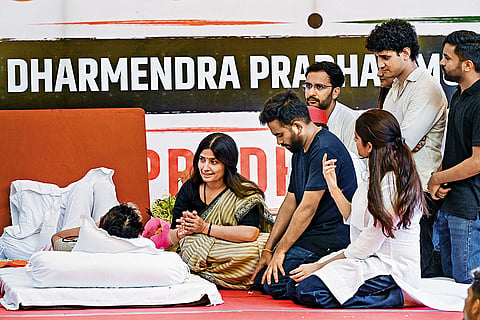
United Front: Samajwadi Party MP Dimple Yadav interacts with Sonam Wangchuk on the 19th day of his hunger strike at the CJP-led student protest at Jantar Mantar | Photo: Imago
Week after week, the crowds at Jantar Mantar grew larger, the slogans louder and the list of visitors longer, until it was no longer just a protest site but a destination in national politics. But no one knew whether the agitation would survive another week, let alone become one of the largest youth-led protests the capital had seen in years, till the fasting Wangchuk was removed from the stage. Bhim Army chief Chandrashekhar Azad arrived at Jantar Mantar around two in the morning. He remained until dawn, returning again on subsequent nights to sit with fasting students as volunteers kept vigil.
Advertisement
Among the CJP volunteers, Azad came to be seen less as a political visitor than as someone whose physical presence offered reassurance if the protest turned confrontational.
By the time Parliament’s monsoon session began, the political equation had shifted. The movement had spread across cities, entered Parliament and dominated the social-media algorithms.
The rest of the Opposition moved more cautiously. Samajwadi Party (SP) MP Dimple Yadav addressed the gathering and appealed to students and opposition parties to join the proposed march to Parliament, while SP chief Akhilesh Yadav conveyed his support over the phone. Mamata Banerjee deputed Rajya Sabha members Sagarika Ghose and Mahua Moitra, who described standing with the protesters as “a democratic duty”.
Shiv Sena (UBT) leader Aaditya Thackeray called the agitation an issue “beyond politics”, while Uddhav Thackeray publicly urged Rahul to visit Jantar Mantar.
When Politics Came Looking
AAP chief Arvind Kejriwal arrived at Jantar Mantar on July 16, over three weeks after the agitation had begun. By then, the CJP had itself begun inviting political parties to join, writing to leaders across the spectrum, including Rahul and BJP leader J.P. Nadda, urging them to stand with the students. Kejriwal demanded Union education minister Pradhan’s resignation and proposed Wangchuk as his replacement. This endorsement reflected a changing political reality: the movement had become too large to ignore.
Advertisement
During the first week, political visitors were sporadic but by the final week, leaders from across the country were waiting behind the stage for their turn at the microphone. Among them was Nationalist Congress Party (NCP) leader Jagdish Avade from Maharashtra, AAP MLA Mehraj Malik who came from Jammu and Kashmir, and Swami Prasad Maurya, national president of the Apni Janta Party, who made the journey from Uttar Pradesh. “The movement has already outgrown Anna Hazare’s. The future of the country is on the roads, and every part of society is here, irrespective of religion, caste or region,” Maurya told Outlook after stepping off the stage.
PDP president Mehbooba Mufti’s speech reflected how far the movement had expanded. The stage was no longer discussing only paper leaks or Wangchuk’s fast. It had become a platform for a much broader critique of governance. She referred to the Chief Justice of India’s reported remark that he did not have time to watch videos of the July 20 violence. “Why? Because they have to go to the Rajya Sabha, they have to become governors. That’s why they don’t have time for these young people, and that’s why I am here.”
Together, But Not United
Nearly every major Opposition formation went to Jantar Mantar. Sharad Pawar and Supriya Sule met the injured protesters. Shiv Sena (UBT) MPs Sanjay Raut and Arvind Sawant visited the site. Delegations from the Left parties, AAP, the Trinamool Congress and others followed. But according to analysts, their convergence did not amount to a common political project. Unlike in the Hazare movement, that unity was missing. The AAP has its own position, some regional parties appear closer to the government on certain issues, the CJP itself does not have a clearly articulated ideology, and the Congress is struggling to keep the Opposition together. For a movement to sustain itself, Kidwai says it would need much more than major leaders appearing on a stage. “It needs students, lawyers, chartered accountants, civil society groups, local and digital media, everyone. Right now, I don’t see it happening. I’m not being cynical. I’m simply pointing to the scale of the challenge before the Opposition,” he says.
Fozia Yasin is senior associate editor with Outlook
(This story appeared in Outlook magazine’s August 17 issue, 'Parliament on Street', which takes an incisive look at the student protests against recurring examination paper leaks, the zing of Gen-Z politics and the Jantar Mantar protest at Delhi which triggered a strong response all across India, sending out a clear reminder that while governments are formed in Parliament, democracies remain alive on the streets)
Published At: