Udhayanidhi Stalin faces backlash and legal action over an alleged remark involving actor Trisha during a DMK protest.
The controversy has intensified the political rivalry between DMK leader Udhayanidhi Stalin and Tamilaga Vettri Kazhagam chief Vijay.
Film actor Trisha’s name has become central to a political row despite the actor having no role in politics.
Outlook Explains | Why Udhayanidhi Stalin Has Made Vijay His Primary Political Target
A row over a protest speech has escalated the political rivalry between Udhayanidhi Stalin and Chief Minister Vijay in Tamil Nadu
Summary
What began as a DMK protest over the Cauvery water-sharing dispute has turned into a political confrontation between the ruling Tamilaga Vettri Kazhagam (TVK) and the Opposition DMK, after Leader of the Opposition Udhayanidhi Stalin was arrested over an alleged double-entendre involving actor Trisha Krishnan.
The controversy has brought together two strands of Tamil Nadu's changing political landscape, Leader of opposition Udhayanidhi's attack on Chief Minister C. Joseph Vijay's government and the emergence of Vijay's TVK as the single-largest party in the 2026 Assembly election.
The Latest Controversy
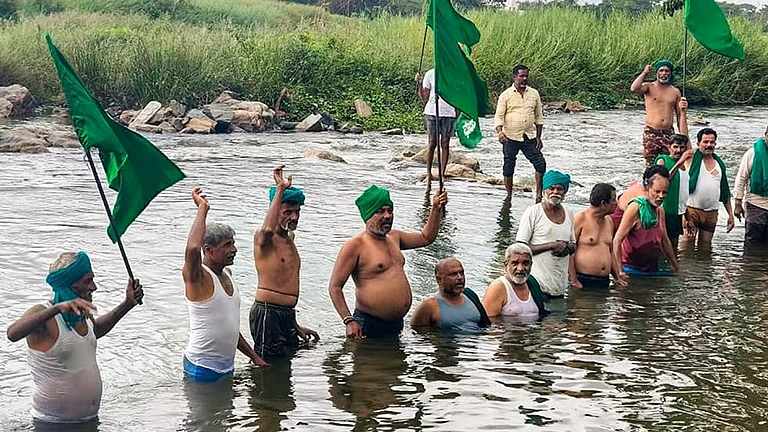
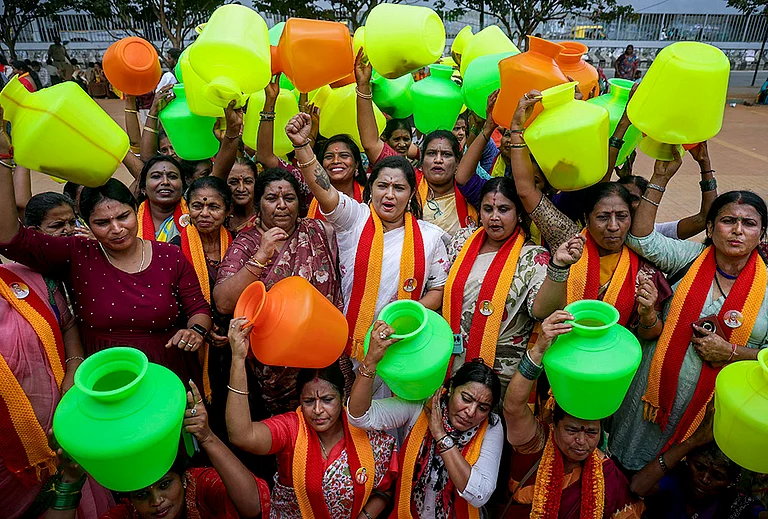
It began during a DMK protest in Thanjavur on August 3 over the Cauvery river water dispute and Karnataka's proposed Mekedatu project.
Udhayanidhi Stalin attacked the Vijay government for failing to secure Cauvery water for Tamil Nadu's farmers, saying the state had not received "even a single drop" of water and accusing the government of remaining silent on the issue.
According to reports, a section of the crowd then began chanting "Trisha, Trisha".
Stalin allegedly responded, "Whether the water reaches anywhere else or not, it should reach there." He subsequently clarified that he was referring to Cauvery water.
The TVK interpreted the remark as a sexual double entendre aimed at actor Trisha. The party accused the DMK leader of making an offensive comment that objectified women and lowered the standards of political discourse.
The TVK women's wing lodged a complaint with the Thanjavur East Police and approached the National Commission for Women. BJP leaders also condemned the alleged remark, describing it as vulgar and offensive.
Police subsequently registered an FIR against Udhayanidhi under several sections of the Bharatiya Nyaya Sanhita, the Tamil Nadu Prohibition of Harassment of Women Act and the Information Technology Act.
Trisha's Name In The Centre
Trisha has never entered politics. Yet her name has repeatedly been invoked in Tamil Nadu's political discourse because of her long professional association with Vijay.
Advertisement
The two actors have worked together in several films over two decades, while rumours about their personal relationship have circulated for years.
Trisha's name has also been invoked by political opponents while targeting Vijay.
Earlier this year, BJP leader Nainar Nagendran faced criticism after saying Vijay should "come out of Trisha's house" before entering politics. Trisha's legal team subsequently condemned attempts to drag her into political debates.
The latest controversy has therefore moved beyond the Cauvery dispute, with Trisha once again becoming the focus of a political confrontation despite having no political role.
Why Has The Udhayanidhi-Vijay Rivalry Intensified
The political rivalry between Udhayanidhi and Vijay has to be seen against the backdrop of the 2026 Assembly election.
Vijay's TVK, which was founded two years ago, emerged as the single-largest party in the Assembly, winning 108 of the 234 seats it contested. The DMK, which had been in power since 2021, was pushed into second place with 59 seats, while the AIADMK won 47.
Advertisement
The result disrupted the established Dravidian political contest between the DMK and AIADMK.
According to the Election Commission, TVK secured 34.92% of the vote, while the DMK polled 24.19%. The TVK's emergence as the single-largest party nevertheless marked a significant change in the state's political landscape.
Vijay had also spent years building a grassroots network through the Vijay Makkal Iyakkam, which had consolidated around 85,000 fan clubs, according to reports. The organisation was involved in blood donation drives, flood relief and other welfare activities.
With TVK now in government and the DMK in Opposition, Vijay has emerged as a central figure in Tamil Nadu's new political contest.
How Has The TVK Responded
The TVK has responded aggressively to the alleged Trisha remark, accusing the DMK leader of making a vulgar and offensive comment.
The controversy escalated after the FIR and Udhayanidhi's arrest.. Speaking before he was taken away, Udhayanidhi denied naming anyone apart from the Chief Minister and questioned why the remark had become an issue.
Advertisement
The DMK has maintained that his speech was about the Cauvery crisis and that clips of his remarks were being circulated in a distorted form. Udhayanidhi himself accused his opponents of using "cut, copy, paste" to portray him as having said something he did not.
The arrest and subsequent protests further intensified the confrontation, with DMK workers taking to the streets in several districts. The party also accused the Vijay-led government of using the police to target the Opposition.
The Madras High Court subsequently directed the police to release Udhayanidhi after questioning.
Tamil Nadu's New Political Rivalry
The 2026 election result suggests that Tamil Nadu's familiar Dravidian political binary has been disrupted.
The TVK emerged as the single-largest party after contesting all 234 seats independently, placing Vijay at the centre of the state's political contest.
For the DMK, the challenge is no longer limited to the AIADMK. Vijay's party has presented itself as an alternative to the established Dravidian parties, while describing the DMK as its political adversary.
Advertisement
The latest Udhayanidhi-Trisha controversy has added a deeply personal and contentious dimension to this emerging rivalry.
Published At: