The Supreme Court permitted the Karthigai Deepam lamp to be lit at the disputed Deepathoon on November 24.
The lamp was lit at its customary location, prompting allegations of non-compliance and a possible contempt petition.
The BJP has turned the dispute into a political issue, targeting the Tamil Nadu government and INDIA bloc partners.
Deepathoon Dispute In Tamil Nadu: Temple, Dargah & The Political Controversy Over Karthigai Deepam
The Karthigai Deepam dispute at Thiruparankundram hill has escalated into a political showdown after the lamp was not lit at the disputed Deepathoon despite a one-time SC permission

Summary
Bharatiya Janata Party (BJP) Rajya Sabha MP Sudhanshu Trivedi on Wednesday accused the Tamil Nadu government of disregarding a Supreme Court order on the lighting of the Karthigai Deepam lamp at a disputed stone pillar on Thiruparankundram hill in Madurai. The apex court had permitted the lighting of the lamp at the site.
Trivedi alleged that the Tamilaga Vettri Kazhagam (TVK)-led government, of which the Congress is an alliance partner, had failed to implement the court's direction on November 24. He also targeted the INDIA bloc and Congress leader Rahul Gandhi, accusing them of showing contempt for constitutional authority.
The controversy has since moved beyond a dispute over a religious ritual, bringing questions of judicial compliance, customary worship, the rights of temple devotees and the adjoining dargah, and the administration's law-and-order concerns into focus.
What Happened On November 24?
On November 20, Supreme Court permitted the lighting of the ceremonial lamp at the Deepathoon on Karthigai Deepam day, November 24, as a one-time arrangement.
The order came from a Bench of Justices Aravind Kumar and Vipul Pancholi, which was hearing appeals against the Madras High Court's directions allowing the ritual at the disputed spot.
The permission was subject to strict conditions. Only an authorised team of temple representatives and government officials could access the site. The Madurai District Collector was made the nodal officer, with arrangements to be coordinated with the temple administration, the Archaeological Survey of India and the police.
The court barred public gatherings, processions, demonstrations and slogan-raising at the location. It also clarified that the one-time permission did not establish any customary right to light the lamp there in future.
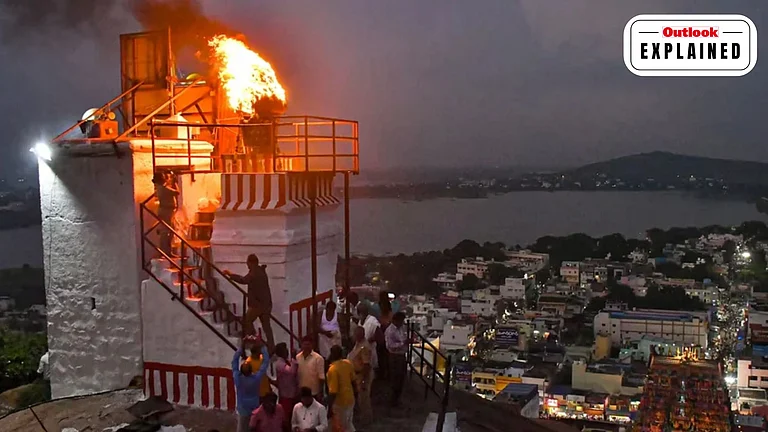
However, the lamp was lit at its customary location near the Uchipillaiyar temple and not at the disputed Deepathoon.

On Wednesday, the Supreme Court was informed by the Madurai District Collector's counsel, Senior Advocate Gopal Sankaranarayanan, that the lamp had not been lit at the Deepathoon. The Collector had filed a status report on the matter.
Advertisement
Senior Advocate Guru Krishnakumar, representing the petitioners who sought the ritual at the pillar, alleged deliberate non-compliance and said his side would file a contempt petition. The Bench declined to initiate contempt proceedings on its own, asking the petitioners to file the necessary plea.

Where Is The Deepathoon, And Why Is It Disputed?
The Deepathoon is a stone pillar situated on Thiruparankundram hill, around 50 metres from the Hazrat Sultan Sikandar Badusha Auliya Dargah.
The hill is home to the Arulmigu Subramaniaswamy temple, associated with Hindu worship, as well as the dargah and other historical religious sites. The present dispute concerns whether the annual Karthigai Deepam lamp should also be lit at the pillar, in addition to the customary location near the Uchipillaiyar temple.
Devotees seeking the ritual describe the pillar as a Deepathoon, or lamp pillar. The Tamil Nadu government and temple administration have argued that it is a survey structure and that there is no established tradition of lighting the festival lamp there.
Advertisement
The dargah management has also opposed the demand, citing its rights over the adjoining hilltop area.
How Did The Matter Reach The Supreme Court?
The dispute returned to court in November 2025, when devotee Rama Ravikumar approached the Madras High Court after the temple administration refused his request to light the lamp at the pillar.
On December 1, 2025, a single-judge Bench of Justice GR Swaminathan directed the temple to light the lamp at the Deepathoon in addition to the customary location. After the authorities did not implement the direction, citing law-and-order concerns, the judge initiated contempt proceedings and permitted a small team to reach the spot under security cover.
A Division Bench of the Madras High Court upheld the direction in January 2026, holding that the pillar was a Deepathoon and that the ritual could be conducted with safeguards.
Advertisement
The Tamil Nadu government and the dargah authorities challenged the High Court's findings before the Supreme Court. During the hearing, the state argued that recognising survey pillars as religious structures could invite similar claims elsewhere.
The Supreme Court's November 20 order allowed the ritual only as a one-time measure, while staying relevant findings of the High Court and leaving questions of custom, ownership and religious rights open.

Why Has The Row Become Political?
The BJP has accused the TVK-led government and its INDIA bloc partners of failing to respect the Supreme Court's direction. Trivedi said the episode exposed what he called the alliance's approach to constitutional values.
The state, meanwhile, has challenged the one-time order through a review petition, maintaining that the customary ritual is performed at the Deepa Mandapam and raising concerns over law and order and the disputed site's status.
Advertisement
The issue now rests on the legal proceedings that follow. The Supreme Court has not settled the larger question of whether the Deepathoon is an established site of religious worship, nor has its one-time permission created a permanent right to conduct the ceremony there.
Published At: