The global military community is still trying to grapple with drone warfare.
Drones have complicated matters as they bypass traditional, on ground physical security measures and provide very limited time frame for the defender to act.
India needs an annual dialogue forum spearheaded by the government to specifically discuss around the theme of counter-drone strategy.
Column | Houthi Attack On Aramco Exposes New Vulnerabilities In Drone Warfare
There is much to be learnt from the latest wave of drone attacks in Saudi Arabia

Summary
Recently, parts of Aramco Tower in Saudi Arabia were hit by debris from a drone and missile attack by the Houthi rebels. Media reports suggest that Saudi Air defence units mitigated several waves of drone and missile attacks in the capital city and across the country. This is not the first time that the Houthis have attacked Saudi Arabia using drones and missiles. In the past few months, Houthis have stepped up pressure on Saudi Arabia’s energy infrastructure, military installations, airports and even public places.
It is a very new kind of warfare, one which the global military community is still trying to grapple with. Not an easy one too, considering that some damage on the defender’s side is inevitable as the adversary’s side will keep sending waves after waves of drones and missiles. Some drones are sent just to exhaust the defender’s air defence inventory. Nevertheless, the defender is under obligation to defend each wave either through soft kill or hard kill options. At some point, fatigue creeps in onto the defender’s side.
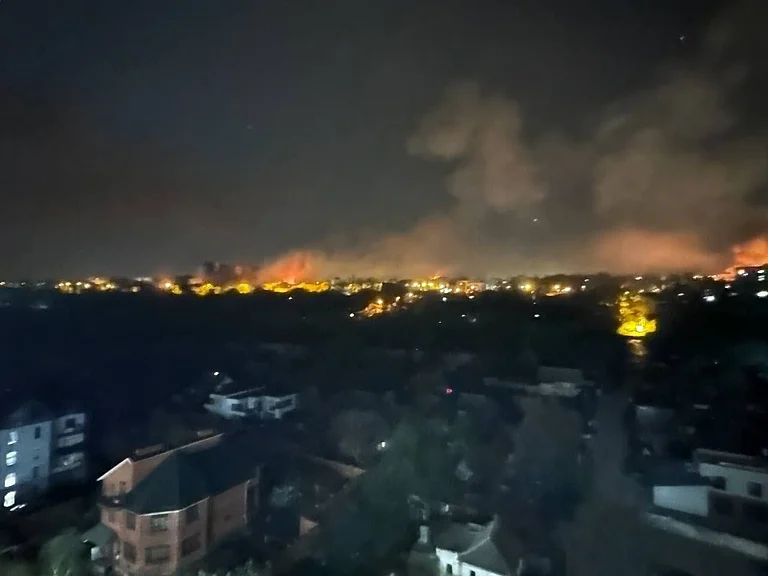
Drones Have Complicated Matters
It exposes several limitations too. What all to defend is a central challenge which security agencies across the world face, especially when facing a well-endowed and determined adversary. Each installation or area also brings with it its own set of complications while planning an air defence architecture.
This was also a question which law enforcement agencies faced a couple of decades ago when terrorism started mushrooming in different parts of the globe. Drones have further complicated matters as they bypass traditional, on ground physical security measures and provide very limited time frame for the defender to act.
The impact is not merely causing physical harm to the target area. It is reputational too. If the target is a corporate entity, then one high-profile drone attack is enough to bring down its stock value. Moreover, both the public and investors can question the company’s preparedness and resilience against such attacks.
Advertisement
In this case, Aramco is widely known as the crown jewel of Saudi Arabia and symbolic of the country’s energy profile. Damage caused to any of its infrastructure, even if it was a result of falling debris, puts pressure on the Kingdom’s military preparedness. Such attacks, as seen in the wider Gulf region and elsewhere in other active conflict zones, also signal to the larger public that any area or installation is vulnerable to drone and missile attacks.
Strategy For Drone Attack Mitigation
For India, there are quite a few security-related lessons to be learnt from such attacks. India needs a national-level conversation to understand drone attacks and its several facets. It is time for Indian security agencies to conduct a vulnerability assessment of Indian entities which could be prone to drone attacks from India’s conventional and unconventional adversaries. Considering how drone warfare has unfolded globally and the unbearable pressure it brings on the energy and economic security of any country, it is time the Union Government formulates an updated, comprehensive national-level strategy for drone attack mitigation. This strategy must take clear cut cognisance of recent developments that have taken place across the globe and the impending challenges they present. As multiple players are involved at national, state and local levels, there is a need for clear-cut work allocation and division of responsibilities among the plethora of security agencies involved in collecting intelligence, actual mitigation of attack and conducting its investigation. There is a need to create all-round capabilities within different security agencies at the central and state government levels on drone warfare.
Advertisement
Considering that several of the drone attacks have taken place world over on privately-owned facilities, there is a need for any future policy to formally make security counterparts in the private sector as equal partners in the counter-drone kill chain. India needs an annual dialogue forum spearheaded by the government to specifically discuss around the theme of counter-drone strategy. Such an initiative will signal and infuse a sense of confidence within the public and portray a resilient profile of India Inc.
As seen in the past few years, drone attacks have often targeted civilian infrastructure and public places, so there is a need for greater sensitisation within the public too when it comes to drone threats. Responsible drone usage is just one part. More importantly, there is a need to create awareness and mechanisms for the public to report if a drone is being used in an unauthorised area or if something sounds amiss. In a hypothetical scenario, if a drone attack indeed happens, the public should know what to do, and more importantly, what not to do. The National Cadet Corps, the National Service Scheme and other such youth-based initiatives are very important to sensitise and create a generation of responsible citizens who are conversant with emerging threats posed by rogue drones.
Advertisement
(The author is an Assistant Professor at the Subhas Chandra Bose Chair of International Relations, Chanakya University, Bengaluru. He specialises on national security issues, defence & aerospace manufacturing and global geopolitics)
(Views expressed are personal)
Published At:
Tags