India promised to end bonded labour by 2030 — yet thousands of families remain unpaid prisoners in brick kilns and farms in 2025.
Rescued workers rarely receive rehabilitation money or justice; most fall back into the same cycle of debt and slavery.
Officials deliberately refuse to register cases as “bonded labour” to avoid international scrutiny and protect powerful contractors.
Bonded Labourers Are Still Waiting — Even As India’s 2030 Deadline Nears
Survivors of bonded labour, from brick kilns to construction sites—describe fear, hunger, and state apathy, as India’s promise to end slavery by 2030 drifts further from the lives it was meant to save.

Summary
Amar Kumari Bharti’s 15-year-old son was made to sleep beside a stranger, night after night. The reason? A thekedaar had to assure himself that neither Bharti nor her son would escape.
They worked for a thekedaar as bonded labourers, unpaid, forced to live in inhumane conditions; a fate shared by many other families working at the brick kilns at Maharajganj, Uttar Pradesh.
This is the story of AmarKumari Bharti (40) from Chhattisgarh, who says she realised very early in life that her only option for survival was to work at brick kilns, with no escape. “My whole life has gone into this.”
Bharti and her family lived in inhumane conditions–no rations, no money; not being allowed to seek medical attention except in the most dire circumstances.
“We were not allowed to seek medical help until the situation became life-threatening. Only then would he (the thekedaar) let us see a doctor, and even then, he would send a man to keep watch over us because he thought, ‘they will run away’”, she says.
Bharti used to work continuously for more than 12 hours, till early morning and starting again by noon.
Bonded labour often starts with a small loan, but once people begin working, they’re never told how much they still owe or when the debt will end, so they end up trapped far longer than they expected.

Bonded Labour Continues Long After the Deadlines
India's 2030 pledge is to end forced and bonded labour. But a new report has laid bare a chasm between promises and reality. Published in November, the 'Report on Migrant Bonded Labour in India' scrutinises the Bonded Labour System (Abolition) Act 1976 (BLSAA) and the Central Sector Scheme for the Rehabilitation of Bonded Labourers 2016. The report draws from surveys of 950 rescued workers across 19 states, including discussions with nearly 1,000 more.
Advertisement
The report's roots trace back to 2016, when the Union Government set a 15-year timeline for total abolition of bonded and forced labour, echoing NITI Aayog's push under Sustainable Development Goal 8.7. The goal calls on all countries to take immediate and effective measures to end forced labour, modern slavery, human trafficking, and the worst forms of child labour, including the recruitment and use of child soldiers, and to eliminate child labour in all its forms by 2025.
This year also saw revisions to the rehabilitation scheme, boosting cash aid to ₹ one lakh for adult men, ₹ two lakh for women and children, and ₹ three lakh for disability cases.
The National Campaign Committee for the Eradication of Bonded Labour (NCCEBL) launched the study in April 2024 to test the 1976 and 2016 enforcements. It asked the questions: Do district magistrates identify bonded labour promptly? Do the vigilance committees deliver rehabilitation?
Advertisement
The survey was carried out across multiple states and districts that are known for seasonal migration and for labour-intensive industries, such as brick kilns and stone quarries. These are the sites where migrant labourers are most likely to enter work through informal advances or labour contractors.
The researchers noted patterns of control: advances taken during the lean seasons, movement across state borders, withholding of wages, surveillance in the workplace, and threats that prevent workers from leaving. The study was therefore designed not only to trace where workers come from, but to follow what happens to them once the state intervenes.
Rescue, the report argues, is only the first step, and not necessarily a decisive one.
Rehana Begum (42), another rescued bonded labourer, had been forced to work since 2014. It took her four years to regain her freedom in 2017.
A resident of Bihar, Begum travelled to Delhi in search of a better life. Her husband owned a small roadside tea stall in Dwarka Sector 7. She had no way of knowing that taking an advance of Rs 5,000 would end up costing her four years of forced labour and exploitation.
Advertisement
One afternoon, when Begum’s husband was away for lunch, a man approached her, a thekedaar, and asked if she wanted a job. Begum naively responded that she, being an uneducated woman, couldn’t do a job. The man offered her work looking after the public washroom in a DDA park. The timings, 10 am to 6 pm, sounded manageable, a regular day’s work. It gave her a sense of hope, a possibility of a better life for her three children.
“After the job was finalised, the thekedaar suggested that I should also shift inside the park and that they would help me in moving and setting up a jhuggi (makeshift house). They (the thekedaar and DDA) paid me Rs 5,000 advance and helped me in shifting. They had said that my duty would start at 10 am, but I was then forced to wake up at 5 am and work until 11 pm.”
Advertisement

Begum said that over the years, innumerable thekedaars had come and gone, but her situation never changed. She was never paid the promised salary for her job, and was then threatened to discourage escape.
“We somehow kept living in those conditions, our only income was through the teastall my husband ran. My girls were all grown up till that time, but I really suffered when my third was born.”
In Nirmal Gorana, the convenor of NCCEBL, Begum found someone who fought for her rights, and she received two lakhs under the rehabilitation scheme. But now, another issue has arisen; she has been receiving notices and running to courts because the government thinks that she is an imposter.
Gorana says the root problem is not the law itself but the deliberate refusal of the state to implement it.
“It’s not that they are doing it by mistake. They are doing it intentionally. They don’t want anyone to declare Bandhua (Bonded labourer),” he said, adding that such declarations trigger international scrutiny. “If Bandhua is declared, then they will have to mention it in the slavery report, which is submitted to the United Nations, about every state.”
According to him, this active denial deepens exploitation. “Instead of getting rid of this disease, they are hiding the disease and increasing it a hundred times”.
His first entrapment began with a ₹5,000 advance that an agent gave him to work at Asia Brick Kiln.
“For eleven months, the munshi and a chowkidar guarded us day and night; they never let us out of sight,” Nathan said. Children from his own village also worked there. Everyone lived on handfuls of rice. No wages were ever paid. A raid by NCCEBL and the district administration finally freed them, but no case was filed, and no back wages were released.
After staying home for six or seven months, hunger pushed him out again. This time, he reached Palwal district, Haryana, where for six to nine months he peeled sugarcane, cleaned cattle sheds, picked dung, swept the owner’s large house and milked cattle. In return, he received only ₹2,000 and barely enough food to survive.
“I fell at the owner’s feet, begged him to send money home,” he recalled.
On New Year’s Day, three men beat him and threw him out. With help from Vinod Kumar Singh of Mehnatkash Association, Nathan filed a complaint before the Collector, but years later, nothing has come of it.
A third time, an agent took Nathan’s entire family, wife, four children and elderly mother to S.M. Brick Kiln in Tarn Taran, Punjab, against a ₹10,000 advance. They worked 16–17 hours daily for ten months. When one of his children fell sick, Nathan asked for just a ₹500 advance. The owner slapped him and told him to summon the contractor. The original advance was inflated to ₹25,000, and no wages were paid. NCCEBL rescued the family along with seventeen others. Yet again, they received no wages.
Back in the village, Nathan and his wife worked nearby fields, but were paid unequal daily rates for the same job: ₹300 for him, ₹250 for her.
Years later, a contractor from his own village took him and 14 others, including one minor, to a construction site in Noida. All of them were crammed into one room “like animals,” and they worked round-the-clock, yet the contractor vanished with every rupee. “Statements were taken, thumbprints collected, but till today not a single paisa has reached us,” Nathan said.
Even the government’s promised rehabilitation has remained a mirage. “If they give one lakh rupees per person as rehabilitation, my family alone has already done labour worth more than six lakhs,” he said with frustration in his eyes.
Today, Nathan still peels sugarcane for up to 14 hours a day, earning at most ₹600.
“Whatever I have earned in my life,” he said, “has been swallowed by slavery.”
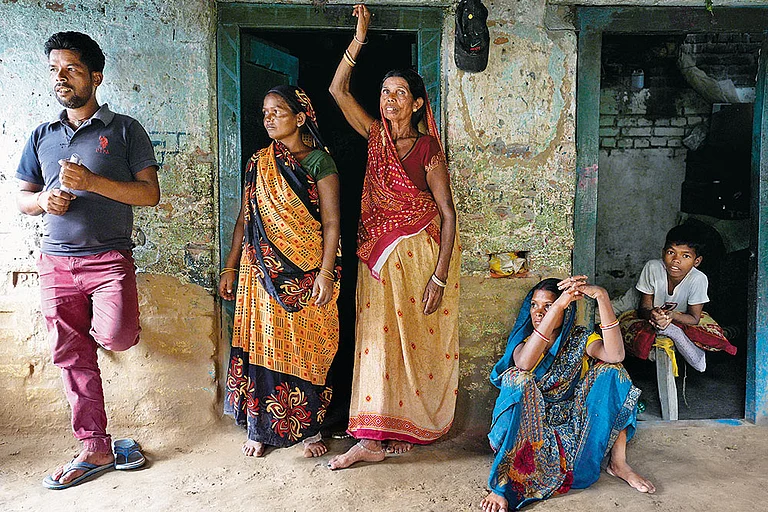
Long-Term Threats, Helplessness and State Apathy Shape Survivors’ Minds
Psychologist Kaeya Nag says rescued bonded labourers are profoundly impacted by the chronic fear and abuse.
"This constant state of hypervigilance, and when the mind is in this kind of stress, panic, anxiety, it is bound to fundamentally alter the mental and physical state".
Nag also detailed the phenomenon of “learned helplessness” that emerges when the threat is sustained over extended periods, “Learned helplessness gets generated, because the threat has been around for so long that you stop fighting it.” This sustained oppression leads to the eventual acceptance of the trauma, as the "dehumanisation" becomes accepted over time.
Discussing the manipulation of children, Nag stressed, "The bond is created on fear, the person is not only feeling unsafe, but is also dependent". She added that "intense long-term fears have lasting, if not permanent, impact on the brain and the entire stress factory of the body".
Nag asserted that chronic stress resulting from bonded labour detrimentally affects cognitive functioning, impacting mental clarity, decision-making, and general mental operation.
She observed that pre-existing issues of self-worth often compound the victim's situation, especially among those from lower castes, contributing to a prolonged stay in exploitative conditions.
While rehabilitation schemes exist, Nag posited that the hope that the victims experience is likely derived more from the "human connection" established with the individuals who are actively attempting to assist them. She reasoned that most labourers would not be aware of the schemes on their own.
No System for Rehabilitation
“In the entire country, there is no such thing as psychological rehabilitation– none,” Gorana says. According to him, trauma is dismissed outright. He said this reflects “a lack of sensitivity.”
Responding to questions about Rehana Begum’s case, in which he also received a notice, Gorana said he was only an intermediary who helped a migrant worker reach the authorities. He added that the only role he played was drafting a complaint.
“I am not a postman in the definition of the government. But I worked as a postman… I worked as a mediator. I got a migrant worker to meet the government, and now I have received a notice myself”, he said.
Kawalpreet Kaur, a lawyer practising before the High Court and Supreme Court, said the biggest obstacle is that officials “routinely deny the existence of bonded labour”, refusing to start inquiries. Instead of applying the statutory presumption in favour of workers, they demand “impossible proof”, turning a protective law into “a gatekeeping exercise”.
She said district administrations delay the release of certificates because they see them as an admission of failure. Bureaucratic apathy, pressure from landowners and brick kiln owners, and a reluctance to acknowledge that bonded labour persists all contribute. “They simply don’t want it on record,” she says.
According to her, authorities “rarely invoke the Bonded Labour Act at all”. Police rely on minor IPC offences or labour laws that avoid naming bonded labour, while district officials stay away from the Act due to political pressure, lack of training, and a mindset that minimises structural exploitation. The outcome, she said, is systematic under-enforcement.
Rehabilitation also breaks down at verification and approval. Even after release certificates, funds are delayed, training is perfunctory, and long-term support like land or livelihood packages is ignored. “Rehabilitation collapses at the first step,” she said.
This non-implementation is not accidental. Acknowledging bonded labour means acknowledging caste-class power structures, so “wilful ignorance becomes the default”. The failure, she said, is “largely intentional, not administrative”.
She added that NREGA could be a crucial safeguard by reducing dependency on contractors and exploitative creditors, but chronic under-implementation and delayed wages blunt its impact.
Gorana also spoke about the personal threats he faces for pursuing bonded labour cases. He said the hostility against him has been growing, even though he works strictly within the government’s own legal framework.
Despite working with district administrations under the Bonded Labour Act, he said he receives no protection from the government.
The study makes it clear that rescue is the only moment when the state is fully present. Everything after that begins to thin out. Families who are supposed to receive food, shelter and medical care immediately after rescue often get nothing. They wait in police stations or temporary rooms, unsure of what comes next. The law promises immediate relief; but in practice, it rarely arrives. Even the journey home is left to workers to arrange, often through borrowed money or goodwill.
After the rescue, the paperwork is no relief. Workers are made to sign statements they cannot read, injuries and illnesses go unrecorded, and police often reduce abuse to simple wage disputes. Release certificates are delayed or replaced with photocopies that no one accepts. Back home, cases are reopened, identity checks drag on for months, seasonal migrants vanish from records, wherein women and children are frequently left out entirely, losing entitlements and schooling, with no one following up to secure their rights.
This is not a technical lapse, but a steady pattern. The process collapses in the space between departments, states, and responsibilities. No one monitors whether families fall back into bondage. No one checks if children return to school. No one tracks contractors who return every season.
By the time the state looks up again, if it ever does, most families have already slipped back into the migration stream, the same road, the same debts, the same labour waiting at the other end.
Today, December 10, the world marks International Human Rights Day. Seventy-seven years after the Universal Declaration of Human Rights proclaimed that “no one shall be held in slavery or servitude,” thousands will wake up before dawn in brick kilns and fields across India, still waiting for the freedom their country promised them by 2030. For them, every day is a reminder that rights remain on paper while chains stay on the ground.
Published At:
Tags