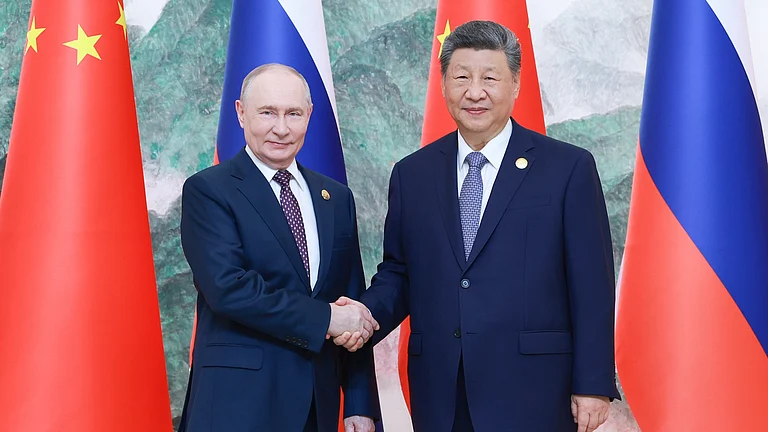
Three anxious powers met in Shenzhen—US President Donald Trump, Chinese President Xi Jinping and Russian President Vladimir Putin—each hoping to borrow stature from the other two.
The summit was good optics: legitimacy for Putin, stature for Xi, reach for Trump. For everyone else, it was a warning about what a great-power condominium might look like, and a reminder that a document with no verifiable commitments is a statement of intent, not a settlement.
A format implying that the big three manage the world, endorse UN reform among themselves and shield each other’s leaders from international law is exactly what middle powers have spent decades resisting. New Delhi will not accept a trilateral directorate over its neighbourhood.
Three Anxious Powers On A Trampoline: Assessing The Shenzhen Trilateral
A summit assembled quickly, 80 minutes of talks, four generic points, and silence on Ukraine, Iran, Taiwan and missile defence

Summary
Three anxious powers met in Shenzhen—US President Donald Trump, Chinese President Xi Jinping and Russian President Vladimir Putin—each hoping to borrow stature from the other two. The meeting lasted about 80 minutes and produced a four-point declaration. It was historic in format and thin in content. The declaration says as much through what it includes and what it leaves out.
The declaration reads like three separate wish-lists stapled together. Point one, on UN reform, is the language of permanent members protecting their franchise. Three veto holders calling for a more effective UN is not a call for a more representative one, and India, Japan, Brazil and Germany would have noticed. Point two promises more refined petroleum products and “stable energy flows”. That is the Iran war and the Gulf disruption entering through the side door and it is the closest the document comes to a concrete deliverable. Even so, it is a statement of plans with no volumes, mechanisms or timelines.
Point three is the most revealing. By insisting on state consent and the immunity of state officials, and warning that the International Criminal Court (ICC) and similar bodies must not “abuse their jurisdiction”, the three leaders effectively declared a shared interest in shielding leaders from international accountability. Putin, who faces an ICC warrant, is the obvious beneficiary, but Washington has its own grievances with the court and Beijing has long rejected external jurisdiction. It is the one clause where all three interests converge and it is not a peace measure at all.
Point four reaffirms that a nuclear war “cannot be won and must never be fought” and promises a dialogue on reducing risks and preventing proliferation. This repeats the 1985 Reagan-Gorbachev formula and commits to talking about talking. There are no limits, no verification and no timetable.

Advertisement
Who Won What
Putin got the most visible dividend. After years of attempted isolation, he sat as an equal at a table of three and signed a document treating Russia as a co-custodian of international security. The ICC clause is a bonus.
Xi got the role he has been cultivating: host, convener and defender of a fraying order. He also avoided the nuclear trap. Washington had floated denuclearisation and arms control as summit themes, and Beijing, with a smaller but rapidly expanding arsenal, has no wish to be capped alongside the two larger powers. A “dialogue on reducing risks” costs him nothing and commits him to no limits.
Trump showed that the American presidency can still gather the other two great powers in one room, even with domestic politics unsettled after the midterms. The energy clause gives him something to point to on fuel prices. But the Iran and Ukraine wars, the subjects that made the summit newsworthy, appear nowhere in the text. A president under pressure to deliver an exit from Iran left with language on petroleum supply.
Advertisement
Poorly Prepared
The signs are all there: a summit assembled quickly, 80 minutes of talks, four generic points, and silence on Ukraine, Iran, Taiwan and missile defence. The participants arrived with divergent priorities, namely recognition for Russia, status and stability for China and a visible win for the US. The declaration papers over the differences and settles none of them. Each leader can claim success, which is usually a sign that nothing hard was decided.
A Wrong Move In A Multipolar World
The deeper problem is strategic. The 2026 order is not a world of three. India is a swing power and the most populous nation on earth. Japan, South Korea and the Indo-Pacific partners sit on the front line of Chinese and Russian pressure. Europe, whose security is most directly affected by Ukraine, was left to read about a settlement of great-power responsibility from the sidelines.
Advertisement
A format implying that the big three manage the world, endorse UN reform among themselves and shield each other’s leaders from international law is exactly what middle powers have spent decades resisting. New Delhi will not accept a trilateral directorate over its neighbourhood. Tokyo, Seoul, Canberra and European capitals will read the ICC clause and the UN language as an attempt to rewrite rules without them. The likely effect is more hedging and more coalition-building among those excluded, along with a sharper demand for a voice in any future arrangement.
The Verdict
For the three principals it was good optics: legitimacy for Putin, stature for Xi, reach for Trump. For everyone else, it was a warning about what a great-power condominium might look like, and a reminder that a document with no verifiable commitments is a statement of intent, not a settlement. Its test will be practical. Do refined fuel supplies improve, does a nuclear risk dialogue actually convene, and does anything change in Iran or Ukraine? If the answer is no, the trampoline gave three leaders a brief lift, and the multipolar world will remember who was left off the guest list.
Advertisement
(The author is a former ambassador and author of The Durian Flavour)
(Views expressed are personal)
Published At:
Tags