Pedro Sánchez faces a tough fight to remain Spain's prime minister.
Housing, immigration and inflation dominate the November 29 elections.
A PP-Vox alliance could shift Spain's politics to the right.
Spain Elections 2026: Can Pedro Sánchez Survive As Right-Wing People's Party, Vox Seek Power?
Pedro Sánchez faces a tough battle as PP and Vox seek power. Here's a look at key issues, opinion polls and what his defeat could mean

Summary
Nearly eight years after coming to power, Spain’s Prime Minister, Pedro Sánchez is fighting hard to remain in office against the conservative People's Party (PP) and the far-right Vox.
Spain is heading into snap elections on November 29 after Sánchez called for snap elections when a bill proposing changes to Spain's housing laws was rejected.
The bill was introduced by the government after protests erupted across Spain over the eviction of an 87-year-old woman, Maricarmen Abascal, from her rented home in Madrid. She died later.
However, his government lost the support of Junts, a centre-right party from Catalonia in north-eastern Spain that wanted stronger protections for property owners.
How Government Is Formed In Spain?
Spain elects its 350-member Congress of Deputies through a proportional representation system in 50 constituencies which are largely based on provinces. Each province is given a minimum of two seats, while Ceuta and Melilla have one representative each. The remaining 248 seats are distributed according to population.
The number of seats varies by province. Madrid has 38, Barcelona 32 and Valencia 16.
Voters choose party lists rather than individual candidates. Seats are allocated proportionally based on the votes each party receives in a constituency.
A party must get at least 3% of the valid votes in a province to qualify for seat allocation. However, in smaller provinces with fewer seats, parties generally need a higher percentage of votes to win seats.A party needs 176 seats for a clear majority in the 350-member lower house.
Who Are Main Contenders?
The main contenders in Spain elections 2026 are Pedro Sánchez of the centre-left Spanish Socialist Workers' Party (PSOE), Alberto Núñez Feijóo of conservative People's Party (PP). Santiago Abascal of the Vox party is also a major player who could decide the fate of the elections.
Sánchez is defending his eight years in power. He is focusing on social welfare, affordable housing, and stronger tenant protections. Sánchez is also in favour of immigration, as he argues that migrant workers benefit Spain's economy.
Advertisement
Feijóo is promising lower taxes, fewer government regulations, and tighter immigration controls. His party also wants to restrict access to certain welfare benefits for migrants.
Abascal’s party has made the removal of migrants its top manifesto demand, calling for the “immediate expulsion of all invaders”. He has also accused Prime Minister Pedro Sanchez’s Socialist government of allowing migrants into the country as part of what he calls an attempt to “replace the Spanish people”.
His Vox party is calling for cuts to regulations and reversing several progressive policies, including those on gender and social issues.
While the PP is the main opposition party, Vox could hold the balance of power if the two parties secure enough seats to form a government together.

What Are The Key Issues In Spain’s Elections?
In this election, the cost of living, immigration and housing are among the key issues. The economy of Spain has grown in recent years, but citizens are struggling with increasing inflation.
Advertisement
Immigration has also become a major issue for disagreement between the parties. The Socialists are defending migrant workers' contribution to the economy, while the People's Party and Vox are calling for tighter controls and tougher action against undocumented migrants. Corruption has also become a major issue in this election.
Higher rent has become another important issue in the elections. Increasing rents and property prices have made it harder to find affordable homes. The shortage of houses has added to public frustration.
Why Is Housing an Important Issue?
Property prices and rents in Spain rose by more than 80% between 2015 and 2025, while wages failed to keep up with the increase.
The country is facing a housing shortage as demand continues to outstrip supply. The Bank of Spain estimates that 700,000 new homes are needed to ease the pressure. Prime Minister Pedro Sánchez has made housing reform a key election issue.
Advertisement
Left-wing parties are calling for rent controls and stronger protection against evictions, while right-wing parties are pushing for more construction, tax breaks for homebuyers and fewer restrictions on housing development.
As a result, millions of Spaniards are struggling to afford homes and face the risk of eviction if their rents go up. Unions said around four million people took part in a general strike on November 11, the first such action since 2012.

Who Is Leading In Spain Elections Opinion Polls?
The conservative People's Party, led by Alberto Núñez Feijóo, is ahead of Prime Minister Pedro Sánchez's Socialist PSOE by a narrow margin in most opinion polls.
Feijóo has described the election as a turning point for Spain, saying the country is at its most important moment in 50 years. He has promised to restore trust in state institutions, strengthen democracy, bring the country together and rebuild national confidence.
Advertisement
However, forming a government could be difficult for PP without support from Vox, which is on third position in most polls.
Spain has nearly 50 million people, of whom around 39 million are eligible to vote in elections to the Congress of Deputies and the Senate.
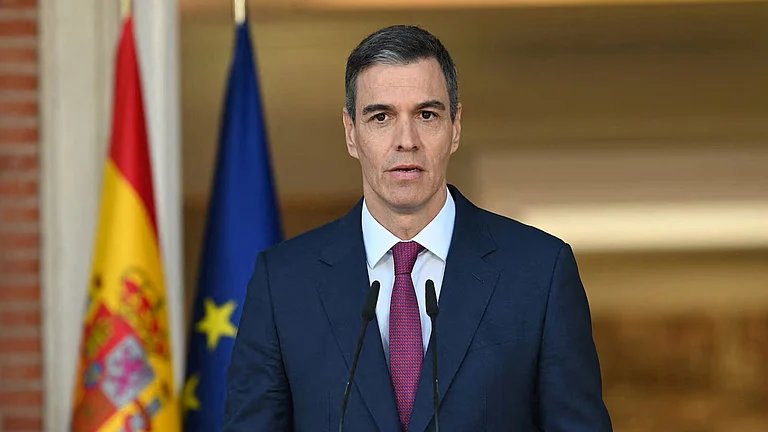
What Will Change In Spain If Sánchez Loses?
If Sánchez loses, Spain could see the end of its left-leaning government, which stood with a stronger position on issues such as Gaza and Palestinian rights.
Sánchez has been among Europe's most vocal critics of Israel's military war in Gaza and has recognised Palestine as a state.
If the conservative People's Party forms a government with support from far-right Vox, Spain will shift its policies towards the right. The new government could introduce tighter immigration laws, it could push for mass deportations. The government could also change welfare policies and roll back some of the progressive measures introduced under Sánchez.
Published At: