Attacks on properties linked to Muhammad Yunus and renewed Awami League mobilisation have exposed the fragile political stability following Hasina's ouster.
Prime Minister Tarique Rahman's BNP faces mounting challenges in maintaining law and order, consolidating power and managing tensions with former allies.
Jamaat-e-Islami is expanding its political influence, raising questions over the balance of power and the future of Bangladesh's opposition.
Sheikh Hasina Eyes A Return To Bangladesh: How Will Tarique Rahman Handle It?
Attacks on Yunus-linked properties, Sheikh Hasina's proposed return and growing friction between the BNP and Jamaat-e-Islami have raised fresh questions over Bangladesh's post-Hasina political transition.

Summary
Bangladesh is once again in the midst of political unrest. With the exiled Sheikh Hasina announcing her return to her home country by 16 December, the nation is facing renewed instability, with attacks on properties linked to former interim chief adviser Muhammad Yunus, rising tensions surrounding Hasina's proposed return from exile and growing friction between political parties.
As the Awami League attempts to regain political relevance, BNP's Tarique Rahman must consolidate its position in the government as parties such as the Jamaat-e-Islami are gaining popularity and are seeking more power after the unified struggle in bringing down the Hasina regime in 2024.
Bangladesh now faces fresh questions over its political stability and the direction of its post-Hasina transition.
Attacks on Yunus-linked properties
After the tenure of Former Chief Adviser to the Interim Government Muhammad Yunus came to an end in February 2026, when the Bangladesh Nationalist Party's (BNP) Tarique Rahman was elected Prime Minister, a period of peace followed.
However, with the news of former Prime Minister, the exiled Sheikh Hasina returning to her home country, has broken that fragile peace.
In the last few days, Bangladesh has witnessed attacks in areas in which the Awami League (AL) has a strong support base, on police stations and workers of the Bangladesh National Party (BNP).
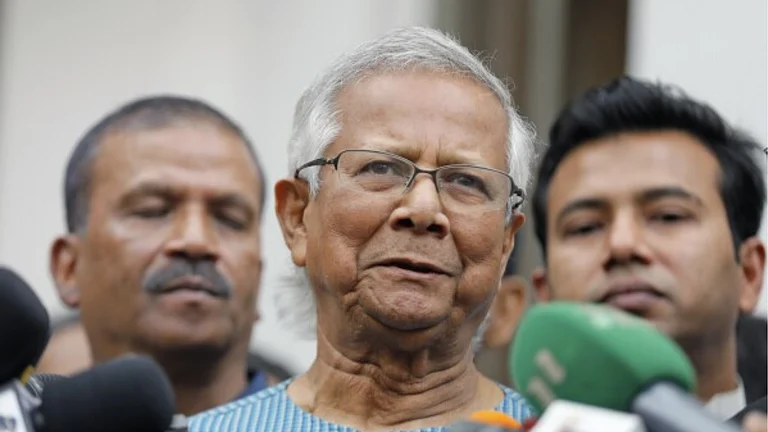
Moreover, the house of interim leader Yunus was also attacked, in which four people were killed. Calling out the repeated arson attacks, he claimed he had witnessed a calculated campaign of arson and terror in recent days. He said, while referring to the leadership of the banned Awami League, that Grameen Bank branches were being attacked "almost every day". He alleged that the branches were being targeted on the instructions of "someone at a higher level."
In what is speculated to be retaliation, nearly 30 properties of people linked to the AL were set on fire on Friday and Saturday.
Advertisement
As per reports, the unrest has claimed four lives, with at least four police installations and 28 police vehicles set ablaze. Another 83 vehicles, including buses, were also torched across the country.
This spell of violence has come forth due to the announcement of Former PM Sheikh Hasina's return.
Following the student-led uprising in August 2024, Hasina had fled the country and taken sanctuary in India. To fill in her leadership absence, the Yunus-led interim government took charge. Under Yunus, Hasina's Awami League was disbanded and declared illegal, with legal proceedings against its leadership.
The Awami League has remained largely inactive since. However, Hasina's repeated assertions of returning to Bangladesh as early as 16 December, despite her death sentence, seem to have revived the disbanded party.
Hasina's proposed return
Hasina's proposed return has become a major point of contention for the Tarique Rahman government. The former prime minister, who has been living in New Delhi since August 2024, has sought to return on December 16 aboard Bangladesh's national carrier, Biman Bangladesh Airlines.
Advertisement
This request was rejected by Dhaka, maintaining that she can only return through extradition from India. State Minister for Foreign Affairs Humayun Kobir has described Hasina as a "fugitive terrorist" and said she would be arrested and jailed if brought back.
Hasina was sentenced to death in absentia for crimes against humanity over the crackdown on the 2024 student uprising, in which the United Nations estimates that as many as 1,400 people may have been killed. She has denied the charges and said she intends to return and surrender before a court.
Her return, however, carries political implications beyond the legal proceedings. While she retains support among sections of the population.
Her announcement of her return has already reactivated some Awami League's grassroots network, which has remained largely dormant since the party was banned, as has been seen in the recent attacks.
The government is therefore faced with a difficult balancing act: containing the party's mobilisation while preventing further violence and addressing demands for the release of detained Awami League leaders and supporters.
Advertisement
BNP's political challenge
For Tarique Rahman and the BNP, the challenge is no longer simply about defeating the Awami League politically. Having returned to power after years in opposition, the party must now establish administrative authority and maintain law and order in a country still dealing with the aftermath of the uprising.
The government has faced criticism over its handling of political violence and the distribution of power. The replacement of senior district officials and transfers of police officers suggest an attempt to regain administrative control. However, changing personnel alone cannot resolve the political conditions that allow repeated confrontations.
The BNP is also dealing with pressure from former allies and other parties that were part of the movement against Hasina. Its disagreements with Jamaat-e-Islami over elections, constitutional reforms and the distribution of political influence have become increasingly visible.
The two parties, which once governed together after winning the 2001 election, have since moved towards separate political strategies. The BNP has sought to position itself as a more inclusive nationalist party, while Jamaat has pursued its own electoral ambitions.
Advertisement
Jamaat-e-Islami
Jamaat-e-Islami's growing influence is another significant development in Bangladesh's changing political landscape. For much of Hasina's tenure, the party faced restrictions and political isolation. Following the 2024 uprising, it has regained political space and is seeking to establish itself as a major force in the post-Hasina order.
Outlining the party's 40-day programme, Jamaat Secretary General Mia Golam Porwar said the party would resist fascism with public support through peaceful and democratic means, Dhaka Tribune reported.
"We will resist fascism alongside the people. We will not resort to violence but will counter it through democratic and lawful means. We will not allow fascism to regain a foothold," he said.
Porwar alleged that the activities-banned Awami League had resorted to sabotage, arson and violence following ousted prime minister Sheikh Hasina's announcement of her proposed return to Bangladesh. Hasina has been sentenced to death.
The growing distance between the BNP and Jamaat, since the toppling of Hasina's government, has also exposed competing claims over political influence. Jamaat Secretary General Mia Golam Porwar accused the BNP of being unwilling to share power.
Prime Minister Rahman has nevertheless held talks with Jamaat leader Shafiqur Rahman in an effort to build political unity. Jamaat's leadership has welcomed the initiative, although the durability of any understanding between the parties remains uncertain.
What lies ahead for Bangladesh?
Bangladesh's political transition is far from settled. The BNP must demonstrate that it can restore institutional authority and contain violence, while Jamaat and the NCP are seeking a greater role in shaping the country's future.
At the same time, Hasina's proposed return raises questions about whether the Awami League can regain political ground and how the government will respond to its supporters.
Whether the BNP can maintain its political dominance, manage its differences with Jamaat and prevent the Awami League's possible resurgence will remain central to Bangladesh's political future. The country's transition from Hasina's rule has opened up a new political contest, but whether it can translate into lasting democratic stability remains to be seen.
Published At: