Modi's Manila interaction with Trump contrasted with their earlier public displays of bonhomie
Disagreements over US mediation claims following Operation Sindoor and tariffs have strained ties
An unfinished trade agreement adds to tensions despite continued strategic cooperation through the Quad
From 'Howdy Modi' To Manila: The Cooling Of Modi-Trump Bonhomie
Narendra Modi’s restrained demeanour at the Manila Quad meeting marked a striking departure from years of public warmth towards Donald Trump. The change comes after Washington’s mediation claims over Operation Sindoor, tariff pressure and an unfinished trade agreement strained ties between the two countries.

Summary
The small Indian flag marker was placed on the floor. Prime Minister Narendra Modi bent to pick it up, explaining, “Main jhanda niche nahi chhod sakta,” I cannot leave the flag down. Donald Trump’s response was brief: “Save it.” The exchange lasted only a moment, but it captured the awkwardness of a meeting in Manila that offered a very different picture of the Modi-Trump relationship from the one the two leaders had spent years cultivating.
At the Tuesday Quad gathering, the familiar embrace and easy handshakes were conspicuous by their absence. Modi appeared restrained, his expression largely unchanged as Trump spoke to the assembled leaders and later engaged with reporters. Japanese Prime Minister Sanae Takaichi bowed towards the Japanese flag, while Modi retrieved the Tricolour marker. Trump and Australian Prime Minister Anthony Albanese left their markers where they lay.
The contrast continued during the photo opportunity. As Trump prolonged the interaction with the media, Takaichi and Albanese appeared increasingly uncomfortable. Modi, meanwhile, seemed keen to bring the exchange to a close, asking, “Can we move?” and gesturing towards the scheduled Quad meeting. His composure stood out against Trump’s animated answers and the visible unease of the other leaders.
The White House footage offered a revealing snapshot of the changed atmosphere. Modi’s demeanour alone cannot establish what he intended to convey, but his visible distance from Trump was striking for a leader who had once made personal warmth a defining feature of their diplomatic relationship.
From Howdy Modi To A More Complicated Friendship
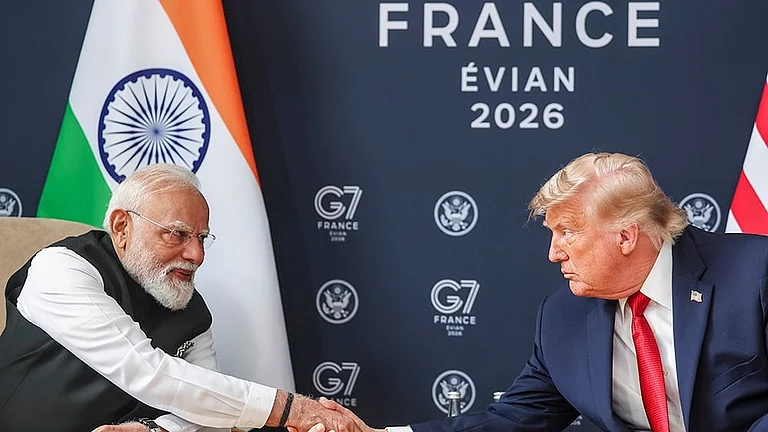
The public chemistry between Modi and Trump had been cultivated with considerable effort. In September 2019, Modi welcomed Trump’s participation in the Howdy Modi event in Houston as a special gesture reflecting the friendship between the two countries. Trump’s visit to India in February 2020, culminating in the Namaste Trump event in Ahmedabad, carried the same message of personal and political closeness.
When Trump won the 2024 presidential election, Modi congratulated his “friend”, recalling the two public events and expressing his desire to expand cooperation in technology, defence, energy and space. Even after the disagreements of Trump’s second term began to surface, New Delhi continued its diplomatic outreach. In September 2026, the two leaders spoke by telephone and reaffirmed their commitment to advancing the India-US Comprehensive Global Strategic Partnership.
Advertisement
That public engagement makes the Manila encounter more significant. Modi had continued to invest in the relationship even as Washington’s approach increasingly tested New Delhi’s strategic and economic priorities. The strain has been building across several fronts.
Operation Sindoor And The Dispute Over American Mediation
The sharpest political disagreement emerged after Operation Sindoor in May 2025. Trump repeatedly claimed that Washington had helped secure the cessation of military action between India and Pakistan. For New Delhi, the assertion touched a longstanding red line: India’s refusal to accept third-party mediation in its disputes with Pakistan.
In a statement on Modi’s June 18, 2025 telephone conversation with Trump, then Foreign Secretary Vikram Misri said the Prime Minister had explicitly rejected the American account. According to the Indian government, the cessation of military action had been agreed through direct communication between the Indian and Pakistani Directors General of Military Operations, following a request from Pakistan. Modi also made clear that India did not accept mediation.
Advertisement
The disagreement was subsequently carried into public view. Washington continued to present the episode as one of Trump’s diplomatic achievements, including in a White House account of his first year back in office in January 2026. New Delhi’s position remained unchanged.
For India, the issue went beyond a contest over diplomatic credit. Trump’s repeated claims appeared to place American intervention at the centre of a military understanding that India insisted had been reached directly between the two sides. It challenged the strategic autonomy Modi’s government has consistently sought to protect.
Tariffs, Russian Oil And An Unfinished Trade Bargain
Economic pressure added another layer to the friction. In August 2025, Trump imposed an additional 25% duty on Indian imports, linking it to India’s purchases of Russian oil. The measure turned New Delhi’s energy relationship with Moscow into a direct source of trade tension with Washington.
The additional Russian-oil-linked duty was withdrawn with effect from February 7, 2026, following announcements about India's commitments on energy purchases and defence cooperation. The US Supreme Court subsequently ruled that the International Emergency Economic Powers Act did not authorise the President to impose tariffs. In July, Washington introduced a separate 10% Section 301 tariff measure covering India under its investigation into restrictions on imports produced using forced labour. The two measures arose under different legal frameworks.
Advertisement
The proposed Bilateral Trade Agreement has also struggled to reach the finish line. An interim framework announced in February 2026 set out terms for specified Indian exports, including an 18% reciprocal tariff rate, but it did not conclude the wider agreement. Subsequent legal and tariff changes in the US complicated its implementation.
The negotiations remain unresolved. New Delhi was seeking more favourable tariff treatment than competitors such as Vietnam and Bangladesh, while differences over market access, agriculture and the changing US tariff regime persisted. The gap between Washington’s public assurances of progress and the absence of a signed agreement has kept uncertainty alive for Indian exporters.
For Modi, these disputes have accumulated alongside the mediation controversy. The relationship has increasingly required New Delhi to negotiate with an administration willing to use tariffs and public pressure to advance its own priorities, even when those measures cut across Indian interests.
Advertisement
The Flag Gesture And A BRICS Precedent
Modi’s decision to retrieve the Indian flag in Manila also recalled an earlier moment at the 15th BRICS Summit in Johannesburg in August 2023. During the leaders’ photo opportunity, he picked up the small Tricolour marker from the ground and placed it in his pocket. The gesture was subsequently highlighted in an official video as an expression of respect for the national flag.
The Manila episode repeated that instinct in a more politically charged setting. Takaichi’s bow towards the Japanese flag added another moment of symbolism, while Trump’s “Save it” response appeared to treat Modi’s action as an attempt to keep a souvenir. India, Japan and the US have separate laws and protocols governing their national flags; the comparison here lies in the gestures and the respect each leader chose to display.
For Modi, the Tricolour has long been central to his public political imagery. His decision to stop and retrieve it, even as the other leaders moved on, was consistent with a gesture he had made before. Yet the exchange acquired a different resonance because of the distance already visible between him and Trump.
The Quad Outlasts The Bonhomie
Despite the awkward public interaction, the Manila summit proceeded with its strategic agenda. The four leaders endorsed new cooperation on maritime surveillance, announced plans for a Quad maritime patrol aircraft exercise in 2027, and backed further work on undersea cable connectivity and cyber security.
Modi’s eagerness to move the gathering forward was therefore also a reminder of the business that brought the leaders together. India continues to regard the Quad as an important platform for Indo-Pacific cooperation, and its interests in maritime security, technology and regional stability remain closely tied to those of the US, Japan and Australia.
The Manila meeting revealed the distance between that strategic partnership and the personal equation once projected by Modi and Trump. The two leaders still have strong reasons to work together, but the public warmth that accompanied Howdy Modi and Namaste Trump has given way to a more guarded engagement. After repeated disagreements over India’s sovereignty, energy choices and trade interests, Modi appeared in Manila to be offering Trump considerably less of the personal reassurance he once did.
Published At: