Israel’s inconclusive election has left both Benjamin Netanyahu’s right-wing bloc and the opposition short of the 61 seats required for a majority.
The prospect of cooperation revives debate over the cordon sanitaire.
India’s coalition history illustrates how electoral arithmetic can encourage cooperation across ideological divides.
Cordon Sanitaire: Why European 'Untouchability' Breaks Down In Jerusalem And Confounds New Delhi
Israel’s inconclusive election could force opposition parties to seek support from Arab-led parties to form a government, testing the limits of the cordon sanitaire and highlighting contrasts with India’s coalition politics

Summary
Israel’s election which is pointing towards an inconclusive end has brought an old political dilemma back to the centre of its democracy: should parties that disagree on fundamental questions of national identity and ideology cooperate to form a government, or should they refuse to cross certain political red lines even if it means prolonging a deadlock?
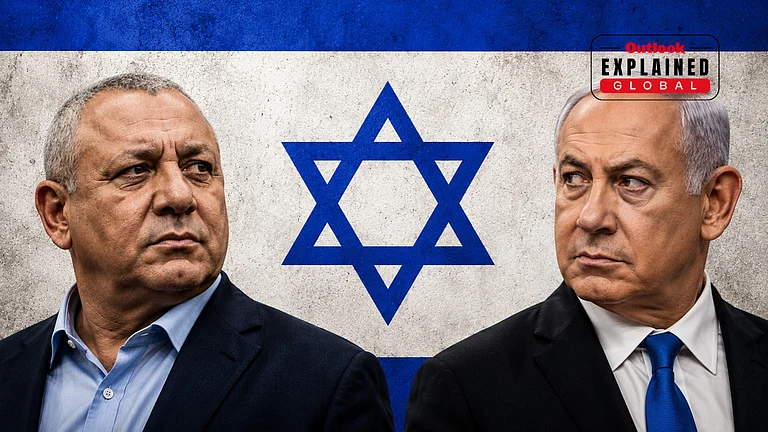
With neither Benjamin Netanyahu’s right-wing bloc nor the opposition led by former military chief Gadi Eisenkot looking like securing a clear parliamentary majority, Arab-led parties could emerge as decisive players in the negotiations to form Israel’s next government. The prospect exposes the fragility of the cordon sanitaire—the political quarantine that mainstream parties in parts of Europe have used to keep extremist forces out of power—and raises a question that resonates differently in India, where coalition politics has repeatedly brought ideological adversaries together in the pursuit of power.
According to reports with counting still under way, neither camp looks to have secured the 61 seats required for a majority in the 120-member Knesset. Netanyahu’s Likud-led bloc was projected to hold around 53 seats, while the opposition is likely to win around 48 seats.
Arab-led parties, meanwhile, were projected to win around 19 seats, a substantial number, potentially giving them considerable leverage in government formation. The final arithmetic could change as counting concludes, but the political dilemma is already apparent: the opposition may need Arab-party support to dislodge Netanyahu, while Netanyahu could seek alternative partners to remain in office.
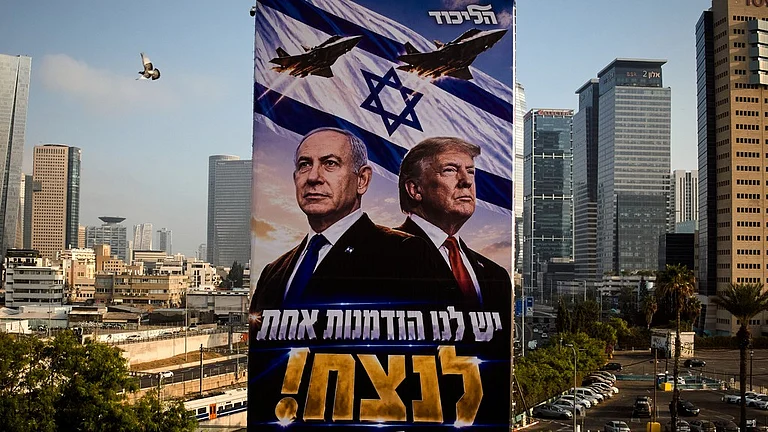
The Politics Of The Quarantine: From Europe To Jerusalem
In European political parlance, the cordon sanitaire refers to an agreement among mainstream parties to isolate a political formation considered incompatible with democratic norms or the established political order. Borrowed from epidemiology, the term describes a barrier designed to prevent contagion. In politics, it means refusing to form a government with a particular party, cooperate with it in parliament or lend it legitimacy through a governing arrangement.
Belgium became an important example of this approach in 1989, when mainstream parties agreed to exclude the far-right Vlaams Blok, later renamed Vlaams Belang, from governing coalitions. France developed a related electoral practice through the Front Républicain, in which voters and parties have rallied behind candidates best placed to defeat Marine Le Pen’s National Rally in runoff elections.
Advertisement
Similarly in Germany, the traditional German parties have observed a Brandmauer (firewall) against the new right wing populist Alternative For Germany (AFD) party.
The underlying argument is that democratic competition cannot be reduced to arithmetic alone. If a party is seen as threatening minority rights or democratic institutions, its exclusion from government may be considered necessary even when its votes could help another party form a majority.
Israel offers a complicated test of this principle. Its proportional representation system treats the country as a single electoral constituency. Parties must cross an electoral threshold of 3.25 per cent to enter the Knesset, and a governing coalition generally needs the support of at least 61 of its 120 members. No single party has ever won an outright majority in the Knesset, making coalition negotiations central to the formation of governments.
The system allows smaller parties to turn relatively narrow electoral support into substantial political influence.
Advertisement
For decades, Israeli politics maintained informal barriers against certain political forces. In the 1980s, Meir Kahane’s Kach party, which advocated the expulsion of Arabs and espoused Jewish supremacy, became a symbol of the limits of acceptable parliamentary politics. Likud prime minister Yitzhak Shamir famously walked out of the Knesset chamber rather than listen to Kahane speak. Kach was subsequently barred from electoral participation under provisions targeting racism and anti-democratic activity.
A different barrier operated against Arab-majority parties, which were historically excluded from governing coalitions led by mainstream Zionist parties.
Both boundaries, however, have come under pressure from coalition arithmetic.
In 2021, Mansour Abbas’s United Arab List, or Ra’am, joined the coalition that brought Naftali Bennett and Yair Lapid to power, ending Benjamin Netanyahu’s consecutive tenure as prime minister. It was a landmark because an independent Arab Islamist party became part of a governing coalition for the first time in Israeli history. The arrangement demonstrated that political cooperation across a deep ideological divide was possible when the alternative was continued deadlock.
Advertisement
The opposite shift came with Netanyahu’s return to office in late 2022. His coalition brought Itamar Ben-Gvir’s Otzma Yehudit and Bezalel Smotrich’s Religious Zionism into senior government positions, including national security and finance. Both parties emerged from a political tradition associated with Kahane’s ideology.
The question of which political actors should be considered acceptable partners was therefore shaped not simply by a consistent democratic principle, but also by competing definitions of national identity and the practical requirements of forming a government.
The latest election has brought this contradiction into sharper focus. If the opposition cannot reach 61 seats without Arab-party support, it must decide whether to seek a formal coalition, negotiate an arrangement in which Arab parties support a government from outside, or explore alternatives that do not depend on them.
The distinction matters because parliamentary support does not necessarily require cabinet participation. A party may vote to sustain a government or support a confidence motion without joining its ministerial ranks.
Advertisement
But even this narrower form of cooperation would test the boundaries of Israel’s political mainstream. Arab parties would have leverage to seek policy commitments on issues affecting Arab citizens, including public services, crime and policing, housing and discrimination.
The election has therefore turned a long-running question of political acceptability into an immediate problem of government formation. The cordon sanitaire, in this setting, is not simply a line separating mainstream politics from the far right. It is also a debate over whether Arab parties can be treated as legitimate partners in governing the country.
Why India’s Coalition Politics Offers A Different Lens
For an Indian political observer, the idea of refusing to cooperate with a party despite its potential to deliver a parliamentary majority may seem counterintuitive. India’s experience has generally favoured political accommodation, particularly in coalition governments, where regional parties and ideologically dissimilar formations have often worked together to secure power.
The 2015 alliance between the Bharatiya Janata Party and the People’s Democratic Party in Jammu and Kashmir brought together parties with sharply different positions on nationalism, Kashmir’s political status and relations with the Union government. Mufti Mohammad Sayeed famously described the partnership as a coming together of the “North Pole and the South Pole”. The alliance eventually collapsed, but it demonstrated how electoral arithmetic could override ideological incompatibility.
In Maharashtra in 2019, the Shiv Sena broke with the BJP after their alliance failed to agree on government formation. The Sena then joined hands with the Congress and the Nationalist Congress Party to establish the Maha Vikas Aghadi government. The arrangement brought together parties with divergent positions on Hindutva and secularism, united by the immediate objective of governing the state.
Earlier, the Janata Party experiment of 1977 brought former Bharatiya Jana Sangh leaders together with socialists and other anti-Congress forces after the Emergency. These arrangements were often unstable, but they showed that ideological distance did not necessarily prevent cooperation when the political incentives aligned.
Part of the difference between European and Israeli politics from the Indian experience lies in electoral mechanics. India’s first-past-the-post system rewards parties that can win individual constituencies by securing more votes than their rivals. Parties often need to assemble broad coalitions of caste groups, religious communities, regional interests and other voters within a constituency. Alliances can help them avoid splitting votes and improve their chances of winning seats.
Israel’s nationwide proportional representation system works differently. Parties can win representation by securing a relatively small share of the national vote, provided they cross the threshold.
There is also a difference in political language. In India, the phrase “political untouchability” can carry uncomfortable associations with caste exclusion, making claims that a party should be kept permanently outside the political system contentious. Parties often portray refusal to negotiate as arrogance or disregard for the electorate.
The Indian model of accommodation has its own limitations. Ideological compromises can create instability, and alliances built mainly to keep a rival out of power may struggle to sustain a common programme. Accommodation can moderate political actors, but it can also legitimise positions that were previously outside the mainstream.
Israel’s experience raises the converse problem. A refusal to cooperate may preserve a party’s ideological consistency, but it can also prevent a parliamentary majority from translating into a functioning government. When the excluded parties hold enough seats to determine the outcome, a cordon sanitaire may become difficult to maintain without accepting repeated elections or prolonged political paralysis, which comes with its own set of problems.
The latest Israeli election places these competing risks before the country’s political leadership. If Arab-led parties become indispensable to the opposition’s path to 61 seats, the choice will not simply be between Netanyahu and his rivals. It will also be between different approaches to political legitimacy: whether a party’s identity and positions make it an unacceptable partner, or whether the electorate’s verdict and the requirements of parliamentary government justify cooperation.
The larger question, however, extends beyond Israel. Does a cordon sanitaire protect democracy by establishing limits on what mainstream parties are willing to legitimise, or does it weaken democratic government when those limits cannot survive the arithmetic of parliament? India’s coalition history suggests that accommodation can offer a way through political deadlock, though not without costs. Israel’s current predicament shows why parties may nevertheless hesitate to cross ideological boundaries.
In the end, the quarantine clause is less a fixed rule than a test of political priorities. When power depends on a handful of seats, parties must decide which compromises they can defend to their voters and which lines they are prepared to cross to govern.
Published At: