A Palestinian poet’s grief highlights how war victims fear being reduced to statistics rather than remembered as human lives with stories and families.
Psychologists say constant exposure to violent imagery through news and social media can lead to desensitisation, where people process suffering as numbers rather than emotional realities.
While distant audiences can look away from war, those living through conflict endure unrelenting fear and loss, even as the world gradually grows accustomed to their suffering.
Compassion Fatigue: How Constant Exposure to War Is Reshaping Global Empathy
Everyday exposure to violence unfolding in different regions across the world is reshaping how people process suffering, with many experiencing psychic numbing or compassion fatigue

Summary
“Inside me there is crying and heartbreak, but I cannot shed tears.
The peak of tragedy is to lose the ability to cry.
Even the voices inside me are suffocated because words are meaningless in the presence of the images of death that surround us from all directions.
Nothing remains. Everything has gone.
I am not well. Not well at all.”

These are the words of Sondos Arafat, a 30-year-old Palestinian woman who writes poetry to make sense of the grief that surrounds her. In one of her poems, she describes a life marked by relentless loss, from the killing of her lecturer to the destruction of her home. She says she aches while she writes, translating her pain into words, as if to prove to the world that she is still alive.
But for much of the world watching from afar, the violence unfolding across West Asia, from Palestine to Iran, Yemen, Sudan and Syria, often appears as a stream of numbers: death tolls, casualty figures and breaking news alerts. Mass killings, once stories of individual lives, are increasingly processed as statistics rather than human tragedies.
For many across the globe, the images are deeply distressing. Videos and photographs from places like Gaza circulate widely online, breaking hearts, triggering anxiety and leaving many feeling helpless. Yet distance, both physical and digital, also allows a degree of escape. When the stream of violence becomes overwhelming, people can step away from their screens, mute certain words or shift their attention elsewhere.

Experts say this constant exposure is reshaping how people process suffering, with many experiencing what psychologists describe as desensitisation, sometimes referred to as psychic numbing or compassion fatigue.
Yaqeen Sikandar, a Turkey-based psychologist specialising in trauma and cognitive behavioural techniques, says that this response by people does not show a lack of empathy but simply proves that the human mind has certain limits. “When the scale of loss becomes too large to emotionally process, the brain turns tragedy into something countable.” He says that human beings were never designed to witness this scale of loss in real time. “Today we see death and destruction in endless clips and captions, but without the rituals or space needed to process grief,” he explains.
Advertisement
The result is a stark contrast between those living through violence and those witnessing it from a distance. For people witnessing wars from outside, suffering appears only as fleeting images on a screen, something that can be scrolled past. But for someone like Arafat, who is witnessing war in her own home, each day unfolds in fear, loss and uncertainty.
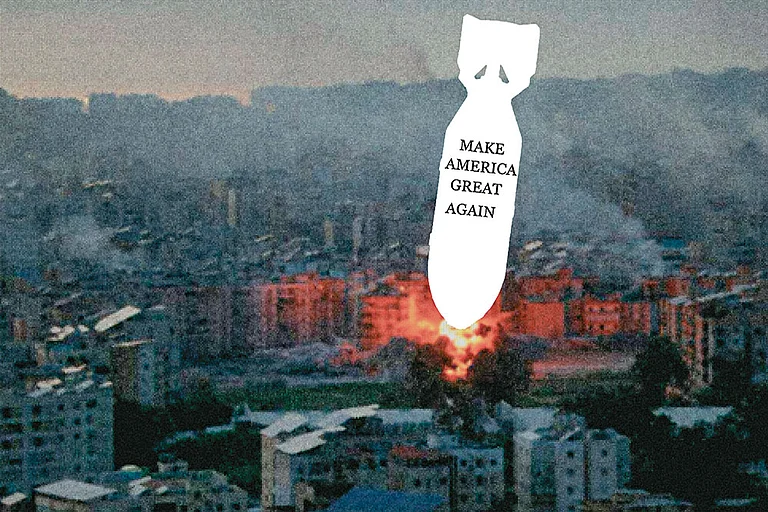
“Behind every number, an entire world has been demolished,” Arafat says. “The family photos, conversations, laughter, dreams—the whole family died beneath the rubble.” Humans in wars, she says, are not numbers to be counted. “We are a father, a mother, a son, a daughter, a grandson, a granddaughter, a friend, a lover, and a family.”
Narges Bajoghli, an Iranian anthropologist, writes that this is where decades of “forever wars” have brought humans. “To a place where annihilating a capital city [Tehran] of a large country doesn’t even register as shocking anymore.” As the US-Israel intervention continues in her country, Bajoghli writes that the mass destruction of Tehran, which is home to millions of families, students, workers and children, gets “reported like the weather.” She asks people to sit with it. “Because this is what we’ve become.”
Advertisement
In the same poem, Arafat asks: “Will I end up as a text to be read?”
Describing this later, she says that this has turned into one of her biggest fears. She calls shelling, fear, hunger, cold and loss a never-ending list of agonies. “I do not blame people for their weariness, but I blame them if they surrender and grow accustomed to the sight of our blood flowing!” she says.
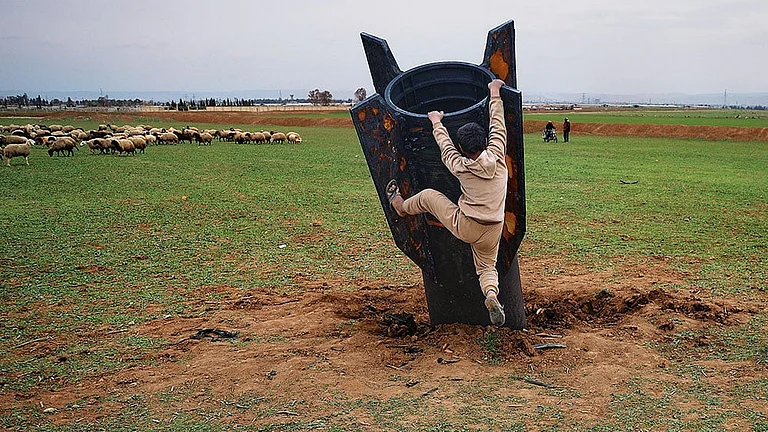
Social media is known for its contribution to desensitisation to war by exposing users to a constant stream of violent imagery. Repeated, algorithm-driven exposure can normalise scenes of brutality, reducing emotional responsiveness and empathy over time. While some users become emotionally numb or fatigued by the volume of tragic content, others experience anxiety, fear, or secondary trauma from repeatedly witnessing violence online.
Sanjeev Jain, a senior psychiatrist at the National Institute of Mental Health and Neuro Sciences (NIMHANS), says the idea that societies can become numb to large-scale violence is not new, adding that societies can gradually grow numb to large-scale violence when death becomes detached from its human context.
Advertisement
Drawing on philosopher Hannah Arendt and her idea of the ‘Banality of Evil’, he explains that atrocities can occur not only through hatred but through ordinary bureaucratic processes in which individuals simply follow orders. Over time, this can turn human suffering into administrative detail and reduce victims to statistics rather than lives with stories.
“Once killing becomes a routine administrative matter, just another procedure to be followed, the scale of violence can expand dramatically,” Jain says.

Global hierarchies shape empathy, says Jain, with deaths in the West often narrated through personal stories, while in much of the non-Western world victims are reduced to “numbers”.
Jain warns that repeated exposure to violence and the way it is reported today can further deepen this detachment, ultimately reshaping how societies think about empathy and morality, he says. “People learn by imitation,” Jain says. “When they see violence normalised at a large scale, they begin to feel that such behaviour is acceptable.”
Advertisement
Clinical psychologist Zoya Mir, who has worked with individuals affected by decades of violence during the Kashmir conflict, says that repeated exposure to traumatic imagery can gradually reshape how people emotionally process suffering.
Drawing on her experience counselling survivors of conflict and trauma in Kashmir, Mir explains that the human brain develops protective mechanisms when confronted with overwhelming distress for prolonged periods. This includes registering violence as information rather than a deeply felt human tragedy, she says, adding that many people initially experience grief, anxiety and helplessness when encountering such visuals online.

She calls emotional numbing a “coping mechanism”, something that allows individuals to keep functioning despite the scale of suffering they witness. “It is not that empathy disappears, but when the brain is repeatedly exposed to trauma it begins to dull emotional intensity as a way of protecting itself,” she says.
Experts note that emotional fatigue or the habit of “numb scrolling” through violent imagery is not limited to survivors of conflict; even people far removed from war zones can feel helpless or emotionally overwhelmed by the constant stream of distressing content online.
For individuals who have previously lived through violence, however, persistent numbness can sometimes signal deeper, unresolved trauma, recovery from which requires deliberate care and support. This may involve setting limits on news consumption, creating space for grounding routines in everyday life, and seeking professional help when the emotional weight becomes too difficult to manage alone.
“Staying informed does not require constant exposure. Choosing when and how to engage with distressing news is a form of psychological self-care,” says Mir, adding that taking breaks from graphic content, discussing difficult emotions with others, and finding small ways to contribute or express solidarity can help people maintain empathy without becoming emotionally numb.
“The brain needs pauses to process grief, otherwise it moves toward emotional shutdown,” she says.

One major factor could be algorithms that are increasingly reshaping both how war is fought and how it is perceived, turning complex human realities into technical, data-driven processes. AI-powered targeting systems and remote technologies such as drones can make life-and-death decisions faster and more mechanical, often creating psychological distance between operators and the violence on the ground and reducing people to patterns or “targets.”
At the same time, digital rights expert Apar Gupta notes that social media algorithms shape public understanding of war by amplifying emotionally charged or viral content, often pushing shocking clips ahead of slower, contextual reporting. Features like infinite scroll can also contribute to “compassion fade,” where repeated exposure to distressing imagery leads to emotional exhaustion and disengagement. Gupta argues that while platforms must reduce harm, they should avoid blanket removals of graphic material, warning that “automated removal of graphic content can end up deleting material that may help prove serious crimes.”
Pro-Palestinian activist Shrishti Khanna, who actively posts informative photos and videos on her social media about the ongoing Palestinian war, observes a similar pattern in how audiences respond to the wars—in her case, posts specifically related to Palestine. She says public engagement often begins with shock and outrage but gradually gives way to fatigue as people struggle to process the scale of violence.
Khanna says that social media design intensifies the psychic numbing effect as images of war appear alongside memes, advertisements and entertainment in a constant scroll, forcing users to shift emotional registers within seconds. The shift from war to memes or other kinds of posts happens quickly. A few searches for cooking tutorials, travel reels, or funny animal videos can gradually transform an entire feed, pushing images of war further down the timeline.

In such an environment, Khanna argues, algorithms end up shaping moral attention itself: “empathy becomes tied to virality,” and when violence is consumed as just another piece of content, “the urgency disappears and sustained pressure fades.”
For those living through the violence, however, there are no such breaks or algorithmic shortcuts.
Dana Flaifl, another Palestinian living in Gaza, says that for people of her community there is no distance from violence and no possibility of taking a break from it the way people outside the conflict sometimes can. Everyday life, she explains, is shaped by constant fear, loss and exhaustion: standing in long queues for water or aid, living in tents, hearing shelling, and carrying the anxiety that death could come at any moment.
This relentless environment leaves many people trapped in cycles of grief, nightmares and a deep sense of hopelessness, slowly draining their emotional strength with the world growing accustomed to their suffering while their reality never pauses.
“This is the biggest pain—that our screams turn into news that only a few care about, while the rest do not even feel us,” she says.

Zenaira Bakhsh is an Assistant Editor at Outlook. She covers governance, minority rights, gender and conflict
This article is part of Outlook 's March 21 issue 'Bombs Do Not Liberate Women' which looks at the conflict in West Asia following US and Israel’s attacks on Iran leading to the assassination of Ayatollah Ali Khamenei, while the world wondered in loud silence, again, Whose War Is It Anyway?
Published At: