Drawing on the ideas of Bertrand Russell, the piece examines how war centralises power and weakens democratic accountability.
The killing of Ali Khamenei and the subsequent US–Israel attack on Iran are framed as part of a broader neo-imperialist project.
The article argues that the conflict reflects deeper structural tensions within American capitalism and warns the Global South about the convergence of neoliberalism and hyper-nationalism.
How The US–Israel Assault on Iran Is Linked With The Crisis of American Capitalism
The Global South must learn from the West Asian crisis that the persistence of neoliberalism alongside hyper-nationalism leads to brutality and genocidal war

Summary
In philosopher Bertrand Russell’s analysis of power and forms of government, war and wealth are the two major forces that have worked against democracy in the past. And war, he says, involves a violent psychology—a kind of devilish impulse—and an escalation of an impending fear where people start looking for a leader who would rescue them from the brutalities of war and lead them to victory. During war, people entrust the leader with supreme power, find him indispensable, and his promised victory entrenches him firmly in the political arena, not to be easily removed. It is with this motivation that the American and Israeli leaders—Donald Trump and Benjamin Netanyahu—have plunged their nations into a unilateral war against Iran.

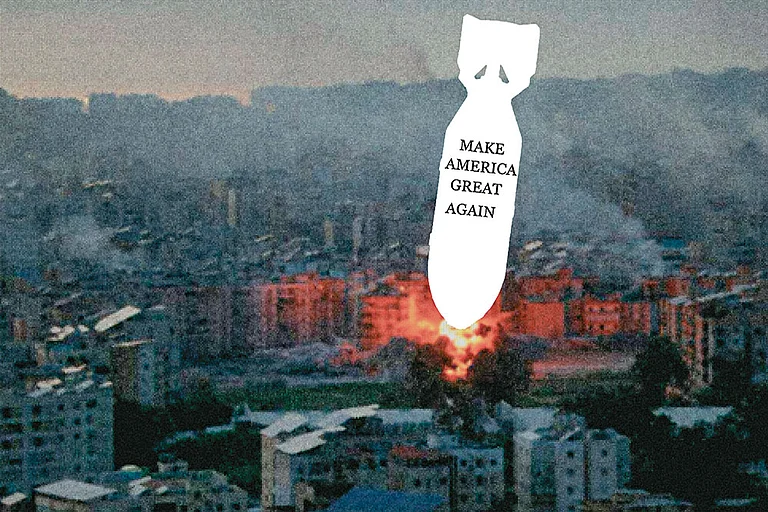
On February 28, Iran’s 86-year-old supreme leader, Ayatollah Ali Khamenei was killed by a US-Israel joint military operation—Operation Epic Fury—leading to the decapitation of the Iranian regime with the possibility of regime change. Their focus remains to destroy Iran’s navy, ground its air force, wreck its missile capability and arms industry, and target the regime, including its top-rung leaders. Touted as ‘The third Gulf war’, the bombing of Iran is being interestingly done in the name of the Iranian people. Yair Lapid, the former prime minister of Israel, said, “We stand with you (Iranians) against this evil regime; a regime that has brought nothing but death and destruction to your country and to the entire region. When this war ends and this regime is gone, we will pray for peace between our historic nations and for the beginning of a new era for the Middle East.” Trump also appealed to the people of Iran immediately after striking them to take over their government once the war is over as it would be their only chance for generations. He said, “Now is the time to seize control of your destiny and to unleash the prosperous and glorious future that is close within your reach. This is the moment for action. Do not let it pass.”
The brutal onslaught on Iran continues, all in the name of the Iranian people, Iran’s nuclear armaments, and therefore, the pre-emptive strikes. But the reality is that the strikes have a deeper underlying motive. The US-Israeli forces want to work through their neo-imperialist and neo-conservative project, even though it remains, in essence, a pathological phenomenon completely wrecking the international legal system.

It is a much-settled theory in international politics that the threat of economic stagnation in capitalist nations is averted, at least temporarily, by colonisation and imperialism. The inevitable expansionist trade policy—particularly of advanced capitalist nations—strategically uses the instrumentality of force and war to decide how far each of them can share in the economic domination of the world. The attack on Iran, and the consequent authoritative domination of West Asia, is not simply about Iran’s regime change and its economic exploitation, but the direct expression of the internal structure of the capitalist system in the US in particular, and global capitalism in general.
Advertisement
The Iran and West Asian crisis is the crisis of American capitalism, more than Israel’s geopolitical ambitions. Since the overall economic collapse of 2008 in the US, their presidents have actively bailed out Wall Street banks, prevented the collapse of banks abroad, undertaken huge fiscal stimulus packages, ramped up global monetary expansion, and sustained globalisation through free trade and untrammelled capital movements. The US, post-2009, is marked by an interesting paradox—long periods of uninterrupted economic growth with a remarkable persistence of a historically low rate of growth accompanied by fairly high unemployment, low levels of wage growth, weakened trade unionism and massive indebtedness. The US economy depicted a continuous weakening of labour amidst surging profits and strengthening of its capital. This sustained period of high profits, however, did not witness the concomitant rise in investment and, therefore, both labour and capital productivity remained historically low. With China’s admission to the World Trade Organization (WTO), and thereafter China leading at the global level in the manufacturing sector, there was a massive decline of US manufacturing jobs, even leading to the closure of plants, particularly in the automobile sector, that had been opened in the rural areas of the Midwest States since the restructuring of the 1980s. Trump’s concerns with cutting taxes, given the already high profits and low interest rates, did not spur new manufacturing investments. For the Trump administration to go in for a massive infrastructure development and create jobs requires heavy subsidies to private capital. This necessitated the war impulse.
Advertisement
In order to remain at the centre of global capitalism, the US pays less attention to its material base at home and more to sustaining its imperial role. History is replete with examples of the US waging war, either for regime change or for complete control over its enemy’s resources. All the Gulf wars were waged by the US to have major control over oil. Trump’s protectionism, laced with a neo-conservative agenda, is constrained by the networked international production chains of US multinationals, but provides a lever for further opening up of markets, if not through multilateral trade agreements then through renegotiation and extension of bilateral trade. This necessitated the impulse to re-colonise.

The US-Israel attack on Iran is part of the far-right neo-conservative efforts to re-colonise the peripheral states—those that are not the core capitalist countries and are comparatively less developed. These states are quite often patronised by the rich and developed nations. America seems to possess preponderant power, which, in many parts of the world, is considered illegitimate power, but quite difficult to challenge. In this spectre of war, the neo-conservatives play the rhetoric of ‘glorious western civilisation’, which was evident when US Secretary of State Marco Rubio’s said that the Americans and the Europeans share a history, the Christian faith, culture, heritage, language, ancestry, and ancestral sacrifices.
Advertisement
The Global South—Asia, Africa, and Latin America—must learn from the West Asian crisis that the persistence of neoliberalism alongside hyper-nationalism leads to brutality and genocidal war. It must decide on what side of history it needs to stand: on the side of the erosion of democracy, international law and sovereignty—by participating or remaining silent to this erosion—or on the side of forces fighting against imperialism and barbarism.
(Views expressed are personal)
Tanvir Aeijaz teaches politics and public policy at the University Of Delhi and is honorary vice-chairman at The Centre For Multilevel Federalism, Institute Of Social Sciences, New Delhi
This article is part of Outlook 's March 21 issue 'Bombs Do Not Liberate Women' which looks at the conflict in West Asia following US and Israel’s attacks on Iran leading to the assassination of Ayatollah Ali Khamenei, while the world wondered in loud silence, again, Whose War Is It Anyway?
Advertisement
Published At: