In India, religion is rarely only a private opinion about whether God exists. It enters birth and death, marriage and mourning, festivals and fasting, charity and family duty.
Are we prepared to say that an Indian who doubts God is morally less trustworthy than one who invokes God every day?
Do our religious beliefs make us more attentive to the hungry, or merely more protective of our identities?
Must We Believe in God to Be Good?
Belief in God may inspire moral life, but belief is not itself proof of goodness

Summary
A recent international survey found that 85 per cent of Indians said belief in God is necessary in order to be moral and have good values. This contrast should not tempt us into easy conclusions. It neither proves that religious India is more moral nor that secular societies are morally superior. What it reveals is something more subtle: societies differ in how they imagine the source of moral life.
In India, religion is rarely only a private opinion about whether God exists. It enters birth and death, marriage and mourning, festivals and fasting, charity and family duty. It supplies stories through which children encounter sacrifice, wrongdoing, forgiveness and justice. To many Indians, the suggestion that morality can survive without God may sound like removing the foundations beneath the house.
Yet, the question remains: are we prepared to say that an Indian who doubts God is morally less trustworthy than one who invokes God every day?
The answer cannot be found in religious labels alone. We have met people who speak fluently of faith but behave without mercy, and others who profess no belief yet live with honesty and care. A person may visit a place of worship regularly and still humiliate an employee, exploit the powerless or abandon an ageing parent. Another may never pray, yet, devote years to caring for someone who can offer nothing in return.

This is not an argument against religion. It is an argument against confusing religious identity with moral character.
In Plato’s Euthyphro, Socrates asks whether an action is good because the gods command it, or whether the gods command it because it is good. If goodness depends merely on command, morality may appear arbitrary. If the gods command what is already good, goodness seems recognisable through reason. Religious thinkers reply that goodness is neither arbitrary nor external to God, but an expression of the divine nature. That answer remains meaningful for believers. But it still does not establish that a person must consciously believe in God before recognising cruelty as wrong or compassion as good.
Advertisement
Indian traditions resist such simplification. Hindu thought has often understood moral life through dharma: right conduct, responsibility and the sustaining order of life. Buddhist ethics places compassion, non-harm and the reduction of suffering at its centre without depending upon a creator God. Jain thought develops non-violence into an exacting moral discipline. Sikh teaching binds devotion to equality, honest labour and service. Across these traditions, morality is not reducible to fear of punishment. It requires the training of desire, restraint of ego, fidelity to duty and recognition of the other.
Psychology also complicates the claim that belief alone produces goodness. Conscience does not arrive as a fully written divine instruction. It develops gradually through attachment, example, empathy, guilt, shame, reason and social learning.
A child begins to understand suffering because someone has responded to the child’s own suffering. They learn trust by being trusted and compassion by experiencing care. Long before moral principles are expressed in theological language, the foundations of moral awareness are being laid in relationships. Religion can deepen this process. Stories, rituals and communities can enlarge moral imagination. They can teach that the stranger matters, that power has limits, that repentance is possible and that those who cannot repay us still possess worth. Faith can give moral obligation gravity by locating it within a larger account of human purpose.
Advertisement
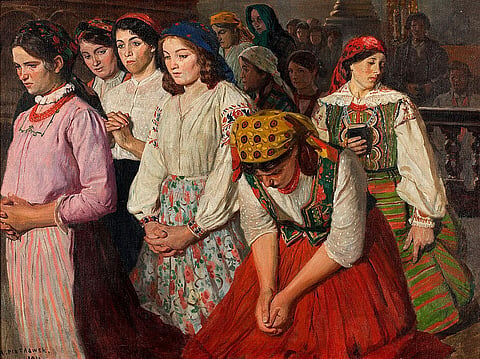
Women praying Wikimedia
Religion can also deform conscience when it relies excessively on fear, shame, unquestioning obedience or the division of humanity into the pure and the impure. A morality concerned mainly with belonging to the correct group may neglect how that group actually behaves.
The psychological test of faith is therefore not whether it produces certainty, but whether it enlarges compassion, humility and responsibility.
India is one of the world’s most visibly religious societies. Sacred words, ceremonies and processions are woven into public and private life. Yet, public religiosity does not automatically resolve corruption, caste humiliation, violence against women, neglect of the elderly, cruelty towards minorities or indifference to poverty. Every religious society faces this contradiction. The danger begins when the visibility of faith is mistaken for evidence of virtue. A nation may multiply the symbols of religion without becoming more truthful, more just or more compassionate. Indeed, the claim that morality belongs principally to believers can itself become morally exclusionary. It places atheists, agnostics and the unaffiliated under suspicion before their conduct is considered. It can also tempt believers into false reassurance: because they possess faith, they assume they possess goodness.
Advertisement

In a constitutional democracy, that assumption is untenable. Citizenship cannot depend upon theological agreement. Hindus, Muslims, Christians, Sikhs, Buddhists, Jains, atheists and agnostics must be able to meet on common ethical ground. That ground includes dignity, honesty, non-violence, equality before the law, freedom of conscience and responsibility towards the vulnerable. These principles do not require citizens to abandon their religious convictions. They require them to translate those convictions into public conduct that does not deny the equal humanity of those who believe differently.
To say that non-believers can be moral is not to say that religion contributes nothing distinctive. For millions, faith remains a source of courage, restraint and hope. It can sustain people when goodness is costly, and justice appears defeated. It can call individuals beyond convenience, reputation and self-interest. It can teach forgiveness without denying wrongdoing, service without reward, and dignity that does not depend upon wealth, usefulness or status. But faith loses moral authority when it claims a monopoly over goodness. Its credibility does not rest upon insisting that unbelievers cannot be decent. It rests upon whether believers embody a form of life marked by truthfulness, compassion, justice and self-restraint.
Advertisement

Religion should not fear goodness outside its boundaries. It should recognise it, honour it and ask what it reveals. The Samaritan in Jesus’s parable was morally exemplary not because he belonged to the approved community, but because he crossed the road towards a suffering stranger. Its force lies in the unsettling identity of the person who showed mercy.
The deepest issue, then, is not whether India should become less religious. It is whether India’s abundant religiosity can become more ethically demanding. Do our beliefs make us more attentive to the hungry, or merely more protective of our identities? Do they make us slower to condemn and quicker to understand? Do they restrain power, or bless it? Do they teach us to recognise dignity in those whose gods, scriptures or doubts differ from our own?
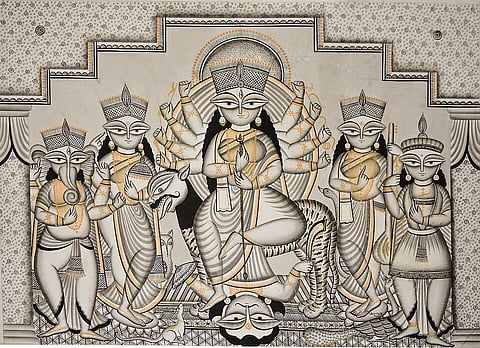
Patachitra painting Wikimedia
Believers and non-believers share a common task: to cultivate the conditions in which conscience can grow. Families must model care. Schools must teach moral reasoning rather than obedience alone. Laws must protect dignity impartially. Public institutions must reward honesty rather than cunning. Religious communities must examine themselves before judging others.
Belief in God may inspire moral life, deepen it and sustain it. But belief is not itself proof of goodness. The final test is found not in how confidently we speak of heaven, but in how faithfully we practise justice on earth—especially towards those who do not believe as we do.
(Dr George John is a retired British Emeritus consultant psychiatrist from London, formerly in private practice in England, now living in Kochi, India. His special interests include interpersonal conflict, human flourishing and the philosophy of psychiatry)
Published At: