The US have denied entry to a FIFA designated Somalian referee for a World Cup match
Many ticketholders of different countries are finding it difficult to obtain entry permissions into the US due to stricter restrictions
The US authorities have reportedly denied visas to some of the Iranian team officials due to Middle-East war
Outlook Explains: Why The FIFA World Cup Is Becoming A Political Battleground
The ongoing FIFA World Cup has become a reflection of today's world we live in where political decisions are now conflicting with the value and norms of a global tournament

Summary
The 48-team 2026 FIFA World Cup, featuring 104 matches across the United States, Mexico, and Canada, kicked off on June 11. The tournament, which FIFA President Gianni Infantino described as the most inclusive tournament in the competition's history, had already faced controversies before kickoff.
Concerns over visa restrictions affecting some participants and criticism of ticket prices drew attention in the lead-up to the event.
On the eve of the World Cup, the FIFA President, Gianni Infantino gave a message of unity about how this tournament can help people distract from the ongoing tensions around the world and send a message of unity.
"When Iran plays, the stadium will be full and I hope there will be a positive atmosphere because this is football," he said.
"We want to unite the world."
Ironically, it's the same World Cup where reportedly 15 Iranian officials are denied visas due to the ongoing conflict between the US and Iran. While the action begins in North America, the political and logistical controversies surrounding the tournament persist.

FIFA President Gianni Infantino speaks during a news conference at the stadium in Mexico City, Wednesday, June 10, 2026, a day before the opening FIFA World Cup match between Mexico and South Africa. AP Photo
Immigration Restrictions
In Donald Trump's second presidential term, the US have tightened their immigration policies, imposing travel ban and visa limit on many countries, which has affected participating national teams, support staff, referees, and fans.
Iran, Haiti, Côte d'Ivoire and Senegal are among the countries subject to partial or full U.S. travel restrictions. While players have been granted special exemptions to participate in the tournament, some officials and support staff have reportedly encountered visa issues.
One of the most widely reported cases involved Somali referee Omar Artan, who was denied entry upon arriving at Miami International Airport and was returned to Istanbul after authorities cited vetting concerns regarding his admissibility. There have also been reports that some Iranian officials travelling with the national team are yet to receive their visas.
Fan access
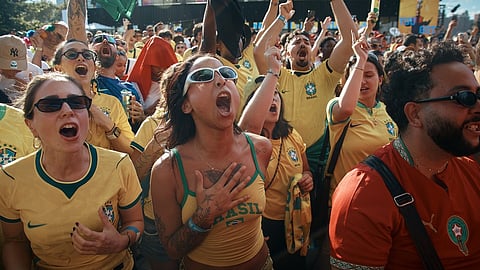
Brazil's fans sing while watching the FIFA World Cup Group C match between Brazil and Morocco during a public watch party in Central Park, Saturday, June 13, 2026, in New York. AP Photo
Stricter visa regulations have had the greatest impact on fans, with many ticket holders unable to travel to the United States after their applications were rejected.
Advertisement
Several supporters applying either for U.S. visas or the Electronic System for Travel Authorization (ESTA), which allows eligible travellers to enter the country without a visa for short visits, have reported difficulties obtaining approval. Ticket prices have also drawn criticism from fans ahead of the tournament.
Climate concerns
According to some reports, this World Cup is projected to be the most polluting in history. As per estimates, the greenhouse gas emission from this tournament will amount to 9 million tonnes of CO2 equivalent, which is double that of the 2022 World Cup.
85% of that is estimated to come from air travel as 48 teams and their millions of fans will travel across 16 host cities in three countries, resulting in extensive flight distances.
The World Cup will be played in extreme heat and humidity across virtually all venues, which could even reduce players' performance throughout the tournament.
Advertisement
As per research by Climate Central, 97 matches out of 104 will be played under rising temperatures that could have a massive toll on the players, which is why public health experts have urged FIFA to allow longer water breaks to prevent heat related injuries.
Security issues
The uncertain times in which the World Cup is being played require stringent measures by host nations to ensure the safety and well-being of the players, officials, support staff, and fans.
While the US is directly involved in a war with Iran, the latter are practicing under heavy security in Mexico and are set to play their group matches in the US. Both countries were involved in a verbal spat before the World Cup regarding the security concerns around the Iranian players in the US, with Trump advising their national team to arrive in the States at their own risk.
While it's now looking that the Iran team will now arrive in the US for their matches and they'll be provided with full-proof security, the denial of visas to their officials by the authorities have added another layer to the geopolitical controversy.
Advertisement
Published At: