NITI Aayog wants states to verify electricity and water availability before approving data centre projects.
The proposed framework calls for long-term water assessments and checks on grid capacity, including upgrades needed for large facilities.
States are encouraged to weigh investment promises against local jobs, environmental risks and the public support projects require.
NITI Aayog’s Data Centre Push Comes With A Caveat: Power And Water Checks First
NITI Aayog’s framework links data centre approvals to electricity supply, water availability and the economic benefits promised by developers.

Summary
As India expands its data centre capacity, NITI Aayog wants states to assess whether proposed facilities can secure the electricity and water they need without putting pressure on existing users. NITI Aayog’s new evaluation framework asks states to assess that readiness before approving projects, and to weigh promised investment against the infrastructure required and the economic value a facility is likely to deliver.
Demand for cloud computing and artificial intelligence (AI) is growing. Data centres store and process information, while AI-focused facilities can require substantial power and cooling. The framework provides common parameters for assessing projects, but states retain responsibility for applying them and determining approval conditions.
What Should States Check Before Approval?
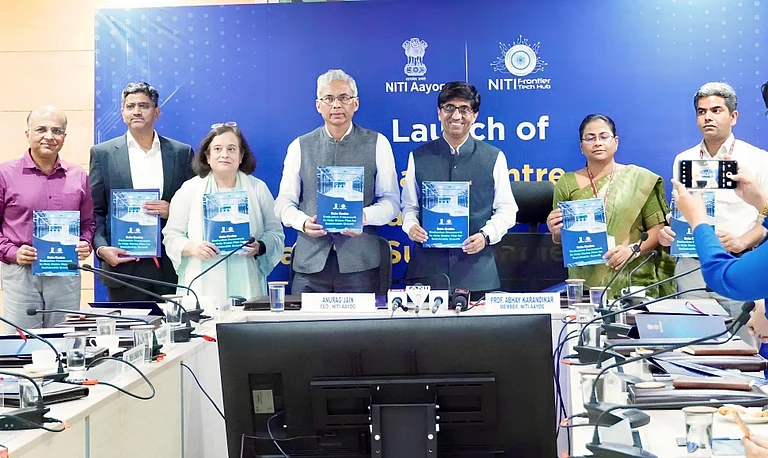
The Indian Express reported that NITI Aayog’s Frontier Tech Hub wants states to examine electricity and water availability, environmental safeguards and measurable economic benefits before clearing data centre projects. Its five pillars cover power and energy; water and cooling; siting and environmental sustainability; economic and strategic value; and governance and implementation.
For power, states are advised to require the developer, electricity distribution company and state transmission utility to prepare a joint power-readiness and ramp-up plan. It should set out expected demand, capacity milestones, grid draw, renewable or captive supply, required grid upgrades, funding and delivery dates.
The framework recommends approving additional electricity load only after the required infrastructure has been commissioned and the agreed technical and payment milestones have been met. For facilities requiring more than 20 MW, the framework recommends automated demand-response readiness and telemetry and control integration with State Load Dispatch Centres (SLDCs), subject to applicable grid codes. The aim is to align approvals with verified infrastructure readiness and the time needed to complete upgrades.
Why Electricity And Water Need Separate Checks
A state may have adequate electricity generation overall but still lack the local grid capacity to supply a large campus. Substations, feeders and transmission lines must carry the load when needed. Where several facilities are planned nearby, their combined demand matters too. Early assessment can identify required upgrades, costs and responsibilities.
Advertisement
Water consumption varies with cooling technology, facility design and local climate. States are advised to establish water sources, quality, peak-summer demand, recycled-water availability and effects on other users.
The New Indian Express, reporting on the Economic Survey 2025–26, said India’s data centre capacity stood at about 1.4 gigawatts in the second quarter of 2025 and was projected to reach around 8 gigawatts by 2030. The report cited an estimate that a single AI data centre could consume up to 20 lakh litres of water a day. Actual consumption varies with the facility’s size, cooling technology and operating conditions.
NITI Aayog recommends a 20–30-year seasonal catchment water balance, considering surface water, groundwater, treated wastewater, climate conditions and competing demand, including drinking water and irrigation. In high-stress locations, states are advised to validate water sources independently, protect existing users and consider alternatives such as treated wastewater or desalinated water where feasible. The framework recommends counting recycled, treated or other non-potable water towards a facility’s supply only when it is contracted, connected and available from the relevant commissioning stage.
Advertisement

Why Location And Local Impact Matter
Resource availability is not just a state-wide calculation. A site may have access to electricity and water on paper but face local constraints, environmental risks or conflicts over land use. The framework recommends that states identify data-centre-ready zones after assessing grid access, water, land, fibre connectivity and relevant clearances. It also proposes identifying high-risk areas where development should be restricted because of water stress, hazard exposure, land-use conflicts or inadequate supporting infrastructure.
The New Indian Express reported that experts and civil society representatives called for an independent assessment of proposed AI data centre projects around Visakhapatnam, with a combined proposed capacity of about 6,500 MW. Participants raised questions about land allotments, water and power needs, environmental impacts, public consultation, employment and government incentives. Retired IAS officer EAS Sarma called for an independent water audit that would account for drinking water, irrigation, population growth and industrial demand.
Advertisement
These concerns are calls for scrutiny, not proof of shortages. An assessment should examine cumulative impacts, resource sources and timelines, and which agencies are responsible for infrastructure. For large campuses, the framework recommends a proportionate community impact assessment covering water, traffic, emissions, noise, waste and employment.
What States Get In Return For Offering Incentives
The framework asks states to assess a project’s economic and strategic value against the support it receives. Land concessions, infrastructure spending, electricity-duty relief, stamp-duty concessions and other forms of public assistance should be quantified. States are encouraged to link incentives to measurable outcomes, including commissioning milestones, renewable energy supply, efficient use of power and water, local hiring, skills development and domestic procurement.
A large investment announcement does not automatically translate into extensive local employment or broader economic benefits. States should compare similar business models and link incentives to verifiable outcomes, including local procurement and supplier activity.
The framework also recommends a time-bound digital single-window system for coordinating approvals. A state approval matrix would list permissions, authorities, documents, processing times, dependencies, fees and escalation mechanisms. Each condition should have a responsible entity, with delivery and post-commissioning energy and water efficiency monitored. The framework also proposes a centralised audit mechanism, with the Ministry of Electronics and Information Technology (MeitY) as the nodal ministry, to verify operators’ compliance and commitments periodically.
Advertisement
The framework provides states with common parameters for assessing data centre proposals, while leaving state authorities to determine approval conditions and monitor compliance. Implementation will therefore depend on how individual states use the guidance, what evidence they require from developers and whether approval conditions are monitored in practice.
The test is not simply how much investment a state attracts, but whether power, water and supporting infrastructure will be ready when capacity comes online. States must also protect existing users and link public incentives to measurable benefits. Clear assessments and enforceable conditions would help identify resource constraints before approval and hold developers accountable for their commitments.
Published At: