Thousands of students, parents, lawyers and citizens joined a peaceful CJP-led march in Pune, demanding the resignation of Union Education Minister Dharmendra Pradhan over the NEET-UG 2026 paper leak and alleged examination irregularities.
Protesters described repeated paper leaks, student suicides and a lack of accountability as signs of a deeper crisis in India's examination system, while also criticising the government's handling of demonstrations and alleged police excesses.
The march concluded with a tribute to students who died by suicide and a collective reading of the Constitution's Preamble, underscoring protesters' demands for transparency, institutional reform and democratic accountability.
'We Are Not Scared': Inside Pune's Student-Led March Demanding Dharmendra Pradhan's Resignation
"These students were going to save lives. Now, there is no one left to save them." As anger over repeated paper leaks and reported student suicides grows, Outlook spoke to the students, parents and lawyers who took to Pune's streets demanding accountability

Summary
Even rain could not stop Pune netizens from assembling at Ambedkar Chowk on 24 July, with thousands coming out to protest armed with umbrellas, clad in raincoats and using posters of Union Education Minister Dharmendra Pradhan- the very man the masses demand the resignation of- as a shield to bear the weather.
Pune city witnessed a long march by various Cockroach Janta Party (CJP) supporters and students on Friday evening. Starting from the historic Shanivar Wada and ending five kilometres later outside the Collector’s office, the protest was peaceful with minimal interference from the police.
“Inquilab Zindabad”, ”Dharmendra Pradhan Istifa Do”, “Modi Sakar Kayar hai, Aaj Ka General Dyer hai”; sloganeering and calls for the Education Minister to take accountability and resign are already familiar to the city, as just over a month ago CJP founder Abhijeet Dipke began the nationwide protest tour in Pune itself. This time, even without the presence of the man behind the movement, thousands of concerned citizens swarmed the streets of the city’s hub.
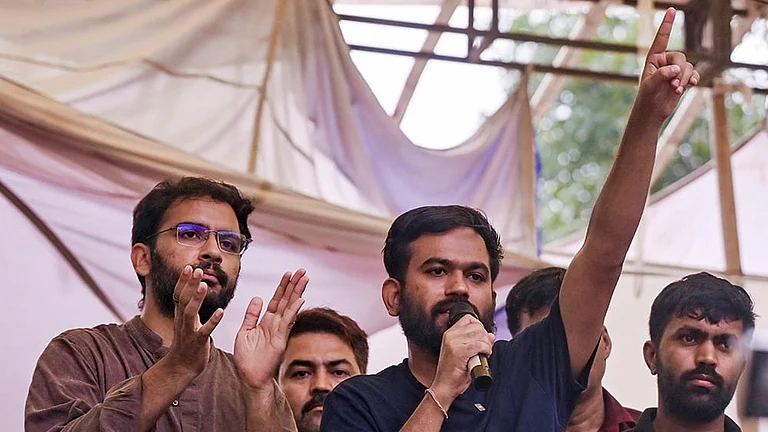
One sentiment remained constant across class, caste, creed and age: accountability must be taken, and it must be taken now.
Among those leading the march were students who said they had personally experienced the consequences of examination irregularities.
Shristi Devkar, a 2025 NEET aspirant, attended the demonstration with her mother, Sarika Devkar, demanding accountability over repeated paper leaks.
"I have come here to protest against the paper leak. A resignation should be given. I wanted to go to Delhi to protest. I am not scared," Sarika Devkar said.
Recalling her own experience, Shristi said the issue was not new. "I gave the NEET last year. This is not the first time there has been a paper leak; even in 2024 there was one. Last year's paper was also extremely difficult, and many people were not able to fulfil their dreams."
Advertisement
She said the exam took a severe mental toll on students. "Many people, including myself, went through depression because of the unfair level of difficulty. We eventually learnt to make do with what we got. Now what is happening this year is even more pathetic than our situation."
According to her, paper leak allegations add another layer of stress after months of preparation. "After giving the exam, students finally relax, and then news of a paper leak comes out. Suddenly there is a re-test with very little preparation time. The government neither understands the pressure this creates nor takes accountability."
Pointing to the reported student suicides linked to the paper leak, Shristi questioned why no one had stepped down yet. Referring to the resignation of Portugal's health minister in 2022 after the death of an Indian tourist, she said, "Foreign countries take accountability even for the deaths of people from other nations. For our country's own citizens, our netas won't take accountability even after several student suicides have happened."
Advertisement
She also argued that ministers should have educational qualifications relevant to the portfolios they lead. "How else are they supposed to lead that ministry without having any knowledge about it?"
For many students, the movement extends beyond the streets. Social media, they say, has become just as important a battleground. Satya, a UPSC aspirant, claimed, “This is the first movement that is being carried ahead by the power of social media. This generation does not follow TV channels or paper; the government knows it too that the youth is watching reels and lives on social media.”
Regarding the Prime Minister’s late-night message to the youth, he added, “It is then no wonder that Modi chose to post an address to protesters on an Instagram reel at a quarter to midnight. Soon after which all these Bollywood celebrities decided to publicly post about the protest, as if it wasn’t already happening for a month now. These tactics are transparent. ”
Advertisement
Another protester, who wore a mask and attended without her family's permission, argued that, “When there is an issue as big as a paper leak which required about 20 lakh students to give a re-test, that is the first stop where a resignation should have been given. Yet over a month has passed since this issue; only now that tens of thousands of students nationwide are protesting so vehemently is the government considering the option of resignation.”
Her sister added, “We are IIT and NID students, so we understand the strenuous process of entrance exams and the preparation that goes into it. The government is definitely late, but at least that's a good sign; it shows that the government is scared and has to take action.”

Among the student protestors were also a group of lawyers who came in support of the youth movement. "The government is corrupt, the judiciary is corrupt, and the police are responding as if students are terrorists. The Chief Justice of India does not have time to watch videos of the brutalities allegedly committed by the Delhi Police. Still, they have time to watch an hour of India's Got Latent and punish comedians,” said Umar Khan, a Pune-based lawyer.
Advertisement
Khan added, “The government and the Education Ministry have failed to perform their duty, which is why paper leaks can happen. They are running a dictatorship. They have forgotten that they are public servants—both the political leadership and the judiciary exist to serve the people. They were elected by the people, for the people. They are not kings; they are meant to serve us.”
“These students who died by suicide were going to become doctors. They were going to save lives. Now, there is no one left to save them," he said.
Lawyer Shweta Douge echoed Khan's criticism, arguing that the government's response had failed to address the actual crisis, "The government is only pretending to take action. They are not taking strong action against the culprits or addressing the root of the issue. The youth can see through this, which is why Gen Z is out on the streets protesting.”
On the Delhi Police's actions during the Parliament march, particularly officers allegedly not wearing name tags, she said, “They are not police, they are gundas.”
Ignited by the mobilisation of the student protest throughout the country, Advocate Gajanan Dhage noted that Pradhan's resignation is just one step along the way and wrote a 33-page letter to the Prime Minister with well-researched context on the impact of the paper leak. The memorandum calls for an independent, time-bound probe into the alleged examination irregularities and paper leaks, accountability within the Education Ministry and the National Testing Agency (NTA), action over the alleged police excesses during student protests, and broader reforms to make India's examination system transparent, secure and merit-based.
For 18-year-old history student at Fergusson College, Devika Patil, watching the protests unfold online, the police brutality in Delhi became deeply personal.
“I am a daughter of a policeman. I am not able to say that proudly to anyone after that day. Earlier I used to be proud of the fact, but now that’s not the case because I know people will make a judgement about me for the same reason,” Patil said.
She added that the news of the violence in Delhi impacted her mental state and led to arguments at home as well.
Rather than remain helpless, Patil has begun a Constitution Awareness Drive on her campus. By connecting with similarly aligned students and alumni over the last few days, she hopes to move Fergusson to make a public statement in support of the student protest.
As the march drew to a close, protesters observed a moment of silence for students who had died by suicide before collectively reciting the Preamble to the Constitution, invoking its promises of justice, liberty, equality and fraternity.
While the government gambles for one more day to discuss and decide upon the resignation of a minister who failed 20 lakh students, those who continue to protest hope that the words enshrined in the Constitution will actually uphold and deliver democracy.
Published At: