Journalists allege police detained and manhandled them during anti-CEC protests.
Media bodies condemned the detentions and demanded accountability.
Journalists approached the Supreme Court over alleged police obstruction.
“We Are Doing Our Job”: Inside Delhi Police’s Detention Of Journalists Covering Anti-CEC Protests
Journalists covering protests against Chief Election Commissioner Gyanesh Kumar alleged they were detained and obstructed by Delhi Police despite identifying themselves as members of the press

Summary
“Sir, we are doing our job,” Rahul Charas told a police officer who approached him from behind, grabbed his hand and ordered him to either board a bus or go home while he was recording the police detaining protesters near Delhi’s Minto Bridge on October 10. Charas showed him his press card, but the officer continued to insist that he get on the bus.
Charas, a journalist with Navbharat Times, was detained along with his colleague, Hritik Joshi, a 25-year-old trainee journalist, who had been sent with him to cover the anti-CEC protests.
Charas told Outlook that the officer began pulling him, repeatedly telling him to get on the bus, before calling four or five other policemen to take him away.
The two had walked from ITO, crossed a deserted barricade on Deen Dayal Upadhyay Marg and reached Minto Bridge. They were heading towards Ajmeri Gate after hearing protesters raising slogans and had recorded visuals before the police detained them, Joshi said. Both journalists said they repeatedly identified themselves as members of the press and showed their identity cards.
However, the bus took them to Maurice Nagar Police Station near the University of Delhi’s North Campus, Charas claimed. When it stopped, the protesters detained alongside them began climbing out through the windows. One by one, they escaped, until only the two journalists remained.
“Eventually, only my colleague and I were left on the bus,” Charas said. The police then told them they could leave too.
By then, Charas said, they had informed a senior colleague about their detention. The senior had spoken to police officials, who had assured him that the journalists would be dropped off along the way. Navbharat Times editor Ashish Pandey later wrote on X that police had also misbehaved with Charas, adding that the journalists were carrying “clear and visible media i-cards”.
On October 10 and 11, Delhi Police detained journalists from mainstream and independent media outlets while they were covering protests against Chief Election Commissioner Gyanesh Kumar. Reporters were allegedly stopped, dragged and pushed into buses before being taken to holding locations, including Chhatrasal Stadium, even when they showed their press cards.
Advertisement
The detentions took place despite the Supreme Court stating on October 11 that journalists must not be obstructed from carrying out their work. Earlier, Delhi Police said in a video posted on X that some protesters had impersonated journalists and obstructed police personnel in the course of their duties.
Before the October 10 protests, Additional DCP (New Delhi) Manjeet Sheoran had urged journalists to maintain a distance from demonstrators while covering protests, alleging that some media personnel joined protests and obstructed police work.
His remarks came days after three women identifying themselves as journalists alleged sexual harassment and manhandling by Delhi Police personnel during an October 3 protest against the Special Intensive Revision (SIR) of electoral rolls at Jantar Mantar.
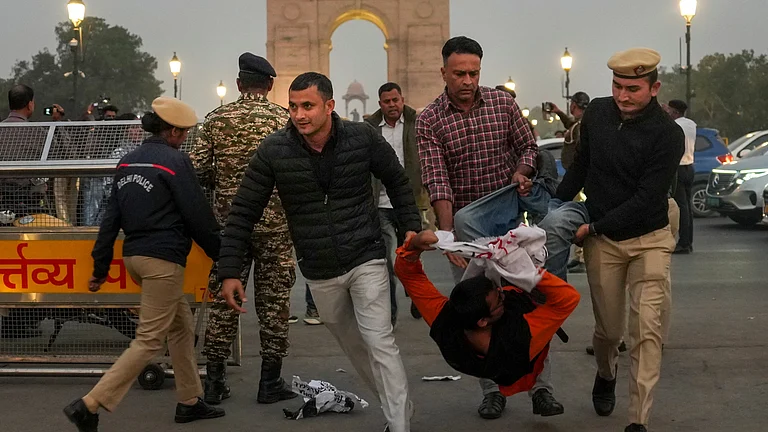
Press Credentials Failed To Prevent Detentions
An Outlook reporter who reached the protest site around 8 am on October 10 said journalists faced restrictions from the outset, with police barricades preventing them from reaching the main venue at Jantar Mantar. The reporter said journalists from several organisations, repeatedly requested permission to enter the area around Janpath and Connaught Place but were initially denied access.
Advertisement
After entering through Janpath Metro Station’s Gate No. 2, Outlook reporter witnessed an independent journalist being stopped as police attempted to detain him near Palika Market. The journalist repeatedly identified himself as a member of the media, prompting other journalists at the site to intervene and call out that he was a reporter. Police then let him go, the reporter said.
The reporter also witnessed a woman journalist and a male journalist being pushed into a police bus near Connaught Place. The woman was displaying her press card through the bus window, while the male journalist repeatedly shouted that he was from the media, the reporter said. Police did not release either journalist at that point, according to the account.
Notably, three journalists from The Indian Express Hindi team, Shashwat, Siya and Vijay Kumar, were detained by police while covering the protests in Delhi on Sunday. Recounting the incident, Shashwat told The Indian Express, “We immediately identified ourselves as journalists and explained that we were there for reporting. All three of us showed our press cards. Despite this, we were told to board a police bus.”
Advertisement
“We had gone there to report on the protests. We had identified ourselves, and explained why we were there. Yet, while trying to speak to protesters and document events on the ground, we found ourselves being taken away with them,” he said.
The Wire also reported that independent journalist Harsh Yadav; Ayush Tiwari and Shoaib Daniyal of Scroll.in; Anushka Bhardwaj of Business Standard; Ashwine Kumar Singh, Astha Savyasachi, Anmol Pritam and Anshu of Newslaundry; and Saurabh Sharma of Reuters were among those detained.
Others included Jagriti Trisha of BoomLive; Shivang Shukla of India Today; Neeraj Jha of Molitics India; Sarthak of The Quint; Pragya Mishra of Bharat Samachar; Kinjal of AltNews; and senior independent journalist Paranjoy Guha Thakurta.
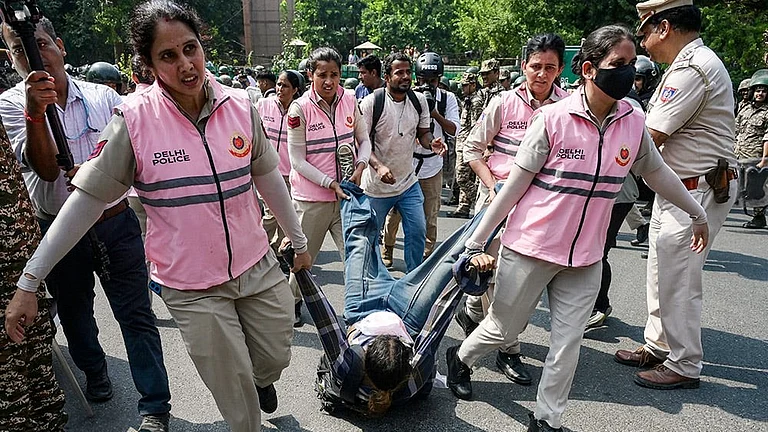
Journalists’ Bodies Condemn Detentions, Demand Accountability
Notably, the United Nations Human Rights Office expressed concern over the mass detention of protesters, civil society members, lawyers and journalists, urging authorities to release those arbitrarily detained. The MEA accused the UN human rights office of applying “extreme selectivity” in its public statements, alleging that violent responses to protests in neighbouring countries and law enforcement actions closer to the office’s own location had gone unaddressed. It said such “double standards” undermined the office’s credibility and contributed to a loss of faith in multilateralism.
Advertisement
Newslaundry journalist Anmol Pritam shared a video on X showing and wrote, "During the massive Delhi Police crackdown against the CJP protest on Saturday, multiple journalists were detained. Despite displaying our Press IDs, the police detained me, our producer, and two other reporters from @newslaundry.”
The Editors Guild of India on October 12 condemned the detention of journalists covering protests on October 10 and 11, saying at least 38 journalists were detained across Delhi, Pune and Ahmedabad. In a statement, the Guild said many were detained despite showing their press credentials, while some had their phones seized. It also condemned the use of excessive force by Delhi Police and other security personnel.
The Guild said detentions in Delhi continued even after the Supreme Court’s October 11 direction that “Lawyers, journalists and other professionals shall not be hindered in discharge of their professional duties in any manner whatsoever.” It urged authorities to comply with the court’s order, prevent a recurrence and take action against those responsible for violating it.
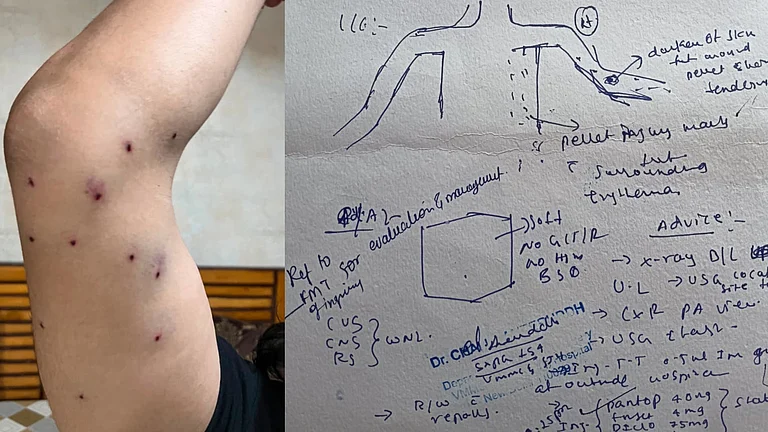
DIGIPUB News India Foundation, a collective of digital news platforms, demanded their release and sought legal assistance for those detained.
“Detained for documenting a protest. Journalists at Jantar Mantar showed their ID cards and were taken anyway. DIGIPUB demands their immediate release. Journalism is not a crime,” the collective said in a post on X.
DIGIPUB also said reports indicated that several content creators and digital journalists had been detained at police stations and other locations across Delhi. It appealed to Delhi-based lawyers to provide pro bono legal assistance to those detained and shared an email address for those seeking to help.
Petition Seeks Probe, Evidence Preservation
The Free Speech Collective has moved the Supreme Court seeking contempt proceedings over the alleged violation of its October 11 order directing that journalists must not be obstructed while performing their professional duties.
The contempt petition seeks an independent, time-bound inquiry into allegations of journalists being detained, assaulted, injured and prevented from reporting during the anti-CEC protests.
The petition also seeks the immediate preservation and production of evidence from October 10 onwards, including CCTV footage, body-worn camera recordings, police videography, wireless communications, duty rosters, vehicle logs, detention registers, arrest memos and medical records.
It further asks Delhi Police to disclose details of journalists detained, removed, injured or prevented from reporting, including the legal grounds for action and the officers responsible. The Free Speech Collective has also filed a separate writ petition seeking binding guidelines to protect journalists from assault, threats, detention and obstruction while carrying out bona fide newsgathering.
Sermon Rawat, an advocate at the Supreme Court of India, told Outlook that Article 22(5) of the Constitution requires the grounds of preventive detention to be communicated to the detainee at the earliest, allowing them to make an effective representation against the detention. He added that preventive detention cannot extend beyond three months without approval from an advisory board.
The quickest remedy against such detention is to approach the High Court or Supreme Court by filing a writ of habeas corpus, Rawat said. A challenge may question the grounds for treating a person as a threat to security or public order, particularly if the allegations are vague or the grounds and supporting documents have not been provided in time.
“The courts have already held in the past that reporting of events or fair reporting based on actual facts or even criticism of the government cannot justify preventive detention,” Rawat told Outlook. He added that a journalist challenging such detention would need to establish that the reporting was fact-based and carried out as part of their professional duties.
Notably, the allegations have also renewed concerns over press freedom in India, particularly whether journalists can report on protests and document police action without fear of detention or intimidation. India ranked 157th out of 180 countries in Reporters Without Borders’ 2026 World Press Freedom Index, a six-place fall from 151st in 2025. The ranking puts India in the “very serious” category.
RSF cited rising violence against journalists, highly concentrated media ownership and outlets with increasingly overt political alignment. Notably, a senior editor who declined to be named said the detention of journalists covering protests raised concerns about press freedom and the public’s right to know.
“The worry is more than just locking up individual reporters. It’s about the freedom of journalists to do their jobs without fear of arbitrary obstruction. The police have an obligation to keep law and order, but that obligation has to be exercised within the framework of law and respect for a free press," she said.
Journalists need to be able to record things of public interest, especially when it concerns the exercise of state power. "If we don’t give them that, we risk leaving the public without the full picture of what happened on the ground,” she said.
Why Did The Protests Begin?
The protests were called amid an Indian Express report that CEC Gyanesh Kumar's two deputies had formally raised concerns at least 14 times in 10 months over revisions to voter lists, registration procedures and digital systems.
The Cockroach Janta Party (CJP) responded by calling nationwide protests. The party said the report showed discrepancies in the Election Commission's functioning and reports of millions of voters being deleted.
The report came against the backdrop of an existing dispute over voter rolls. Critics say a nationwide voter-verification exercise launched last year led to millions of eligible voters being removed, and that the changes favour the ruling BJP. The Election Commission has denied the allegations, saying the exercise removed duplicate, deceased or ineligible voters.
CJP convener Saurav Das has said the protests will end only when Kumar resigns. The demand follows the movement's July campaign, which ended with the resignation of Education Minister Dharmendra Pradhan.
Additional reporting by Rucha Pramanick
Published At: