Recently, the concept of peace-building through education is being widely studied and practised around the world.
The concept of peace-building during a conflict entered the United Nations’ lexicon in 1992.
The state claims that public school infrastructure in South Bastar has been restored. Over the last seven years, a large chunk of public schools which were once demolished has been restored back.pertinent unaddressed question is: does mere restoration of schools ensure peacebuilding through education in Bastar? Is absence of violence peace?
Opinion: Just Reopening Schools In Conflict Zones Isn't Enough
The process of reopening schools in conflict torn South Bastar is no less than a political peace process

Summary
A UNESCO estimate in 2011 said around 52 million children worldwide had been forced out of schools due to armed conflicts. Conflicts have ravaging impacts on schooling, often by destroying school buildings, usage of school buildings by the parties in conflicts, displacing populations and leading to unsafe conditions for children across the world. But recently the concept of peace-building through education is being widely studied and practised around the world. The concept of peace-building during a conflict has found space in the United Nations’ lexicon in 1992. Prior to that, peace-building was visualised as a pos-conflict measure with all emphasis on peacekeeping forces during the conflict. But evidence has shown that education can either deepen the underlying factors of conflicts or can help address them. Nepal’s schools as Zones of Peace, a concept incubated by the UN, has been a classic example of how education can help in addressing the factors of conflict whereas leveraging the unequal and unjust public education measures for peace-building in Sierra Leone has deepened the underlying factors of the conflict.
The Bastar region in Chhattisgarh is also the site of a protracted armed conflict between the state and the Maoists. The state presently has an upper hand and has been making tall claims of restoring peace in the region. One of the tall claims of the state is that public school infrastructure in South Bastar has been restored. Over the last seven years, a large chunk of public schools which were once demolished has been restored back. Mentions of schools being restored find frequent spaces, from the speeches of top notch ministers to the media statements of the IGP, SPs in Bastar.
But the pertinent unaddressed question is: does mere restoration of schools ensure peace-building through education in Bastar? Is absence of violence peace?
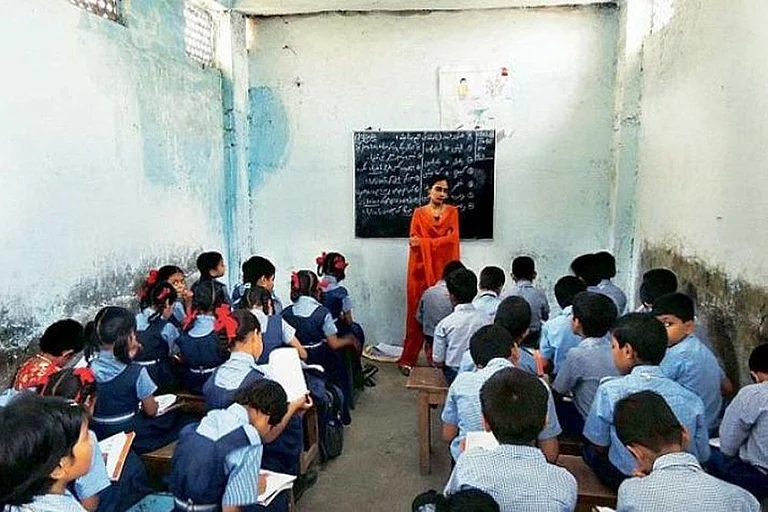
The re-opened schools of South Bastar
“A school is being constructed in the Rekawaya village of Abujhmaad for the first time after independence”, said Prime Minister Narendra Modi during his speech during Chhattisgarh Rajya Mahotsaav held at Raipur on November 1st, 2025. A government school existed in the Rekawaya village of Narayanpur district in Chhattisgarh since 1989, but was demolished by Maoists during the Salwa Judum period in 2005 with allegations that school buildings were occupied by state forces. Post Salwa Judum, this region had emerged as a ‘liberated zone’ of the Maoists where they operated their Jantana Sarkar (People’s Government). A Maoist run school operated in the region till the Covid-19 induced lockdown but was closed with increased frequency of patrol by security forces in the region. The school remained closed for two years but since 2022 the villagers of Rekawaya decided to operate the school themselves using a coordination committee comprising members from 13 village panchayats in the surrounding region. The school was named ‘Bhumkal Chaatrawas’ based in the Bhumkal Adivasi Rebellion of 1910. More than 100 children were enrolled. But, in 2024, during the summer break, a local reporter in Bastar alleged in his report that the school was a Maoist training camp for children and it was alleged that security forces had ransacked the school premises. This incident had raised concerns among the villagers and the school coordination committee approached us.
Advertisement
We were then extensively documenting and contributing in the restoration of public school infrastructure in the South Bastar region and had been advocating for re-opening of all closed and demolished public schools in the region with both national and international agencies. One of the severe consequences of Salwa Judum was that the public schools in Sukma (then Dantewada), Bijapur and Narayanpur districts of the South Bastar region were demolished by Maoists under allegations that those are being used as barracks by the security forces. For more than a decade, the schools remained closed forcing thousands of children out of school. As per Jay Prakash Maurya, IAS, who had served as Collector in Sukma district, in 2018 around 25000 children were out of school in Sukma alone. When schools were closed, the teachers appointed in those schools were assigned by the district administrations for administrative duties in the Salwa Judum relief camps. A retired teacher of Bijapur under the condition of anonymity had said, “I was teaching in a school in Gangaloor region of Bijapur for almost a decade by then. But after the Salwa Judum started, the school was closed and entry of outsiders in the village was barred by the Maoists. I was posted in a nearby Salwa Judum relief camp where my primary duty was to keep notes of the ration that was supplied by the administration. In 2012, I was posted to another school in the vicinity of Bijapur town.” Another education official from Sukma, on condition of anonymity, recalled, “I was teaching in a school in an interior village of Konta Block in Sukma. But after the school was demolished during Salwa Judum, I was posted in a relief camp near Dornapal in Sukma. One day I was asked by superior officer to accompany the police forces into an area. There I saw at least five ripped dead bodies lying. I felt like throwing up. We were there to collect the bodies. I convinced a few locals to stitch the bodies before they were loaded in the vehicle to be carried to the morgue in Dornapal,” he claimed. While the state focused on militarising the region, re-opening of schools never found a place in their priority list. Local activists in Sukma allege that two locals were arrested in 2012 after they had approached the collector office demanding to re-open the schools in the region. But in 2018, Ashok Baghel, an educated local youth of Kamaram village in Sukma, had approached the then collector of Sukma, Jay Prakash Maurya with an request to let him re-open the closed school in his village but was asked to seek ‘approval’ from the Maoists first pertaining to the risks involved in operating a school in a ‘liberated zone’. After multiple rounds of negotiations with the Maoists, schools were allowed to be re-open in the region but with two conditions, first, no concrete buildings and second no outsider appointed as teachers. The district administration agreed to these conditions and conducted a survey of the total number of out of school children in the Maoist-affected Konta education block of Sukma, appointed educated local youths as teachers while managing their salaries from the District Mineral Foundation Fund and re-opened 55 closed public schools at Sukma in 2018. The numbers of re-opened schools steeply increased since then. At present there are 107 re-opened schools in Sukma and around 300 re-opened schools in Bijapur. The schools have been re-opened but challenges pertain as the youth teaching in these schools called ‘Shikshadoots’ have been facing fury from both parties of the conflict. Multiple allegations of these teachers being assaulted by the security forces and sometimes jailed under allegations of being Maoist sympathisers have come to light. In June 2025, a mid-day meal cook of the re-opened Jhadppagatta Government Primary School was allegedly killed in a fake encounter. His body was produced as a slain Maoist with a bounty worth 1 Lakh INR but his bank account statement showed his salary was allegedly being credited for months by the education department. At least nine teachers have been killed by the Maoists accusing them of being police informers.
Advertisement
Even though pertinent challenges exist, we are of strong conviction that the process of reopening schools in conflict torn South Bastar is no less than a political peace process. Local youth like Ashok took the initiative and brought both the contesting parties in the conflict on a same page of consensus, to let children continue their schooling even though the war continued. We thought of pitching the same model, convincing the state to re-open the school in Rekawaya. Our thoughts were guided by three reasons. First, it is the right of children in India to receive free and quality schooling, second is operating a community owned school without recognition and sustained funding is challenging. Third, the school stood in a conflict zone and there is already record of it once being a Maoist run school and allegation of being a Maoist Training Camp followed by targeting of the school premises by security forces, hence it’s important to immediately secure the lives of 100 children enrolled in the school while also preventing them from dropping out.
Advertisement
The School coordination Committee of Rekawaya School was skeptical of handing over the school to the state authorities, the state was not a trusted entity till then. We had multiple levels of meetings with community members and also with representatives from other parties in the conflict discussing the pros and cons of a public school in the region. The most important issue that was highlighted was the safety of children. Finally they agreed. A Gram Sabha was organised and it was decided by the villagers of thirteen panchayats that they will approach the Collector of Narayanpur with an application requesting the state to re-open the school in Rekawaya. On the lines of Sukma and Narayanpur, the district administration had sanctioned re-opening of the Rekawaya School in December, 2024. Fourteen lakhs INR have been issued and a composite structure including an Anganwadi centre, primary school and middle school with attached 100-seat hostel have been approved. Local youth are recruited as Shikshadoots, Anganwadi workers and hostel wardens. The Rekawaya School was the first re-opened school of Narayanpur district.
Advertisement

Reflecting on these schools based on Galtung’s peacebuilding framework
Professor Johan Galtung, a Norwegian sociologist, is the founder of peace and conflict as a discipline for studies. His writings indicate that ‘absence of violence is not peace’ and his framework for positive and negative peace-building has been widely applied to analyse the peace-building processes throughout the world. Positive peace-building refers to processes which not just ensure lack of violence but also address the structural violence and injustices which had contributed as factors for the conflict. Negative peace-building refers to processes which ensure immediate lack of direct violence but don’t address the underlying factors of the conflict.
Reflecting on the re-opened schools of Bastar based on Galtung’s framework one observes that these schools have been successful in ensuring equitable schooling to the conflict affected children in Sukma, Bijapur and to some extent in Narayanpur while driving a macro level policy change. The state has been ushering special emphasis to re-opening of schools in the region displaying this as its achievement. Re-opening of schools in the region was hardly an issue for the state before the youth of Bastar like Ashok had taken the initiative. For almost a decade, post 2011, those ‘liberated’ regions of South Bastar had no public schools and the state had concentrated all their resources in militarising the region irrespective of clear instructions for restoration of public schools in the region by Supreme Court in its 2011 judgment banning Salwa Judum. Rather multiple sources indicate instances of falsely framing locals for demanding schools in 2012.
But once re-opened these schools have been presently serving solely as state instruments in the region without any representation of the local communities in any decision making related to the school processes. With a uniform curriculum, lack of contextual resources in the classroom processes, lack of proper recognition of children’s mother tongues in the classroom and resources, lack of mental health support to the children horrified by the violent memories of the conflict, no involvement of the underlying factors of the conflict in classroom discussions and no or very limited role of communities in decision making related to the school processes diminishing the collaborative community ownership of these re-opened schools, presently these schools are failing to address the structural violence or injustices which have led to the conflict. As per Galtung’s framework, the re-opened schools of Bastar are contributing in building negative peace in the region by ensuring universal access to children and driving macro level policy changes. But these schools are presently lacking meso and micro level interventions to address the underlying structural violence and injustices meted on the communities. Hence, these schools’ contribution to positive peace-building in the region is not significant at present.
If the re-opened schools of Bastar are to significantly contribute in positive peace-building, they require critical shifts like institutionalized community participation in school governance and processes, curricular space for local histories and languages, trauma and informed pedagogies, and financial and social securities for locally appointed Shikshadoots. These are not radical departures, but extensions of India’s constitutional commitments.
The re-opened schools of Bastar have opened a new avenue to reimagine public schooling in conflict zones of India. If these schools incorporate measures for positive peace-building, it will be the first state-community led model of positive peace schooling in India (and may be a global first) without any pursuance by the international agencies like that happened in Nepal.
Prasun Goswami is a conflict education practitioner and researcher working on schooling and peace-building in conflict-affected regions of India, presently focusing on Bastar and Manipur.
Raunak Shivhare is an independent journalist engaged in field reporting and documentation on education and conflict in central India.
Views expressed are personal
Published At: