Nitish Kumar’s decision to seek a Rajya Sabha seat has revived speculation over Bihar’s next chief minister and the future of his party
The 2025 Assembly polls were widely seen as a test of Kumar’s political endurance
In a series of 2025 issues, Outlook explored themes shaping Bihar’s politics—from caste as the state’s enduring political currency to the influence of Kumar’s welfare policies and the Bharatiya Janata Party emerging as the strongest political force in the state.
Nitish Kumar’s RS Move Rekindles Debate Over Bihar’s Political Future
As the state watches these developments closely, Outlook revisits its coverage of the 2025 Bihar Assembly elections to examine Nitish Kumar’s long political dominance and what his possible transition could mean for the state.

Summary
Bihar Chief Minister Nitish Kumar has decided to file his nomination to Rajya Sabha polls ending all speculations over “Will he or Won’t he?” The decision has again sparked debate in the political circles in Bihar over who would succeed Nitish Kumar especially since he has always been vocal against dynasty politics in India.
However, what adds to all this suspense surrounding Nitish Kumar’s decision to file his nomination to Rajya Sabha polls is the strong rumour that his son Nishant Kumar has started his political journey this year.
The decision to file his nomination to Rajya Sabha polls brings back memories of the intense political environment during the 2025 Bihar assembly elections. The elections were considered to be a litmus test for Nitish Kumar’s political endurance. The election was expected to decide whether Nitish Kumar would be able to get another term as Chief Minister or face a serious challenge to his leadership from the younger generation of politicians in Bihar.
As these political manoeuvres continue to play out in current times, Outlook magazine revisits the November and December issues of 2025 titled Caste is the biggest political party in Bihar, Solitude of Power, and The Burden of Bihar to examine how Nitish Kumar’s politics affected Bihar and how it might affect Bihar if he is set to pass on the reins to the BJP. Will JD(U) disintegrate or join BJP?

The politics of Nitish Kumar had also been subject to debate on whether he would continue as chief minister even if his alliance party came to power. In the Outlook issue dated 11 November 2025, Ravi Ranjan and Ankit Singh had written on whether Kumar would emerge as the Chief Minister of Bihar again in 2025.
In her article titled “It Was Nitish Vs Nitish In Bihar” in the 20 November 2025 issue, Chinki Sinha stated that in the Assembly elections, in the end, it was Nitish Kumar who was key to all political calculations. She mused, as a Bihari who had been waiting for decades for something to happen in the state, about what exactly that something might mean. She also stated that the BJP had been waiting for its turn in Bihar for a long time, and in 2025, it had become the strongest political force in the state.
Advertisement
Chinki Sinha wrote that during the Assembly elections it was ultimately Nitish Kumar who remained central to the political contest. She reflected, as a Bihari who has waited decades for change, on what that change might actually look like. Sinha also noted that the BJP had long been waiting for its turn to lead in Bihar, and that by 2025 it had emerged as the strongest political force in the state.
Bihar is one state where caste remains the only currency of politics, especially during Assembly elections, writes Mohammad Ali. He says, “While the current political discourse may be trying to move beyond caste, the ground reality is very different.”
What will happen to the women who trusted Nitish Kumar is a question that now has to be answered. In the course of the elections, Professor Ashwani Kumar wrote that in spite of the hurdles posed by patriarchy and the under-representation of women in party nominations, women voters seem to have responded well to the policies initiated under the umbrella of Nitish Kumar’s welfare state.
Advertisement
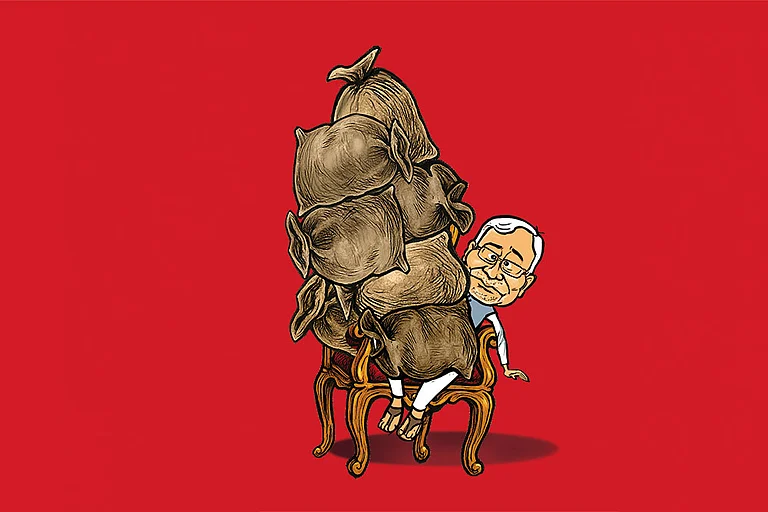
In the 11 November 2025 issue, Ashlin Mathew examined how, through the Chief Minister’s Women’s Employment Scheme, JEEViKA and similar programmes, Nitish Kumar transformed welfare into a powerful electoral strategy, compelling his rivals to follow suit. The question now is whether these schemes will continue as he has decided to no longerbe at the helm in Bihar.
The issues explored the many layers of Bihar’s political landscape and the long career of Nitish Kumar. It asked a central question: after decades of navigating shifting ideologies and alliances to remain in power, could the 2025 election be Kumar’s final political test?
The Opposition has also slammed the move too. Jairam Ramesh of the Indian National Congress Party posted on X that “what we had warned during the election campaign seemed to be coming true.” He called it a shift in leadership that ignored the authority of the people.
Advertisement
As speculation continues to surround Nitish Kumar’s successor, so does the political future of Bihar.
Published At: